

Your fully loaded 4WD is likely illegal the moment you hit the bitumen for your next touring trip. It's a frustrating reality for many Australian drivers; once you add a steel bull bar, a winch, and a canopy, your factory payload is effectively gone. You're left with a sagging rear end, compromised braking, and the genuine risk of being uninsured if you're involved in an accident while overweight. We understand that you want to explore remote tracks with gear you can rely on, not with a vehicle that feels unstable and dangerous under pressure.
This 2026 guide shows you how to resolve these issues by installing GVM upgrade suspension kits Australia wide. You'll discover how to legally increase your vehicle's carrying capacity while actually improving its off-road performance and handling. We'll break down the latest Western Australia Department of Transport regulations, compare professional suspension kits from Dobinsons and Fulcrum, and explain the critical differences between pre and post-registration certification. It's time to get your setup sorted for total peace of mind and mechanical reliability on your next adventure.
Key Takeaways
- Learn why exceeding your factory Gross Vehicle Mass can void your insurance and how a certified upgrade keeps your rig legal on Australian roads.
- Compare the technical specifications of Dobinsons and Fulcrum GVM upgrade suspension kits Australia wide to find the best match for your specific vehicle and touring load.
- Understand the critical timing differences between pre-registration federal compliance and post-registration certification through the WA Department of Transport.
- Follow our step-by-step process to calculate your vehicle's real-world weight, including fixed accessories like bull bars, winches, and canopies.
- Discover why professional installation by a Perth specialist is essential for ensuring your suspension geometry and braking performance meet strict safety standards.
Understanding GVM Upgrades in Australia: Safety and Legal Compliance
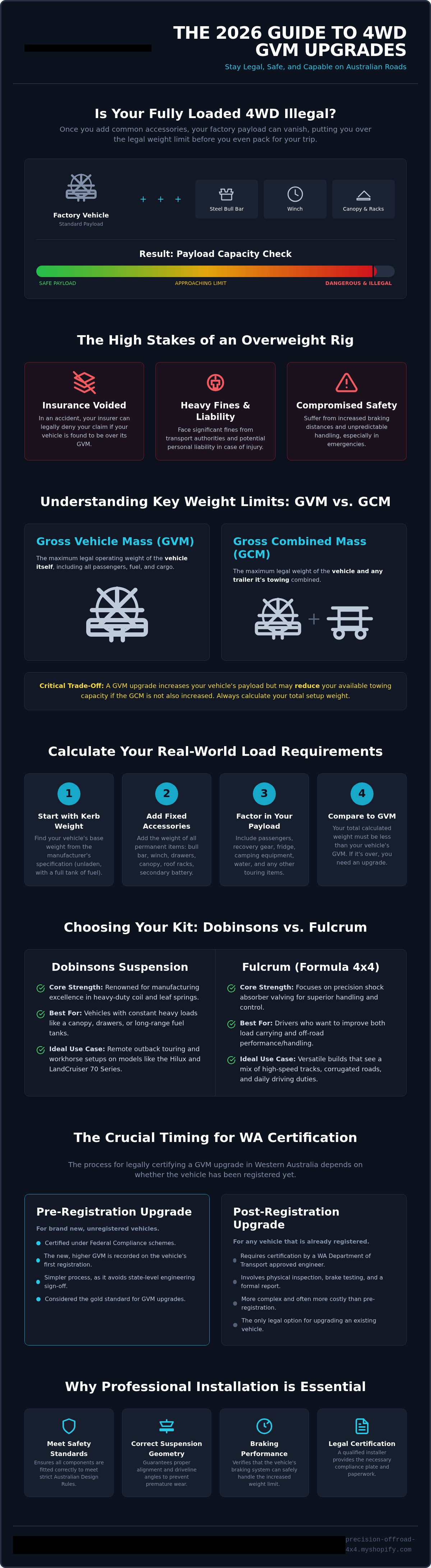
Every 4WD leaves the factory with a specific weight limit known as the Gross Vehicle Mass (GVM). This figure represents the maximum legal weight of the vehicle when it's fully loaded, including fuel, passengers, and cargo. For most modern dual-cab utes and wagons, this limit is surprisingly low. Once you install a steel bull bar, a winch, and a canopy, you've likely consumed half of your available payload before you even pack a fridge or a recovery kit. Driving a vehicle that exceeds its GVM isn't just a mechanical strain; it's a significant legal liability.
The legal risks of operating an overweight rig in Australia are severe. If you're involved in an accident and your vehicle is found to be over its GVM, your insurance provider can legally deny your claim. You also face heavy fines from transport authorities and potential personal liability in the event of an injury. Beyond the paperwork, the physical safety of the vehicle is compromised. An overweight 4WD suffers from increased braking distances and unpredictable handling during emergency swerving manoeuvres. High-quality GVM upgrade suspension kits Australia wide are designed to address these specific safety and compliance issues by re-engineering the vehicle's weight-bearing capacity.
GVM vs GCM: Know the Difference
It's vital to distinguish between GVM and Gross Combined Mass (GCM). While GVM is the limit for the vehicle itself, GCM is the maximum allowable weight of the vehicle and any trailer it's towing combined. A common misconception is that a GVM upgrade automatically increases your towing capacity. In many cases, increasing your GVM actually reduces the amount you can tow if the GCM remains unchanged. This payload versus towing trade-off is a critical calculation for long-distance tourers. You must ensure your total setup stays within the legal GCM limit to remain compliant on the road.
The Role of Suspension in Weight Management
Factory suspension systems are typically designed for unladen ride comfort rather than constant heavy touring loads. When you load a standard 4WD to its limit, the springs often sag, which reduces suspension travel and causes the vehicle to bottom out on rough tracks. Upgraded springs and shocks are engineered to maintain correct ride height and control under load. A GVM kit uses reinforced components to redistribute operational stress across the chassis and axle housings, preventing structural fatigue under heavy loads. By fitting specialised components from brands like Dobinsons or Fulcrum, you ensure the vehicle remains stable and level, even when carrying a full kit of recovery gear and supplies.
Dobinsons vs Fulcrum: Choosing the Right Suspension Kit for Your Build
Selecting GVM upgrade suspension kits Australia wide involves evaluating two industry leaders: Dobinsons and Fulcrum. Both brands offer robust solutions, but their engineering philosophies differ. Dobinsons is renowned for its vast range of heavy-duty springs, while Fulcrum focuses on the precision valving of their Formula 4x4 shocks. The choice depends on your vehicle's base platform and how you intend to use it. If you're building a dedicated touring rig, the suspension must be matched to your constant load rather than just your maximum capacity.
Most dual-cab utes utilize leaf springs in the rear. These are excellent for load carrying but can become harsh when empty. GVM upgrades for these vehicles often involve multi-leaf packs with revised rates to maintain comfort while increasing payload. In contrast, wagons like the 300 Series LandCruiser rely on heavy-duty coil springs. Shock technology is equally critical for weight management. Foam Cell shocks are a staple for heavy touring because they resist aeration and fade during long corrugated drives. Monotube shocks offer faster response times and better heat dissipation, making them suitable for high-speed off-road performance.
Dobinsons Suspension: Reliability for the Outback
Dobinsons has built a reputation on spring manufacturing excellence. Their GVM kits feature heavy-duty spring rates specifically calculated to handle constant loads without sagging. This makes them a preferred choice for popular models like the Toyota Hilux and LandCruiser 70 Series. If your build includes a heavy rear canopy and long-range fuel tanks, Dobinsons provides the structural support needed for remote Australian travel. Their components are designed to withstand the harshest environments found in the Kimberley or the Pilbara.
Fulcrum and Formula 4x4: Precision Engineering
Fulcrum’s Formula 4x4 range excels in vehicle stability through advanced shock valving. These systems are designed to manage the increased centre of gravity that comes with a loaded 4WD. The Formula 4x4 shocks provide a balance between ride quality and extreme load capacity, ensuring the vehicle doesn't feel unstable on the highway. For more technical insights, read our 4x4 Suspension: The Ultimate Performance and Reliability Guide for 2026. If you're ready to upgrade your rig, you can browse our suspension range to find the right kit for your touring requirements.
Pre-Registration vs Post-Registration: The Crucial Timing for WA Owners
The timing of your suspension installation determines the complexity of your legal compliance. For new vehicle buyers, the pre-registration window offers a streamlined federal approval process. For those who already own their rig, the post-registration path involves state-based engineering and inspection. Both methods result in a legal vehicle, but the administrative steps and costs differ significantly. Selecting GVM upgrade suspension kits Australia wide requires a clear understanding of these two distinct regulatory frameworks to avoid unnecessary expenses or compliance issues.
Pre-Registration: The Hassle-Free Path
Performing an upgrade before the first registration is known as Second Stage of Manufacture (SSM). This federal approval means the vehicle is registered with the higher GVM from day one. It's a national certification, so if you sell the vehicle interstate, the upgrade remains valid without further inspections. This is often the most cost-effective route because it eliminates the need for an independent engineer's report. Many Perth dealerships work directly with specialists to coordinate these installs before delivery, ensuring your rig is ready for the tracks the moment you pick up the keys. It also simplifies the insurance process, as the vehicle is rated for the higher capacity from its first kilometre.
Post-Registration: Upgrading Your Current Rig
Post-registration upgrades apply to any vehicle that has already been licensed in WA. This process is more involved and requires certification from a Department of Transport approved signatory. In Perth, this means your installation must be inspected by a Licensed Vehicle Modifier to ensure it complies with current standards like VTB-180A. The engineer assesses the kit's integration with your vehicle's braking and electronic stability control systems. Post-registration upgrades require a state-specific modification plate to be fixed to the vehicle as permanent proof of its legal status. While this adds engineering fees to the build, it's the only legal way to rectify a sagging, overweight vehicle that's already on the road. Professional fitting is mandatory here to ensure the engineering signatory can sign off on the work without delay.
How to Calculate Your Load Requirements for a GVM Upgrade
Determining your vehicle's real-world weight is a methodical process. You cannot rely on the brochure figures once you have started adding gear. Brochure weights often exclude the weight of a full tank of fuel or the weight of a tray on a cab-chassis model. Follow these five steps to establish your requirements accurately:
- Step 1: Identify your factory tare weight and GVM from the tyre placard or owner's manual.
- Step 2: List every permanent modification, including bull bars, winches, side steps, and roof racks.
- Step 3: Estimate variable loads such as fuel, water, passengers, and recovery gear.
- Step 4: Visit a public weighbridge in Perth, such as those in Welshpool or Henderson, to get a precise measurement of your vehicle in its 'touring trim' with full tanks.
- Step 5: Compare this total to your factory GVM and the capacity of GVM upgrade suspension kits Australia wide.
The Hidden Weight of 4x4 Accessories
Accessories add up faster than most owners realise. A steel bull bar can weigh 80kg, while an aluminium equivalent might be half that weight. This mass sits directly over the front axle, which significantly affects steering geometry and braking efficiency. Adding a dual battery system, a rear drawer setup, and a fridge slide can easily add another 150kg to the rear of the vehicle. For more information on choosing the right gear for your build, check out our guide on Essential 4x4 Accessories for Australian Tracks (2026). Every kilogram counts against your legal limit and impacts how your suspension performs.
Axle Load Limits: Don't Forget the Balance
Compliance is not just about the total weight. You must also stay within individual front and rear axle capacities. It is common for a vehicle to be under its total GVM but over its rear axle limit because of a heavy canopy or high tow-ball download. A certified GVM kit often re-rates these individual axle capacities legally, which provides more flexibility for your build. This ensures the chassis and axles aren't under undue stress during off-road use. If you need a professional assessment of your rig's balance, you can shop our GVM solutions online or visit our Perth workshop for an expert consultation.
Expert GVM Upgrade Fitting and Supply in Perth
Professional fitting is the final, non-negotiable step in securing a legal GVM increase. In Western Australia, the Department of Transport requires that post-registration modifications are inspected and certified by a Licensed Vehicle Modifier. Precision Offroad 4x4 serves as your local Perth specialist, supplying and installing premium GVM upgrade suspension kits Australia wide from trusted brands like Dobinsons and Fulcrum. We ensure that every component is installed to strict workshop standards, maintaining the structural integrity of your chassis while meeting all engineering requirements for WA compliance.
A GVM lift changes your vehicle's suspension geometry significantly. Without a professional wheel alignment, you'll experience premature tyre wear and compromised steering response. Our team calibrates your setup to account for the new ride height and constant load, ensuring the vehicle tracks straight and remains stable at highway speeds. We focus on the functional performance of your rig, ensuring that the increased capacity doesn't come at the cost of driveability or safety during emergency manoeuvres.
Complementary Upgrades: Wheels and Tyres
Increasing your GVM often means your factory wheels are no longer fit for purpose. Many original equipment wheels lack the load rating required to support a 3.5-tonne or 3.8-tonne GVM legally. It's a critical safety point that many owners overlook. We recommend pairing your suspension with load-rated aftermarket wheels and high-performance Maxxis tyres. Maxxis offers several patterns with high load indices that are perfectly suited for heavy touring rigs and harsh Australian conditions. For a deeper look at your options, see The Technical Guide to 4x4 Wheel Upgrades in Perth (2026).
Book Your GVM Assessment at Precision Offroad 4x4
Navigating the WA engineering process is complex for many 4WD owners. Our Perth workshop team assists you by coordinating with approved engineers to ensure your modification plate is issued without hassle. We provide tailored quotes based on your specific vehicle model and intended touring weight, whether you're driving a 79 Series LandCruiser or a late-model Hilux. We take the guesswork out of compliance so you can focus on the trip ahead. Contact the team at Precision Offroad 4x4 for a GVM upgrade quote today to ensure your rig is legal, safe, and ready for the tracks.
Prepare Your 4WD for the Long Haul
Ensuring your rig is legally compliant isn't just about avoiding fines; it's about protecting your insurance and maintaining vehicle safety under heavy loads. You now understand how heavy accessories deplete your factory payload and why specific GVM upgrade suspension kits Australia wide are necessary to rectify sagging and poor handling. Choosing between premium brands like Dobinsons and Fulcrum depends on your specific constant load and touring requirements. Whether you're opting for a pre-registration federal approval or a post-registration WA modification plate, professional installation remains the critical factor for a successful build.
Precision Offroad 4x4 provides the technical expertise and specialised workshop facilities needed to navigate Western Australia's strict licensing requirements. Our Perth-based team stocks high-performance suspension from Dobinsons and Fulcrum to ensure your vehicle is balanced and reliable on the tracks. Don't risk an overweight vehicle that compromises your safety and legal standing. Get a professional GVM upgrade quote from Precision Offroad 4x4 in Perth today. We'll help you build a capable, compliant rig that's ready for any Australian adventure.
Frequently Asked Questions
Does a GVM upgrade increase my towing capacity?
A GVM upgrade does not typically increase your Gross Combined Mass (GCM) or your maximum towing capacity. It only increases the allowable weight of the vehicle itself, which includes the tow ball download weight. In many cases, increasing your GVM actually reduces your available towing capacity if the GCM remains fixed. You must calculate your total combined weight to ensure you stay legal while towing a caravan or trailer.
Can I install a GVM upgrade kit myself to save money?
You cannot legally install a GVM upgrade kit yourself if you require a compliance plate. These upgrades must be fitted by an authorised specialist and certified by a Department of Transport approved modifier. In Western Australia, a Licensed Vehicle Modifier must inspect the installation to ensure it meets safety standards. DIY fitting voids the engineering certification process and leaves your vehicle illegal on public roads.
Is a GVM upgrade legal in all Australian states?
GVM upgrades are legal across Australia, but the certification process varies between states. Pre-registration upgrades under Federal Second Stage of Manufacture (SSM) are recognised in every state and territory. Post-registration upgrades are governed by state authorities, such as the WA Department of Transport. While a WA-certified vehicle is legal to drive interstate, some states have different requirements for vehicles being permanently re-registered in a new jurisdiction.
Will a GVM upgrade make my 4WD ride roughly when it's not loaded?
A GVM upgrade will often result in a firmer ride when the vehicle is unladen. The heavy-duty spring rates in GVM upgrade suspension kits Australia wide are engineered to support constant loads or heavy accessories. When the ute is empty, the suspension doesn't have the necessary weight to compress the springs effectively. This can lead to a stiffer feel over small bumps compared to the factory suspension.
How much does a GVM upgrade cost in Perth?
The cost of a GVM upgrade in Perth varies based on the vehicle model and the chosen suspension brand. You'll need to account for the physical suspension components, professional labour, and the mandatory engineering certification fees. Post-registration upgrades in WA incur additional costs for the independent engineer's inspection and the modification plate. Contact our team for a detailed quote tailored to your specific rig and load requirements.
Do I need a special licence to drive a vehicle with a GVM upgrade?
You don't need a special licence as long as the upgraded GVM remains at or below 4,500kg. Most light vehicle GVM upgrades for dual-cab utes and wagons stay well below this threshold. A standard C-Class car licence covers vehicles up to this weight limit. If an upgrade pushes the GVM over 4,500kg, the vehicle is reclassified as a light truck, which requires an LR (Light Rigid) licence.
What happens if I get into an accident and my 4WD is overweight?
Driving an overweight vehicle can lead to your insurance claim being denied after an accident. If an assessor determines that your vehicle exceeded its legal GVM, the insurer may argue that the vehicle was unroadworthy or that the weight contributed to the incident. You also face potential prosecution and heavy fines from transport authorities. Certification ensures your vehicle remains safe and legally covered in the event of a collision.
How long does it take to fit a GVM upgrade and get it certified?
Fitting the physical suspension components usually takes a full day in our Perth workshop. However, the certification process for post-registration upgrades depends on the availability of the engineering signatory. Once the inspection is complete, it can take several days to finalise the paperwork and fix the modification plate. We recommend booking in advance to ensure a streamlined turnaround for your vehicle's compliance.