

You’re three days deep into the Kimberley when the fridge stops humming and the engine won't turn over. It’s a scenario that turns a dream trip into a costly recovery mission. For many off-roaders, the fear of a flat battery in a remote location is a constant shadow over their touring plans. Choosing the right 4x4 electrical accessories Australia demands for these environments is about more than just convenience; it’s about mechanical integrity and survival in the heat and dust.
We understand that the transition to smart alternators and the complexity of modern DC-DC chargers can be confusing. You need a system that just works, regardless of how many corrugated tracks you tackle. This 2026 guide provides the expert validation you need to select and organise a reliable power setup for the Australian outback. We’ll show you how to build a fail-safe system for your lights and fridges without blowing your GVM or compromising your vehicle’s safety. From lithium battery integration to clean, vibration-resistant wiring, here is how you master your off-road power requirements for the long haul.
Key Takeaways
- Learn why vibration-resistant wiring and dust-proof components are non-negotiable for surviving corrugated tracks and avoiding electrical failures in the bush.
- Identify the most reliable 4x4 electrical accessories Australia offers for dual battery setups, including the performance benefits of modern LiFePO4 lithium technology.
- Compare high-performance LED lighting and UHF communication tools to ensure your convoy stays connected and the track stays visible during night drives.
- Master off-grid power management using solar blankets and pure sine wave inverters to keep your fridge running and electronics charged without risking a flat starter battery.
- Understand how the weight of your electrical gear affects your GVM and why integrating these upgrades with your suspension is critical for maintaining vehicle handling.
Why Your 4x4 Electrical Setup Matters for Australian Touring
Touring the Australian outback requires more than just a full tank of diesel. Your vehicle’s electrical system is the lifeline for your navigation, communication, and food preservation. Selecting the right 4x4 electrical accessories Australia offers is the difference between a successful expedition and a dangerous breakdown. Poorly planned systems often succumb to the harsh reality of the tracks, where vibration and heat act as constant destructive forces. A single loose wire or an undersized fuse can lead to vehicle fires or total system failure when you’re hundreds of kilometres from the nearest workshop.
The Australian Outback Environment
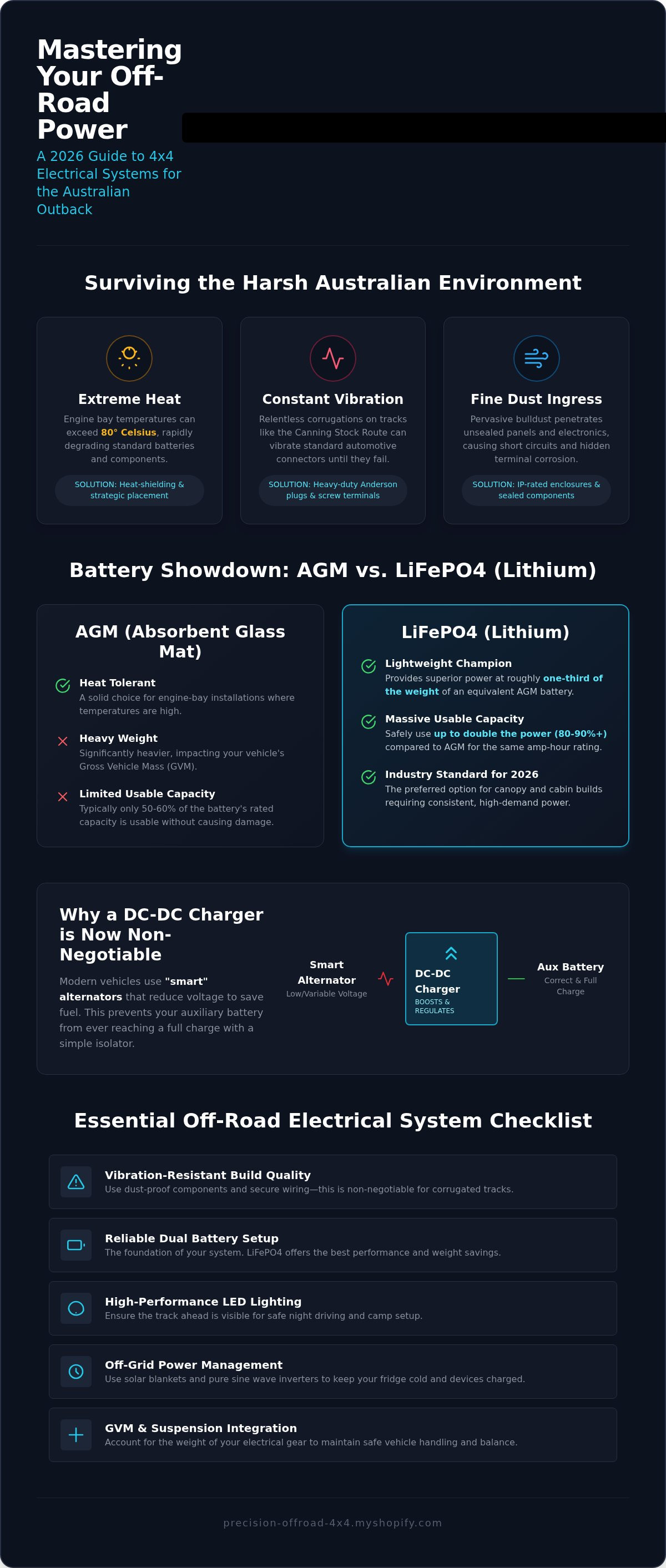
Heat management is the primary challenge for any dual battery setup. Engine bay temperatures in the Pilbara or the Simpson Desert can exceed 80 degrees Celsius, which rapidly degrades standard components. Understanding automotive battery basics helps you realise why heat-shielding and proper placement are vital for longevity. Beyond the heat, the relentless corrugations of the Canning Stock Route will vibrate standard automotive connectors until they fail. Professional installations utilise screw-terminal or heavy-duty Anderson plugs to ensure circuits remain closed. Dust ingress is the final hurdle; fine bulldust can penetrate unsealed control panels, causing short circuits or terminal corrosion that stays hidden until your gear stops working.
System Reliability vs. Modular Gadgets
We’ve seen a significant shift from loose, portable power packs to fully integrated vehicle systems. While a portable box is convenient for a picnic, it lacks the mechanical security of a hard-wired setup. A "system" approach means your charging, storage, and distribution components work together as a single unit. This integration is essential when you consider how your electrical gear interacts with other essential 4x4 accessories for Australian tracks, such as winches or high-draw compressors.
Redundancy is critical for solo remote travel. If your primary DC-DC charger fails, having a secondary solar input or a manual link to the starter battery provides a fail-safe that prevents a total power blackout. Building a reliable tourer involves looking at the vehicle as a whole. Your electrical needs shouldn't be an afterthought. They must be planned alongside your suspension and wheel upgrades to ensure the vehicle remains balanced and capable. This functional expertise ensures your gear survives the environment it was built to explore.
Core Components: Dual Battery Systems and DC-DC Chargers
A dual battery system is the heart of any reliable off-road setup. It separates your vehicle’s starter battery from your auxiliary power, ensuring you can run accessories without risking a dead engine in the morning. Modern 4x4 electrical accessories Australia enthusiasts rely on have evolved significantly, moving from simple solenoid isolators to sophisticated management systems that handle complex charging profiles. This setup is the foundation of self-sufficiency when touring remote regions.
Choosing the Right Battery Chemistry
Choosing between AGM and Lithium (LiFePO4) depends on your mounting location and power requirements. AGM batteries remain a solid choice for engine-bay installations because they tolerate high temperatures better than most electronics. However, they are heavy and offer limited usable capacity. Lithium batteries have become the preferred option for canopy and cabin builds. They provide up to double the usable power at roughly one-third of the weight. For 2026 touring, an integrated Lithium battery of at least 100Ah is the industry standard for high-demand builds requiring consistent power for fridges and electronics.
The Role of the DC-DC Charger
Modern vehicles feature smart alternators designed to meet the Australian New Vehicle Efficiency Standard. These alternators often reduce voltage to save fuel, which prevents auxiliary batteries from reaching a full charge. A DC-DC charger is now non-negotiable. It acts as a voltage booster to overcome drops over long cable runs and ensures your secondary battery receives the correct charging profile. Selecting high-quality 4x4 electrical accessories Australia requires a focus on compatibility with your specific vehicle's alternator profile. Most high-end chargers now include integrated MPPT solar regulators, which simplifies your wiring and allows for seamless charging from both the engine and solar panels while parked.
Sizing your system requires a realistic audit of your daily power consumption. A standard 60L fridge might draw 30-40Ah per day in summer, while LED camp lighting and device charging add another 10-15Ah. If you plan on using an inverter for coffee machines or laptops, your capacity needs will increase. We recommend a redundancy-first approach to sizing, ensuring you have enough storage to last at least two days without sunlight or engine input. To find the right components for your build, you can browse our range of high-performance 4x4 accessories designed for Australian conditions.
Lighting and Communication: Safety Accessories for the Track
Safe touring depends on your ability to see hazards early and communicate clearly when things go wrong. While the dual battery systems discussed previously provide the energy, your lighting and communication gear are the primary tools for active safety on the track. High-quality 4x4 electrical accessories Australia travellers choose must be rugged enough to withstand the heat and vibration of corrugated roads without flickering or failing. When you're kilometres from help, these components are your primary link to the outside world and your best defence against wildlife strikes at dusk.
Optimising Your Driving Light Patterns
Choosing between LED light bars and round driving lights (spotties) depends on where you drive. Round spotties typically offer superior distance through pencil beams, making them ideal for long, straight desert tracks where seeing a kangaroo 800 metres away is vital. In contrast, LED bars provide a broad spread of light that illuminates the road shoulders, which is better for winding coastal tracks in the South West. We recommend a colour temperature between 5000K and 5700K; anything higher produces a harsh blue glare that increases driver fatigue during long night stints. Proper mounting is also critical. Ensure your lights are secured to a vibration-dampened bull bar to prevent the beam from bouncing, which can be distracting and dangerous. For maximum safety, integrate your lighting with high-performance 4x4 suspension upgrades to ensure the vehicle remains level and the beams stay pointed at the road, even when the car is fully loaded.
UHF Radio Setups for Remote Travel
A reliable UHF radio is the backbone of convoy safety. While handheld units are useful for spotting during a recovery, a fixed-mount 5-watt radio is essential for vehicle-to-vehicle comms over distance. Your choice of antenna is just as important as the radio itself. A high-gain antenna (6.6dBi or 9dBi) works best on flat, open plains but can struggle in hilly terrain where the signal "overshoots" the target. For mountainous regions or tight bush tracks, a lower-gain 3dBi antenna provides a more spherical signal pattern that performs better at short ranges.
All installations should follow the AS 5732:2022 safety standard to ensure wiring is properly fused and protected from mechanical damage. Beyond driving safety, don't overlook functional camp lighting. Low-draw LED strips or amber-coloured work lights help create a usable outdoor living space without attracting swarms of insects or draining your auxiliary battery too quickly. Clear communication and reliable illumination turn a stressful night drive into a controlled, safe experience.
Power Management: Solar, Inverters, and Control Panels
Reliable power management is the brain of your off-road setup. It ensures your batteries charge efficiently and discharge safely while providing the data you need to stay powered. High-quality 4x4 electrical accessories Australia provides must include a shunt-based monitoring system. These devices provide a real-time fuel gauge for your battery, showing exactly how many amp-hours remain. Without this data, you risk over-discharging your batteries, which can lead to permanent damage and system failure in remote locations.
Solar Solutions for Stationary Camping
Solar input is your only source of passive charging when the engine isn't running. Fixed panels mounted on a roof rack provide constant top-ups while driving, but they are limited by the vehicle's orientation. Portable solar blankets are often superior for shaded campsites. They allow you to park your vehicle under a tree while placing the blanket in direct sunlight up to 10 metres away. For indefinite camping, we recommend at least 200W of solar for a standard single-fridge setup. Using an MPPT regulator instead of a basic PWM controller increases charging efficiency by up to 30 percent in overcast conditions. Ensure your panels are secured with locking cables to prevent theft and anchored properly against high winds.
Inverters and 240V Power
Pure sine wave inverters are essential for charging laptops, cameras, and running small kitchen appliances. Modified sine wave units are cheaper but can damage sensitive circuitry in modern electronics. When sizing an inverter, match the continuous wattage to your highest-draw appliance. A 2000W inverter is common for induction cooktops, but it requires a high-discharge Lithium battery bank to avoid voltage sagging. High-wattage inverters require short, heavy-gauge cable runs to minimise resistance and heat build-up. All 240V installations must include safety switches and professional wiring to prevent fire risks and ensure compliance with Australian standards.
Weight Management and GVM
The weight of your electrical gear is often overlooked during the planning phase. A large battery bank, heavy-gauge copper cabling, and steel mounting brackets can add 50kg to 100kg to your vehicle's rear. This cumulative mass directly impacts your GVM and suspension performance. It is vital to manage this weight alongside your 4x4 wheel upgrades to maintain safe handling and legal compliance. Overloading the rear of the vehicle with heavy batteries affects braking distances and tyre wear. Functional expertise means balancing your power needs with the physical limits of your vehicle's chassis.
If you are ready to upgrade your vehicle's power capabilities, shop our range of Supreme Innovations accessories and electrical components built for the outback.
Planning Your Electrical Layout and Installation in Perth
A well-designed electrical layout is the difference between a reliable tourer and a vehicle plagued by phantom faults. When installing 4x4 electrical accessories Australia wide, the focus must be on mechanical security and ease of access. A clean, fused, and labelled wiring loom is a functional requirement, not a luxury. If a circuit fails on a remote track, you need to be able to identify the correct fuse and cable path without stripping out your entire canopy. Using high-quality corrugated conduit and heat-shrink connectors ensures that your wiring resists the abrasive effects of bulldust and constant vibration.
GVM and Weight Distribution
Electrical components contribute significantly to your Gross Vehicle Mass (GVM). While a single lithium battery is relatively light, the cumulative weight of heavy-duty copper cabling, steel mounting brackets, and multiple chargers adds up quickly. Position these heavy items as low and as far forward as possible to maintain a stable centre of gravity. Heavy battery banks positioned behind the rear axle can induce pendulum handling and increase body roll during cornering. If your electrical setup is pushing your rear axle limits, we often recommend installing Dobinsons suspension kits or Fulcrum suspension kits to compensate for the constant load and maintain legal ride height.
Local Perth Expertise and Support
Preparing a vehicle for the specific challenges of Western Australian tracks requires local knowledge. The relentless corrugations of the Gibb River Road or the extreme heat of the Pilbara will expose any weakness in a DIY installation. Professional installation in a Perth workshop ensures that your gear is selected and secured for these exact conditions. We focus on future-proofing your build by using premium Supreme Innovations products and components that can be easily expanded as your touring needs change. This approach ensures your system remains serviceable for years, rather than becoming a birds-nest of tangled wires after the first trip.
Accessing local technical support is vital for long-term reliability. If you have questions about your charging profile or need to adjust your setup for a specific trip, having a local specialist who understands your vehicle build is a major advantage. To get your power system right the first time, visit Precision Offroad 4x4 in Perth for expert advice on your electrical setup and total vehicle integration.
Powering Your Next Outback Adventure
Building a reliable off-road setup requires more than just buying the latest gadgets. It is about creating a cohesive system that handles the extreme heat and vibration of the Australian bush. By prioritising high-quality 4x4 electrical accessories Australia enthusiasts can ensure their fridges stay cold and their communications remain clear even on the most corrugated tracks. Remember that every battery and cable adds weight to your vehicle. Balancing this load with the right suspension is essential for maintaining safe handling and legal GVM compliance.
Our Perth-based workshop specialises in performance upgrades that survive the toughest WA conditions. As stockists of Dobinsons and Supreme Innovations, we provide the functional expertise needed to integrate your power needs with your vehicle's mechanical limits. Don't leave your remote touring safety to chance with unverified gear or messy wiring. We focus on providing durable solutions that give you the confidence to explore further.
Explore our range of 4x4 accessories and suspension kits at Precision Offroad 4x4 for expert technical advice and premium components. We look forward to helping you build a vehicle that is truly outback-ready.
Frequently Asked Questions
Do I really need a DC-DC charger for my dual battery system?
Yes, you definitely need a DC-DC charger if your vehicle has a smart alternator, which is standard on almost all modern 4x4s. These alternators reduce voltage output to save fuel, meaning your auxiliary battery won't reach 100 percent charge without a booster. A quality charger also overcomes voltage drop across long cable runs. This ensures your 4x4 electrical accessories Australia wide receive the stable power they require for reliable operation in the heat.
What is the best type of battery for 4x4 electrical accessories in 2026?
Lithium (LiFePO4) is the superior choice for 2026 touring due to its high energy density and lightweight profile. It allows you to use nearly 100 percent of its capacity without damage. However, if you must mount the battery in the engine bay, a high-quality AGM is safer because lithium cells are sensitive to extreme heat. For most canopy builds, lithium provides the best longevity and performance for powering fridges and lights over long durations.
Can I install my own 4x4 electrical accessories, or do I need a pro?
While basic plug-and-play kits exist, professional installation is recommended for integrated touring systems. Perth-based workshops like ours ensure that wiring is correctly sized, fused, and protected from the abrasive bulldust found in the Kimberley. DIY mistakes often lead to voltage drops or, in extreme cases, vehicle fires caused by vibration-induced shorts. A professional build provides the mechanical integrity needed for thousands of kilometres of corrugated tracks and harsh outback conditions.
How much solar power do I need to run a 12V fridge in Australia?
You generally need a minimum of 200W of solar to keep a standard 60L fridge running indefinitely in Australian conditions. This allows for overcast days and the higher ambient temperatures found in northern WA. Using a portable solar blanket is often more effective than fixed panels, as it lets you park in the shade while keeping the cells in direct sunlight. Always pair your panels with an MPPT regulator for maximum charging efficiency and battery protection.
Will adding a dual battery system affect my vehicle warranty?
Adding a dual battery system won't automatically void your entire vehicle warranty. Under Australian Consumer Law, the manufacturer must prove that the aftermarket accessory or its installation directly caused the specific failure. Using professional installers and high-quality 4x4 electrical accessories Australia retailers stock helps mitigate this risk. We ensure that our installations are non-intrusive and comply with all current Australian safety standards to protect your vehicle's integrity and your peace of mind.
How do I stop my 4x4 accessories from draining my main start battery?
You prevent starter battery drain by using a DC-DC charger or a Voltage Sensitive Relay (VSR) to isolate the two batteries. These devices ensure that accessories only draw power from the auxiliary battery when the engine is off. When you start the vehicle, the system reconnects them to allow the alternator to charge both. This isolation is the foundation of a reliable touring setup, ensuring you never get stranded with a dead engine in remote locations.
What are the essential electrical accessories for a solo outback trip?
For solo outback travel, redundancy is your priority. Essential items include a reliable 100Ah lithium battery, a DC-DC charger with solar input, and a fixed-mount 5W UHF radio for emergency communication. We also recommend a portable jump starter and a shunt-based battery monitor so you know your exact state of charge. These components ensure you can manage your power needs independently when help is hundreds of kilometres away in the vast Western Australian interior.
How does adding electrical gear impact my GVM in Western Australia?
Adding electrical gear like heavy-duty batteries and cabling can increase your vehicle weight by 60kg or more. In Western Australia, this contributes to your GVM and can negatively affect handling and braking. If your build includes large battery banks alongside other accessories, you should consider Dobinsons suspension kits or Fulcrum suspension kits. These upgrades help manage the constant load and ensure your vehicle remains legal and safe on the road while carrying all your gear.