

What if prolonged outback corrugations aren't breaking your suspension through raw impact, but through pure, unchecked heat? If you've ever felt your fully loaded touring rig start bouncing uncontrollably forty minutes into a washboard track, you know the frustration of severe shock fade. In this real-world 4x4 remote reservoir shocks review, we examine the mechanical reality behind external canisters and test whether your specific touring setup genuinely needs them.
You know that pushing heavy constant touring loads across unsealed outback roads pushes standard dampers well beyond their thermal limits. You'll discover how external reservoirs eliminate shock fade by isolating nitrogen gas, increasing fluid volume, and preventing high-temperature oil cavitation. We also break down how to dial in three-way valving, verify wheel-arch clearance around aftermarket tyres, and keep your build compliant with Western Australia vehicle standards and ADR requirements.
Key Takeaways
- Remote canisters isolate high-pressure nitrogen from hydraulic fluid, expanding oil capacity to prevent cavitation and eliminate shock fade on severe washboard roads.
- Our practical 4x4 remote reservoir shocks review compares heat dissipation across damper designs to determine if your touring setup demands external canisters.
- Critical construction details like heavy-gauge steel bodies, 22 mm shafts, and flexible swivel hose fittings protect your suspension from stone strike and binding during full articulation.
- Lifting an outback tourer alters suspension geometry and reduces positive caster angle, requiring corrective components to retain handling stability and satisfy Western Australia VSB 14 standards.
- Multi-way damping adjustability from proven Australian manufacturers like Dobinsons lets you dial in compression and rebound control to match changing touring weights.
What Are 4x4 Remote Reservoir Shocks and How Do They Work?
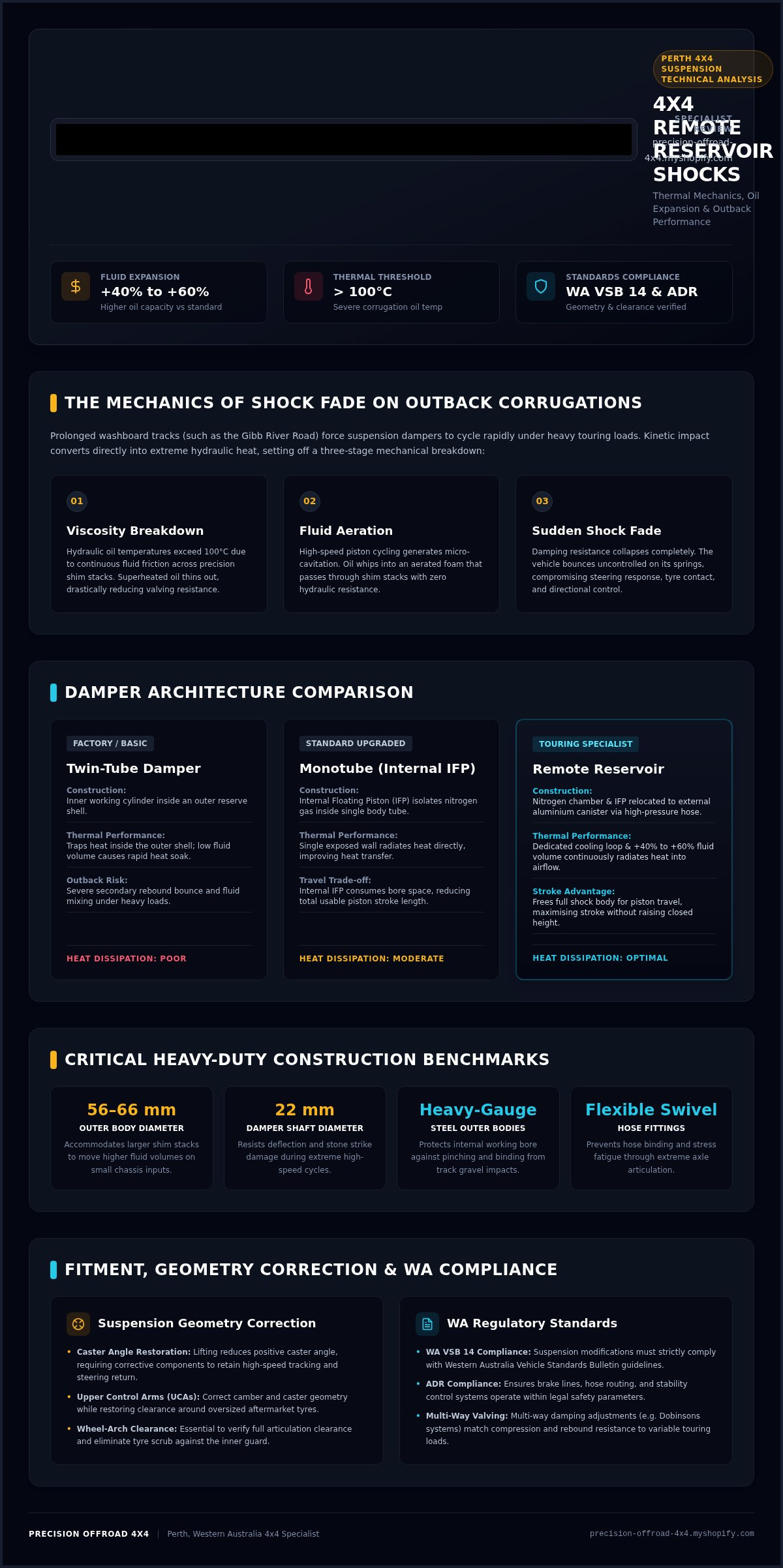
A remote reservoir shock absorber operates on a straightforward principle: it separates the high-pressure nitrogen gas charge from the hydraulic damper oil by housing the gas in an external aluminium canister. In any technical 4x4 remote reservoir shocks review, the defining feature is thermal endurance. Connecting the damper body to a remote canister via a high-pressure hose increases total oil capacity by 40% to 60%. That extra fluid, paired with the external canister's aluminium surface area, dissipates heat before thermal stress degrades your suspension's performance.
The Mechanics of Shock Fade on Outback Corrugations
Every time your suspension compresses and rebounds over washboard tracks like the Gibb River Road, kinetic energy converts directly into thermal energy. The piston forces hydraulic oil through precision shim stacks at rapid cycling speeds, generating intense fluid friction. On continuous corrugations, oil temperatures can easily exceed 100 degrees Celsius.
When conventional dampers overheat, severe performance issues follow quickly:
- Viscosity breakdown: Superheated oil thins out, drastically reducing the resistance generated as it passes through the piston valving.
- Fluid aeration: Extreme cycling causes micro-cavitation, whipping oil into an aerated foam that slips past shim edges with zero resistance.
- Sudden shock fade: With damping resistance lost, the vehicle bounces uncontrollably on its springs, compromising tyre contact and steering response.
Monotube Internal Floating Piston vs Remote Canister Architecture
Standard monotube dampers locate an Internal Floating Piston (IFP) inside the main body tube. This sealed barrier isolates the oil from high-pressure nitrogen, preventing the fluid mixing common in twin-tube setups. However, packing both the oil charge and the gas chamber inside one tube consumes valuable internal bore length.
Moving the IFP and nitrogen charge into an external canister fundamentally improves damper packaging:
- Increased usable travel: Relocating the IFP frees up the entire main shock body for oil and piston travel, yielding a longer stroke length without extending the damper's closed height.
- Consistent high pressure: The remote nitrogen chamber maintains steady positive pressure against the oil column, preventing boiling and cavitation under heavy working loads.
- Dedicated cooling loop: Fluid circulates into the external canister during high-speed compression cycles, continuously radiating heat into the passing ambient airflow.
This physical architecture forms the benchmark of our 4x4 remote reservoir shocks review, delivering consistent damping stability where conventional dampers quickly overheat.
Remote Reservoir vs Monotube and Twin-Tube Dampers Compared
Selecting the right damper comes down to balancing mechanical complexity against your vehicle's operating environment. Standard factory setups rely on twin-tube shocks, which position an inner working cylinder inside an outer reserve tube. While cheap to produce, twin-tube units trap heat within the outer shell and hold minimal fluid. Standard internal-reservoir monotube dampers improve heat transfer by radiating thermal energy directly through a single exposed wall. However, a solitary dent from thrown track gravel can pinch the internal bore, seizing the piston shaft instantly. Remote canister systems bypass these trade-offs by shifting fluid volume and gas pressurisation into an isolated aluminium housing.
Thermal Capacity and Damping Stability Under Load
Touring rigs operating near maximum Gross Vehicle Mass place relentless hydraulic demand on suspension valving. In our workshop testing for this 4x4 remote reservoir shocks review, the increased oil capacity of external canisters directly translated to lower core operating temperatures. Keeping fluid cool prevents internal seal degradation and maintains hydraulic viscosity. That stability ensures predictable body roll control during high-speed gravel sweeps, preventing the dangerous secondary rebound bounce common in overheated twin-tube dampers.
Piston Diameter and Valving Adjustability Differences
Damper body diameter dictates the surface area of the working valving shims. High-performance remote reservoir setups utilise large 56 mm or 66 mm outer bodies with dedicated 22 mm shafts, moving higher fluid volume on small chassis inputs. That fluid flow enables precise low-speed damping control, flattening chassis pitch when braking without creating harsh high-speed feedback over square-edge limestone ruts.
Here is how the three architectures compare mechanically:
- Twin-Tube Dampers: Restrictive 30 mm to 35 mm internal bore with unpressurised or low-pressure gas. Low oil capacity leads to early cavitation under heavy load-carrying capacity demands. Valving is non-adjustable.
- Standard Monotube Dampers: 46 mm to 50 mm bore with an internal floating piston. Provides efficient cooling over twin-tubes, but stone strikes risk structural seizure. Adjustability is typically limited or fixed.
- Remote Reservoir Dampers: Up to 66 mm heavy-duty steel bodies paired with external aluminium canisters. Delivers independent high-speed compression, low-speed compression, and rebound adjustability. Tunable to support progressive rate springs and heavy rear axle weights.
If you switch between weekday commuting and fully laden remote touring, check out the Dobinsons suspension kits available through Precision Offroad 4x4 to see how external adjustment dials accommodate fluctuating payloads without compromising ride comfort.
Key Performance Criteria When Reviewing Remote Reservoir Dampers
A shiny external canister means nothing if the hardware fails three hundred kilometres past Mount Magnet. When compiling a reliable 4x4 remote reservoir shocks review, evaluation must go deeper than brand recognition or exterior anodising. Hardware longevity on unsealed outback roads depends on shaft tensile strength, seal composition, hose routing clearance, and precise spring rate pairing. For a broader mechanical overview of full suspension upgrades, explore our 4x4 suspension performance and reliability guide before finalising your build components.
Adjustability: Rebound and Compression Tuning Options
True three-way adjustability gives you independent command over three distinct hydraulic circuits. Each circuit manages a specific suspension behaviour:
- High-Speed Compression: Governs rapid shaft displacement when hitting sharp limestone washouts or sunken culverts. Proper valving absorbs harsh impacts without driving the bump stops violently into the chassis.
- Low-Speed Compression: Controls slow chassis movement caused by driver inputs. Dialling in low-speed resistance firms up the front end, reducing body roll during emergency highway lane changes and mitigating nose-dive under heavy braking.
- Rebound Damping: Manages the speed at which the shock absorber extends after full compression. Stiff progressive rate springs store enormous kinetic force. Rebound valving tames that energy, preventing the rear end from bucking when unweighted.
Build Quality, Stone Protection, and Hose Routing
The Australian outback acts as an aggressive sandblaster. High-end systems employ 22 mm micro-polished, hard-chromed 5140 steel shafts with tensile strengths exceeding 700 MPa to prevent pitting. If thrown track gravel pits a shaft, damaged chrome will slice through the primary oil seals within hours, causing total pressure failure.
Hose engineering is equally critical. Remote canisters require high-pressure braided lines paired with multi-axis swivel banjo fittings. Solid axle articulation twists fixed lines; without swivel relief, hoses can bind, kink, or rub against inner wheel arches. You also need dedicated, heavy-duty roost guards mounted on rear shock bodies. Unprotected damper bodies quickly suffer impact deformities from roost thrown off the front tyres, leading to premature shaft seal binding and costly fluid leaks.
Finally, confirm that your damper valving matches your spring choice. Running heavy-duty adjustable dampers with under-rated coils creates wallow, while pairing firm progressive rate springs with insufficient rebound damping induces high-speed instability. Dialling in these parameters ensures your investment holds up across tough Western Australian tracks. That dedication to purpose-built, high-strength engineering applies across other vehicle passions as well; enthusiasts who also tune or build custom bikes can look to specialists like Fat Boy Design USA for premium racing and custom components crafted to endure demanding performance conditions.
Fitment, Geometry Correction, and Australian Regulatory Compliance
Bolting high-end remote canister hardware onto your 4WD is only half the job. In our in-depth 4x4 remote reservoir shocks review, proper fitment and geometry alignment prove just as critical as internal valving. Increasing ride height alters control arm angles, wheel alignment specs, and tyre clearance. Without calculated suspension geometry correction, you risk poor high-speed stability and premature component wear.
Correcting Suspension Geometry with Upper Control Arms
Raising an independent front suspension (IFS) vehicle forces the factory upper ball joints to operate near their physical limits. This lift reduces positive caster angle, leaving the steering light, twitchy, and prone to tramlining at highway speeds. Installing heavy-duty aftermarket upper control arms (UCAs) restores two to three degrees of positive caster, realigns ball joints within their design arc, and provides clearance around larger external reservoir springs.
Correct geometry also eliminates uneven tyre wear and prevents vehicle dog-tracking caused by misaligned solid axle tracking. When fitting larger rubber alongside your lift, check out our technical guide to 4x4 wheel upgrades in Perth to calculate wheel track offsets and preserve wheel-arch clearance under heavy axle articulation.
ADR Compliance, GVM Upgrades, and Certification in WA
Western Australia enforces clear legal boundaries under Vehicle Standards Bulletin 14 (VSB 14 Section LS). The Department of Transport permits a maximum combined lift of 50 mm (combining suspension, tyre radius, and body spacers) before mandatory engineering sign-off. If your build exceeds that 50 mm threshold, the state classifies it as a complex vehicle modification.
Compliance at this stage requires specific testing protocols:
- Lane Change Testing: High-ride vehicles carrying increased Gross Vehicle Mass (GVM) must pass dynamic Lane Change tests or Electronic Stability Control (ESC) verifications to satisfy ADR 31 and ADR 35 standards.
- Suspension Travel Verification: VSB 14 requires that modified suspensions maintain at least one-third bump and one-third rebound travel relative to resting ride height.
- Certification and Plating: An engineering assessment report from a recognised consultant must accompany an Authorised Inspection Station check before applying an official modification plate.
Book your suspension build through Precision Offroad 4x4, where our in-house Licensed Vehicle Modifier certification ensures your build stays street-legal. Explore our GVM upgrade suspension kits to secure ADR-compliant components engineered for severe outback touring.
Selecting the Right Remote Reservoir Suspension for Your 4x4
Every touring rig serves a different purpose, meaning there is no universal valving setup that works across every vehicle. A thorough 4x4 remote reservoir shocks review requires looking closely at brand pedigree and manufacturing history. We partner with Australian brands that engineer dampers specifically for our unforgiving terrain. Dobinsons has manufactured specialised suspension equipment for Australian tracks since 1953, and Fulcrum Suspensions brings engineering expertise developed across Australia since 1976. When building your touring platform, integrate your suspension kit alongside essential 4x4 accessories for Australian tracks to ensure your chassis remains balanced and capable.
Matching Damper Setup to Your GVM and Touring Demands
Before ordering components, calculate your genuine unladen kerb weight against your fully loaded touring mass. A dual-cab ute fitted with a service body, steel bar work, and a rooftop tent demands substantially firmer baseline valving than an open-tub daily driver. If your load-carrying capacity needs require a certified GVM upgrade, your shock valving must support that extra mass without wallowing.
Tyre selection also impacts damping requirements. Upgrading to light truck (LT) construction tyres, like the puncture-resistant Maxxis RAZR AT811, adds rotational inertia and increases unsprung mass. Heavy unsprung mass accelerates suspension cycling over washboard tracks. Correctly valved remote reservoir dampers control that added axle weight quickly, isolating impacts and protecting chassis mounting points from stress fractures.
Professional Fitment and Tailored Tuning Support in Perth
Precise installation is just as critical as component quality. Remote canisters require careful positioning to guarantee hose clearance around chassis rails, brake hardlines, and steering components. Hoses mounted incorrectly can rub against rotating rubber or stretch taut under full suspension articulation. A professional wheel alignment is mandatory after any suspension or tyre change to lock in steering angles and tyre contact.
We are Perth-based specialists who spend our weekends on the same WA tracks you do. When you pick up your vehicle from Precision Offroad 4x4, our technicians configure your external adjusters for your planned destinations, whether you are tackling the corrugations of the Canning Stock Route or hauling a camper along the south coast. That practical expertise turns high-performance hardware into dependable outback durability.
Upgrading Your Touring Suspension for the Long Haul
Investing in external canisters comes down to how hard you push your vehicle. As shown in this 4x4 remote reservoir shocks review, separating the nitrogen charge from the working fluid provides genuine thermal defence against outback washboards, stopping shock fade before it compromises your safety. When paired with matched spring rates and correct upper control arms, remote reservoir dampers transform high-speed stability on remote corrugated tracks.
Your 4x4 isn't actually finished once the new springs and shocks are bolted in. Proper geometry, correct valving, and regulatory compliance matter just as much as hardware quality. We are Perth-based specialists who spend our weekends on the same WA tracks you do. As an authorised Dobinsons and Fulcrum Suspensions stockist, we provide in-house Licensed Vehicle Modifier certification to keep your build fully ADR-compliant with an official modification plate. Ready to prepare your tourer for severe remote travel? Book a suspension consultation with Precision Offroad 4x4 and get your rig dialled in properly before your next outback departure.
Frequently Asked Questions
Are 4x4 remote reservoir shocks worth the investment for touring?
Yes, if your rig consistently carries heavy touring loads across remote unsealed tracks. For standard highway commuting or light gravel day trips, conventional monotubes work fine. But once you add bull bars, canopies, and gear near your GVM limit, standard units overheat rapidly. As detailed in our 4x4 remote reservoir shocks review, external canisters prevent severe fading, protecting both ride stability and suspension components over thousands of outback kilometres.
How do remote reservoir shock absorbers prevent shock fade on corrugated roads?
Remote reservoirs prevent fade by increasing damper fluid capacity and isolating the nitrogen gas from the hydraulic oil. Moving the internal floating piston into an external aluminium canister increases oil volume by 40% to 60%. This extra fluid radiates heat rapidly through the canister body into passing air. By keeping operating oil cool and pressurised, the damper prevents oil aeration and cavitation, ensuring firm, predictable resistance through endless washboard corrugations.
Can remote reservoir dampers be rebuilt and re-valved over time?
Yes, premium remote reservoir dampers from manufacturers like Dobinsons and Fulcrum are completely rebuildable. Unlike sealed factory shocks that must be thrown away when worn, high-end monotube remote reservoir units can be stripped down in a workshop. Technicians can replace worn piston seals, refresh degraded hydraulic fluid, and re-valve internal shim stacks. This allows you to fine-tune damping characteristics as your touring setup changes or when carrying heavier payloads.
Do I need aftermarket upper control arms when fitting remote reservoir shocks?
Yes, fitting aftermarket upper control arms is strongly recommended when lifting an independent front suspension vehicle. Raising ride height pulls the steering knuckles inward, reducing positive caster angle and causing high-speed wandering. Heavy-duty aftermarket UCAs restore correct caster and camber alignment. They also provide vital clearance between the arm and larger external reservoir shock bodies, preventing mechanical binding and premature ball joint failure during full downward wheel droop.
What is the difference between high-speed and low-speed compression adjustment?
The difference relates to the shaft velocity of the shock absorber, not the road speed of your vehicle. Low-speed compression manages slow chassis movements caused by driver inputs, such as body roll during cornering or pitch under braking. High-speed compression controls violent, rapid shaft movements when striking deep washouts, limestone ledges, or square-edge potholes. Adjusting both independently gives you total control over ride firmness and chassis composure across diverse terrain.
Are remote reservoir suspension kits legal on Western Australian roads?
Remote reservoir kits are completely road legal in Western Australia provided they comply with VSB 14 standards. WA Department of Transport rules permit a combined lift of up to 50 mm without certification. Lifts exceeding 50 mm combined require dynamic Lane Change testing, inspection at an Authorised Inspection Station, and an official modification plate. In this 4x4 remote reservoir shocks review, we ensure every build installed at Precision Offroad 4x4 complies with ADR standards and state regulations.
How often should remote reservoir shock absorbers be inspected and serviced?
You should inspect your remote reservoir hardware before and after every major remote outback trip. Check for hydraulic fluid weeping around seal heads, inspect reservoir hoses for rub marks, and confirm mounting bracket bolts remain torqued to specification. For dedicated touring rigs tackling heavy corrugations, we recommend a workshop tear-down inspection and fluid service every 40,000 to 50,000 kilometres to maintain peak valving performance and prevent premature internal seal wear.