

A single sidewall puncture on a remote track in the Pilbara can turn a weekend escape into a dangerous recovery mission. It's a reality many Western Australians face when they prioritise aesthetics over technical suitability. You likely know that the right set of 4x4 tyres Perth drivers select can make or break a vehicle's performance. Whether you're airing down for the soft sands at Lancelin or hauling a heavy canopy across the Kimberley corrugations, your rubber is the only thing keeping you grounded. It's frustrating to deal with tyre scrubbing after a lift or watching expensive tread disappear on harsh gravel roads.
This guide provides the technical expertise you need to master the essentials of selecting, fitting, and maintaining tyres specifically for WA’s harshest environments. We'll show you how to achieve reliable grip and long-distance durability while staying within legal limits. You'll learn about the synergy between your Maxxis tyres and suspension setup, the 50mm diameter limit, and why Light Truck construction is the standard for serious touring in 2026. We've stripped away the marketing hype to focus on functional performance and mechanical integrity.
Key Takeaways
- Match your tread pattern to Western Australia's unique transition from soft coastal sands to high-speed inland corrugations.
- Ensure legal compliance by understanding WA's tyre diameter limits and matching load ratings to your vehicle's GVM.
- Master the technical selection of 4x4 tyres Perth specialists recommend for balancing off-road traction with daily road manners.
- Identify why suspension synergy with optimised suspension systems is essential to prevent tyre scrubbing and maintain vehicle stability.
- Learn the precise tyre pressure adjustments needed to protect your tyre carcass on sharp limestone and remote gravel tracks.
Choosing the Right 4x4 Tyres for Perth and WA Terrain
Off-road tires are specialised rubber compounds engineered for off-bitumen traction and carcass durability. In Western Australia, your choice of 4x4 tyres Perth depends on more than just tread depth. It's about how the carcass handles the extreme heat of a bitumen run to Geraldton before hitting the sharp limestone of the Coral Coast. A tyre is a technical component that must manage weight, heat, and friction simultaneously. If the compound is too hard, you lose grip on wet Perth roads; if it's too soft, the Pilbara rocks will shred it in days.
Sidewall strength is non-negotiable for WA drivers. When you air down to 15 PSI for the soft sands of Wilbinga or Lancelin, the sidewall takes the brunt of the vehicle's weight. A weak sidewall risks unseating the bead or suffering a pinch flat. This performance is directly linked to your 4x4 suspension, which manages weight transfer and determines how effectively the tyre's contact patch meets the ground. A well-tuned suspension setup ensures that the tyre stays in contact with the terrain, preventing the "skipping" effect that leads to rapid tread scalloping on corrugations.
The "Perth Mix": Sand, Scrub, and Bitumen
Sand driving is a staple of the West Australian lifestyle. You need a tyre that "balloons" correctly at low pressures. This creates a longer footprint, rather than just a wider one, allowing the vehicle to float over the sand rather than digging in. Selecting 4x4 tyres Perth owners can rely on involves balancing these beach requirements with highway manners. Many owners daily drive a 79 Series or Ranger on the Kwinana Freeway. Mud-terrains might look aggressive, but they can be noisy and lose traction on wet bitumen during a winter downpour. WA summer road temperatures often exceed 50 degrees Celsius, which causes inferior compounds to harden and lose their flexibility prematurely.
Tread Life vs. Off-Road Performance
There's always a technical trade-off. Soft, grippy compounds offer elite traction on technical rock climbs but won't last a full season of heavy touring. Cheap imports often fail on their first trip north because they lack the internal ply strength to handle sustained vibrations. You should always check the manufacturing date on the tyre sidewall. Tyres that have sat in a warehouse for years lose their elasticity, making them prone to chipping and cracking in the harsh sun. Focus on Light Truck (LT) construction for the best balance of durability and load-carrying capacity. It's a small investment that prevents a costly recovery from a remote track.
Tread Patterns Decoded: A/T vs. M/T vs. R/T
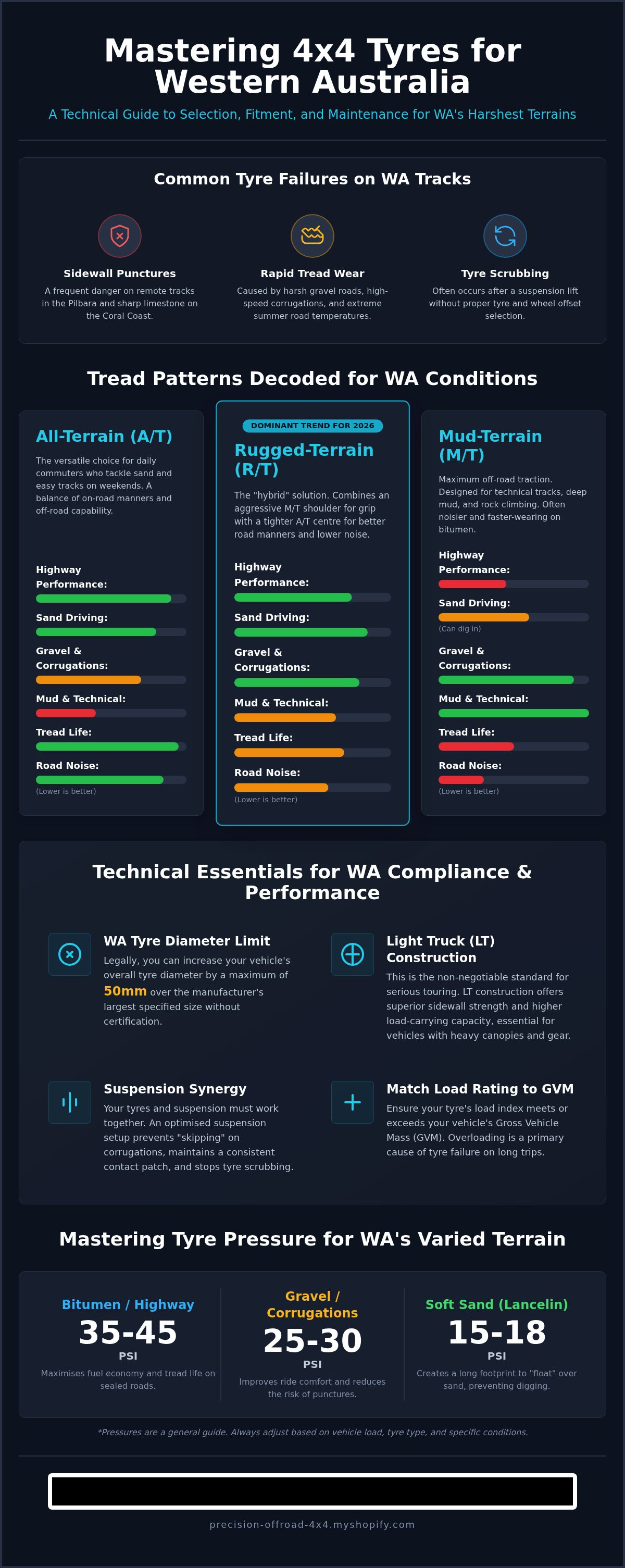
Selecting the right tread pattern is a technical decision based on your vehicle's duty cycle and your tolerance for road noise. For most owners of 4x4 tyres Perth, the choice falls into three primary categories. All-terrain (A/T) tyres are the standard for the daily commuter who hits the beach on weekends. Mud-terrain (M/T) tyres provide maximum mechanical keying on technical tracks. However, the Rugged Terrain (R/T) or "hybrid" tyre has become the dominant trend in 2026. These hybrids bridge the gap by offering the aggressive shoulder of a mud-terrain with the tighter centre blocks of an all-terrain. Understanding Tread patterns and tyre sizes is the first step in building a vehicle that performs as well on the tarmac as it does in the scrub.
Maxxis tyres have become a preferred choice for WA owners because they offer a range that covers all three categories with heavy-duty construction. Whether you're looking for the high-mileage stability of an A/T or the aggressive bite of an M/T, the carcass integrity remains a priority. This reliability is vital when you're 500 kilometres from the nearest service centre. If you're planning a new build, you can explore our range of Maxxis options to find the specific tread that matches your intended track usage.
Maxxis Razr: A Case Study in WA Versatility
The Razr series is engineered for the high-speed heat and abrasive surfaces of WA. The Razr AT features a 3D triple-reinforced carcass that resists punctures while maintaining a quiet profile on the Kwinana Freeway. It's an ideal choice for long-distance touring where fuel efficiency and road manners are important. In contrast, the Razr MT focuses on sidewall protection and technical grip. It uses a high-strength casing to resist the sharp limestone edges found on our coastal tracks. Modern block spacing in these designs helps reduce the harmonic "drone" traditionally associated with aggressive treads, making them more bearable for daily use.
When to Choose Mud-Terrains in the West
Mud-terrains are often viewed as overkill for a simple Perth beach run. In soft sand, an aggressive tread can sometimes dig a hole rather than providing the floatation you need. However, M/Ts are essential for inland tracks where the terrain is unpredictable. Sharp rocks in the Pilbara or the Murchison require the heavy-duty puncture resistance that only a mud-terrain's thicker carcass provides. These tyres also feature self-cleaning tread blocks, which are vital for the occasional WA winter mud. They prevent the tyre from becoming a "slick" in slippery conditions, ensuring you maintain forward momentum when the track turns soft.
Technical Specs: Sizing, Load Ratings, and Offset
Understanding the alphanumeric codes on your sidewall is a mechanical necessity for any build. Most 4x4 tyres Perth owners deal with Metric sizing, such as 285/70R17, where 285 is the width in millimetres and 70 is the aspect ratio. In contrast, Imperial sizing like "33-inch" refers to the total diameter. In Western Australia, the Department of Transport allows a maximum tyre diameter increase of 50mm from the manufacturer's standard size as a minor modification. However, you must account for the total vehicle lift. The maximum allowable lift in WA is 50mm total; this means if you install a 50mm suspension lift, you cannot legally increase your tyre diameter at all without engineering certification. A common compliant setup is a 25mm suspension lift paired with a 25mm increase in tyre diameter.
Your choice of wheels and their offset determines the tyre's position within the arch and its scrub radius. WA regulations permit a maximum track width increase of 50mm beyond the factory specification. It is also vital to remember that wheel spacers remain illegal for on-road use in Western Australia. We focus on achieving the correct offset through wheel selection to ensure tyres don't protrude beyond the guards, which is a common cause for defect notices on Perth roads.
The Load Rating Trap
Load ratings are often overlooked but are critical for safety and insurance compliance. If you have fitted heavy 4x4 accessories such as steel bull bars, winches, or rear drawer systems, your vehicle's weight increases significantly. Standard "Passenger" (P) rated tyres are unsuitable for these loads as they lack carcass density. You must use Light Truck (LT) construction tyres, which feature extra plies for better weight distribution and puncture resistance. If your vehicle has a GVM upgrade, your tyres must meet or exceed the new axle load ratings to remain legal and safe under full load.
Wheel Offset and Scrub Radius
Changing your wheel offset alters the scrub radius, which is the distance between the steering axis and the centre of the tyre's contact patch. Moving to a "Zero Offset" on a modern ute like a Ranger or Hilux pushes the wheel outwards to provide a wider stance. While this improves stability, it often causes the tyre to scrub against the body mount or inner guard during full steering lock. Wider tyres don't always translate to better performance; on soft sand, a tyre that is too wide can create excessive rolling resistance, making the engine work harder and increasing fuel consumption. We prioritise a balanced offset that maintains steering geometry while providing clearance for larger rubber.
Integrating Tyres with Your 4x4 Suspension
A common mistake in the Perth 4x4 community is assuming a 2-inch lift automatically provides clearance for 35-inch tyres. While height helps, the suspension's primary job is managing the dynamic movement of the vehicle. When you upgrade to larger 4x4 tyres Perth specialists recommend, you're increasing the "unsprung weight", which is the mass of components not supported by the springs. This puts additional strain on your ball joints, wheel bearings, and shock absorbers. High-quality Dobinsons and Fulcrum suspension kits are engineered with valving and spring rates specifically designed to control this extra mass, preventing the vehicle from feeling "wallowy" or uncontrolled on undulating WA tracks.
A professional wheel alignment is mandatory after fitting new rubber. Changing tyre diameter or wheel offset alters the steering geometry, which can lead to rapid tread wear and poor handling. If your alignment is out, even the most expensive Maxxis tyres will scrub and wear unevenly. You can shop our range of suspension and tyre packages to ensure your build is balanced from the ground up.
Clearance and Articulation
Testing for tyre clearance in a flat workshop car park is insufficient. True clearance must be measured at full suspension compression and steering lock. If you're fitting larger Maxxis tyres, you likely need bump stop extensions to prevent the tyre from impacting the inner guard during heavy articulation. For Independent Front Suspension (IFS) rigs, upgrading to aftermarket Upper Control Arms (UCAs) is often necessary. These provide the additional clearance needed for larger tyres and allow for correct caster adjustment, which is often impossible with factory arms after a lift.
The Impact on Braking and Gearing
Increasing tyre diameter changes your vehicle's effective final drive ratio. A jump from 31-inch to 33-inch tyres will make your speedometer read slower than your actual speed, which is a legal and safety risk. It also increases braking distances because the brakes have to stop a larger, heavier rotating mass. In WA’s north, where long-distance towing is common, larger tyres can lead to excessive transmission heat as the engine struggles to maintain torque in higher gears. If you're moving up two or more tyre sizes, a differential re-gear is a functional necessity to restore factory performance and protect your drivetrain.
Maintenance and Longevity for WA Drivers
Maintaining your rubber is just as critical as the initial selection. For owners of 4x4 tyres Perth, the golden rule of longevity is managing pressures based on the specific surface. Running highway pressures on the corrugated tracks of the Murchison leads to rapid tread chipping and internal carcass fatigue. Conversely, failing to air up before hitting the bitumen after a day at Wilbinga causes excessive heat build-up. This heat softens the compound and can lead to delamination or a total blowout. We recommend a 5-tyre rotation every 5,000 to 10,000 kilometres. This practice ensures even wear across all corners and prevents the "scalloping" or heeling often seen on aggressive mud-terrain blocks after heavy braking.
A post-trip inspection is a mechanical necessity after visiting the Pilbara or Coral Coast. Sharp rocks and limestone can cause deep cuts that don't immediately result in a flat but compromise the tyre's integrity. You should look for internal carcass damage, which often presents as subtle bulges on the sidewall or a new vibration through the steering wheel. Catching these issues early prevents a dangerous failure on the North West Coastal Highway. In 2026, premium all-terrain tyres are expected to last between 60,000 and 80,000 kilometres, but this is only achievable with disciplined maintenance and pressure management.
The Pressure Game
Pressure settings are terrain-dependent and vary based on your vehicle's weight. For the soft coastal sands of Lancelin, 12 to 16 PSI is often required to create a sufficient footprint for floatation. On inland gravel tracks, dropping to 24 to 28 PSI helps the tyre absorb small impacts, which protects your suspension components from high-frequency vibrations. Heat is the primary killer of tyres on long WA highway stretches. An under-inflated tyre flexes too much, generating internal temperatures that destroy the rubber bond. Always carry a high-quality compressor to ensure you can return to safe bitumen pressures immediately after leaving the track.
Professional Fitment and Support in Perth
A specialist 4x4 workshop understands the nuances of modified vehicle geometry that generic tyre centres often overlook. When we fit new rubber, we don't just balance the wheels; we check for wheel bearing play and bush wear in your suspension. These components often fail prematurely under the stress of larger, heavier tyres. Identifying a worn ball joint or a leaking shock absorber during a tyre change saves you from an expensive breakdown in a remote area. Proper fitment ensures your build remains reliable and legally compliant. Get your rig track-ready with a set of Maxxis tyres from our Perth workshop.
Prepare Your Vehicle for the Next WA Adventure
Building a capable off-roader requires more than just picking an aggressive tread from a catalogue. It involves a technical understanding of how your rubber interacts with Western Australia's unique terrain and your vehicle's mechanical limits. By balancing load ratings, wheel offsets, and suspension geometry, you ensure your vehicle remains safe and legal on the road while being unstoppable on the tracks. Whether you're navigating the sharp limestone of the north or the deep sands of the coast, the right set of 4x4 tyres Perth drivers choose must be matched to their specific build requirements.
Precision Offroad 4x4 provides the expert technical advice and rugged, reliable service you need to get the job done right. As specialists in Maxxis and Dobinsons builds, our local team ensures every component works in harmony to protect your drivetrain and maximise performance. Don't leave your safety to chance on remote tracks. Upgrade your rig with specialist 4x4 tyres at Precision Offroad 4x4. Your next adventure starts with the right foundation.
Frequently Asked Questions
What are the best 4x4 tyres for sand driving in Perth?
All-terrain tyres are generally superior for sand as they provide a smoother footprint without digging in. A tyre with a flexible sidewall that allows for a long contact patch at low pressures is ideal. For the soft sands of Lancelin or Wilbinga, a hybrid or A/T tyre often outperforms a mud-terrain because it floats over the surface rather than churning through it.
How much does a set of 4x4 tyres cost in Perth?
The cost of 4x4 tyres Perth drivers pay depends on the tyre size, load rating, and construction type. Light Truck (LT) tyres usually carry a premium due to their reinforced carcasses and puncture resistance. While specific pricing varies by brand and model, investing in a high-quality set is a long-term saving when compared to the cost of premature wear or remote recoveries.
Will 33-inch tyres fit my Hilux without a lift kit?
Fitting 33-inch tyres to a standard Hilux usually causes significant scrubbing on the body mounts and inner guards. To fit this size safely and legally, you typically need at least a 50mm suspension lift and wheels with a specific offset. Even with a lift, some minor trimming or aftermarket upper control arms may be required to maintain full steering articulation without contact.
Are mud-terrain tyres too noisy for the Kwinana Freeway?
Modern mud-terrain tyres have improved significantly, but they still produce more road noise than all-terrain alternatives. The aggressive tread blocks create a hum on high-speed stretches like the Kwinana Freeway. If noise is a concern for your daily commute, a Rugged Terrain (R/T) tyre offers a quieter middle ground while retaining the aggressive look and off-road bite you need.
How often should I rotate my 4x4 tyres for WA touring?
You should rotate your tyres every 5,000 to 10,000 kilometres to ensure even tread wear. This is especially important for vehicles used for heavy touring across the state. Regular rotation prevents the "scalloping" effect common on aggressive tread patterns and helps extend the overall lifespan of the set. Always include the spare in your rotation pattern if it matches the other four.
Do I need a wheel alignment after getting new tyres?
A professional wheel alignment is essential every time you fit new 4x4 tyres Perth specialists install or whenever you modify your suspension. Even a slight misalignment can cause rapid tread wear and negatively impact your fuel economy. For 4x4s, an alignment ensures that the steering geometry remains correct after changing tyre diameters or wheel offsets, protecting your investment and maintaining vehicle stability.
What is the legal tyre size increase in Western Australia?
In Western Australia, you can increase your tyre's overall diameter by up to 50mm from the manufacturer's standard size. This is classified as a minor modification under VSB14 regulations. However, your total vehicle lift, combining suspension and tyres, cannot exceed 50mm without engineering certification. For example, a 25mm suspension lift and a 25mm tyre diameter increase would be the maximum allowable limit.
Why should I choose Maxxis tyres for my 4x4 build?
Maxxis tyres are a preferred choice for WA builds due to their exceptional carcass durability and puncture resistance. Models like the Razr series are specifically designed to handle the high heat and abrasive surfaces of our northern tracks. They provide a reliable balance of off-road traction and on-road manners, making them a versatile option for both weekend enthusiasts and serious long-distance tourers.