

Australian market pricing for 4x4 underbody protection Australia kits typically ranges from $99–870, with a median market cost of $349 based on industry listings. Selecting the right setup requires balancing steel versus aluminium weight against protection levels and verifying local vehicle modification compliance. You can rely on Precision Offroad 4x4 for expert advice on choosing, installing, and certifying the ideal bash plate (underbody protection system) for your 4WD.
Key Takeaways: Australian 4x4 underbody protection typically costs between $99 and $870, with steel preferred for rock crawling and aluminum for weight-sensitive sand touring.
- Aluminum guards can match steel mass at 8mm thickness to provide extreme toughness.
- Except when rock crawling, avoid heavy steel plates if your vehicle is near GVM limits.
- Choose 4mm structural steel for rocky WA tracks to prevent transfer case housing fractures.
- Installation is a 1 to 2 hour DIY job using basic socket sets and tools.
Match plate material to rocks, sand and loaded touring
Your terrain and loaded mass should drive the material choice before you look at price. Three common situations show how that works in practice:
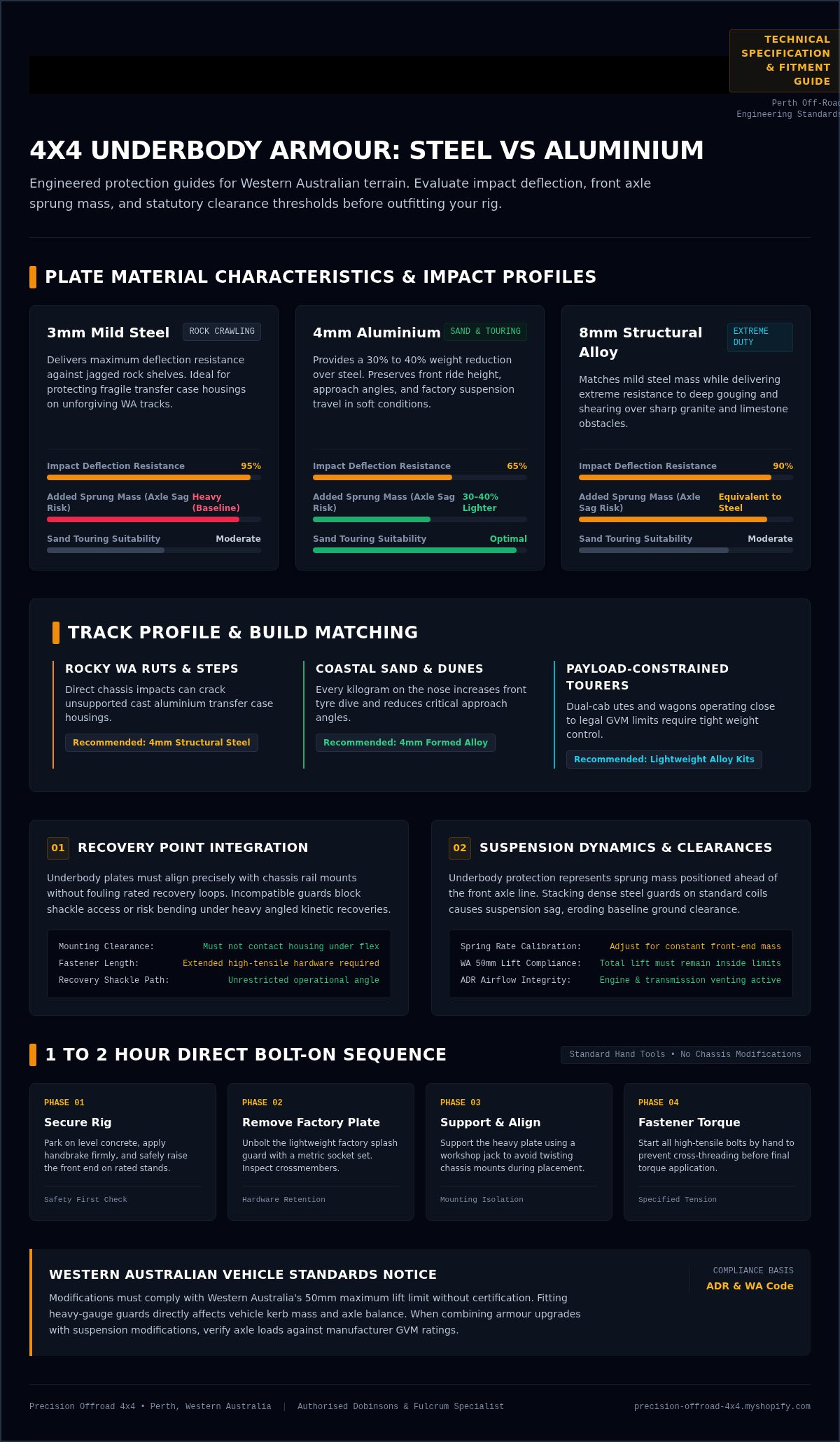
- Rocky WA tracks where a transfer case housing has already taken hits: fit 4mm structural steel guards so the next strike lands on the plate, not the casing.
- Light sand touring where every kilogram on the nose matters: choose aluminium so you keep ride height and approach angle.
- A dual-cab or Everest already running near legal payload: prefer lighter alloy body protection rather than stacking heavy steel on a tight GVM margin.
With clients we see that fitting 4mm structural steel guards prevents severe transfer case housing fractures on rocky WA tracks. Carbon steel gives high impact resistance; aluminium cuts the extra mass the chassis must carry (sprung mass on the suspension, not unsprung wheel mass).
Steel suits hard rock crawling where deflection resistance comes first. Aluminium suits long sand runs where holding factory ride height matters more than gouge toughness. Before you buy, verify plate fitment against your crossmembers and front differential drops. A heavy protection guard only works when it lands on correct structural anchor points; low-grade options flex under impact and can drive bolts toward the oil pan. Confirm the layout still meets Australian Design Rules for airflow and engine cooling.
Browse tested vehicle armour collections at Precision Offroad 4x4 (precision-offroad-4x4) and lock in fitment before the next remote trip. Request fitment advice for your chassis if you are unsure which thickness matches your tracks.
Keep recovery points clear when you add front guards
High-performance protection guards can integrate with rated front recovery points without compromising chassis structural integrity, provided the bolt pattern is right.
Fitment depends on accurate alignment between chassis rail mounting locations and the guard plates. Precision Offroad 4x4 supplies tailored vehicle equipment so aftermarket recovery loops stay usable without obstruction. You still need correct running clearance so the plate does not make dynamic contact under harsh hits.
When you add serious front armour, treat the extra mass as sprung load on the front axle and re-check suspension travel. Reviewing our 4x4 Coil Spring Upgrade Guide for Australia helps you balance that loaded front end. Fitted together with rated points, plates should leave recovery attachment angles open for snatch straps. Misaligned plates can block shackle operation or bend under heavy lateral loads.
Verify mounting hardware lengths: factory bolts are usually too short for dual-bracket fitment. Standard hardware suits tourers; heavy setups need reinforced structural spacers. Ask the team to confirm recovery point clearance on your bar and chassis combination before you order.
Steel vs aluminium: how guard mass changes your clearance
Steel plates prioritise impact resistance; aluminium guards cut vehicle mass so you hold clearance longer on soft tracks.
| Material | Weight Comparison | Impact Profile |
|---|---|---|
| 3mm Mild Steel | Baseline heavy mass | High deflection resistance |
| 4mm Alloy | 30–40% lighter | Moderate gouging resistance |
| 8mm Structural Alloy | Equivalent mass to steel | Extreme gouging resistance |
Market listings place complete underbody kits across the band already noted in the introduction, with the same industry median. Steel guards add sprung mass over the front axle, which can encourage suspension sag and reduce belly clearance over time. Aluminium holds ride height more readily and helps preserve factory approach angles. Steel remains the practical pick for rock work; alloy fits long-distance touring where mass and fuel use dominate.
Heavy front plates slowly compress coil springs, trimming axle clearance without a dramatic warning thump. Recheck spring rates after you bolt on thick steel, and for touring layouts read our 2026 Australian 4WD Camping Setup & Touring Guide before you commit to a material.
Fit underbody plates at home in one to two hours
A direct bolt-on underbody plate is often a 1–2 hour home job with basic hand tools. In our Perth workshop we regularly fit these guards without drilling or cutting, and retail component pricing follows the market band described above.
DIY sequence:
- Secure the vehicle: Park on flat ground, apply the handbrake, and safely lift the front end.
- Remove factory guards: Unbolt the thin factory protection guard with a socket set.
- Position the new plate: Lift the heavy-duty plate into place and support its mass so the suspension and mounts are not twisted during alignment.
- Fasten hardware: Thread all supplied high-tensile bolts by hand, then tighten to the specified torque.
Factory mounting points on quality kits line up with the new hardware in a modular way, so you are not fabricating brackets on the driveway. If a suspension upgrade is also on your list, review our 2026 Australian GVM Upgrade & 4WD Suspension Guide so the finished build still meets Australian Design Rules. DIY suits hands-on owners; professional fitting suits drivers who want guaranteed alignment on the first pass. Book a workshop slot if you would rather have Licensed Vehicle Modifier oversight from the start.
Build a true landed cost for 4x4 underbody protection Australia
Sticker price is only the start: add regional freight before you compare suppliers. For sump and transfer case duty on harsh WA rock, a heavy-duty steel guard still outperforms thin alloy on strike survival, and complete sets from top Australian suppliers sit in the market band already quoted.
Interstate Transport for thick steel climbs quickly. From hands-on builds, freight quotes into Perth often surprise remote owners who skipped a landed-cost check. Each plate also adds mass to the front axle; over long corrugated miles that extra load can wear factory shock absorbers harder than you expect.
Factor local installation labour if you lack stands and torque tools, and confirm the unit ships with a warranty statement that covers off-road structural failure.
Tip: Budget for additional freight costs if shipping heavy steel bash plates across Australia.
Get a freight-inclusive figure for your suburb before you pay deposits on heavy steel.
Stay inside Western Australia’s 50mm lift rule
Western Australian regulations allow a maximum total lift of 50mm without an approved engineer’s report under VSB14 standards. A 50mm (2-inch) lift is the usual local target: more approach and departure angle, plus belly room for deep sand ruts, without stepping into full certification.
From client work, careful component selection prevents odd handling on corrugations. Precision Offroad 4x4 supplies Dobinsons and Fulcrum suspension kit setups engineered for local terrain (at most the hardware you need for the lift you run).
Post-registration upgrades on a licensed WA vehicle need post-registration inspection. A Licensed Vehicle Modifier must sign off so the work aligns with standards such as VTB-180A. Pushing past legal lift without a modification plate leaves you exposed in an incident in much the same way as driving without cover.
Underbody armour adds security, yet plate mass still changes how the front end sits on its springs. Stay inside the lift cap and the inspection path stays simple.
Tip: Ensure total suspension lift does not exceed 50mm to remain compliant without engineering certification in WA.
Leave heavy plates off when you are already near GVM
Bolt heavy steel underbody armour onto an over-tonnage rig and you invite mechanical strain plus legal trouble.
In our Perth workshop we regularly weigh builds where accessories alone have pushed the vehicle over Gross Vehicle Mass. That extra load dulls braking response, speeds up shock fade on corrugations, and drags springs into premature sag. Adding this mass without a certified GVM upgrade conflicts with Australian Design Rules. You risk a failed roadworthy, a defect notice, or an insurance dispute after a crash.
Heavy steel guards belong on dedicated rock-crawling vehicles that still have spare payload. Lightweight alloy suits touring builds that already sit close to the legal limit. Read your weighbridge ticket before you add another steel panel; if the margin is gone, choose alloy or finish a GVM upgrade path first.
Buy plates through accredited Australian suspension specialists
Verified underbody setups are how sumps, gearboxes, and transfer cases survive real strikes. You want evidence that a plate designed for your rails has taken local track punishment, not only brochure photos. Precision Offroad 4x4 is an authorised Dobinsons and Fulcrum retailer and puts forward gear tested for WA tracks.
Durability checks from real use matter before you hang more mass under the chassis. Unverified hardware can crack under stress and put driveline parts at risk hundreds of kilometres from help. Choose components with documented testing so the structure you rely on is still intact after the hit. Talk to the specialists about the plate thickness and mount style that match your suspension and recovery layout.
Details and enquiries: Precision Offroad 4x4.
Frequently asked questions
What is the price of underbody protection for my vehicle?
According to market listings, complete protection components span the Australian retail band set out at the start of this article (median A$349). Total cost moves with structural thickness and how much of the underbody the set covers. Request a personalised quote for exact pricing on your vehicle build.
Do underbody plates change GVM, payload or roadworthy risk in Australia?
Yes. Plate mass counts toward GVM and payload. If you are already close to the limit, heavy steel can push you over, affect braking and suspension wear, and create roadworthy or insurance issues unless you hold spare capacity or a certified GVM upgrade. Weigh the vehicle first, then choose steel or alloy to match the margin you still have.
Which material option is available for my truck?
You can choose between folded steel and high-grade aluminium underbody plates. Heavy steel plates give strong impact resistance on rocky terrain. Light aluminium guards reduce additional sprung load over the front axle.
Is your 4x4 underbody protection range compatible with recovery points?
Most protection guard options integrate directly with rated recovery points and aftermarket bull bars. Mounting brackets must share chassis location points without binding or stressing crossmembers. Always check component clearance during installation.
Can I install underbody protection myself, or do I need professional help in WA?
You can fit many bolt-on systems at home with basic hand tools, but Western Australian road rules still govern related chassis and lift work. Under the National Code of Practice (VSB14), WA allows a maximum total lift of 50mm without engineering certification. Post-registration upgrades on already licensed WA vehicles require inspection by a Licensed Vehicle Modifier against standards such as VTB-180A. Precision Offroad 4x4 is an authorised Dobinsons and Fulcrum retailer and can guide the build so plate, suspension and paperwork stay aligned.
Ready to Protect Your Underbody?
A fitted underbody plate shields your sump, transmission and transfer case on harsh WA trails. The practical decisions stay the same as at the start: pick steel or aluminium for the terrain you actually drive, confirm recovery-point and cooling clearance, stay inside WA lift and GVM rules, and budget freight plus fitting so the landed setup matches the job.
As a Perth-based specialist with Licensed Vehicle Modifier certification and authorised Dobinsons and Fulcrum retailer status, Precision Offroad 4x4 advisers use real-world track testing to keep rigs working through 2026. Manufacturer warranties remain in place when fitment follows the approved method.
Inspect your underbody clearance before the next remote run, then reach out for a custom quote on the plate and suspension package your build can legally carry.