

A thick bash plate can still leave a vulnerable component exposed. Choosing 4x4 underbody protection Australia drivers can use starts with your vehicle’s layout and the tracks you drive, not plate thickness alone.
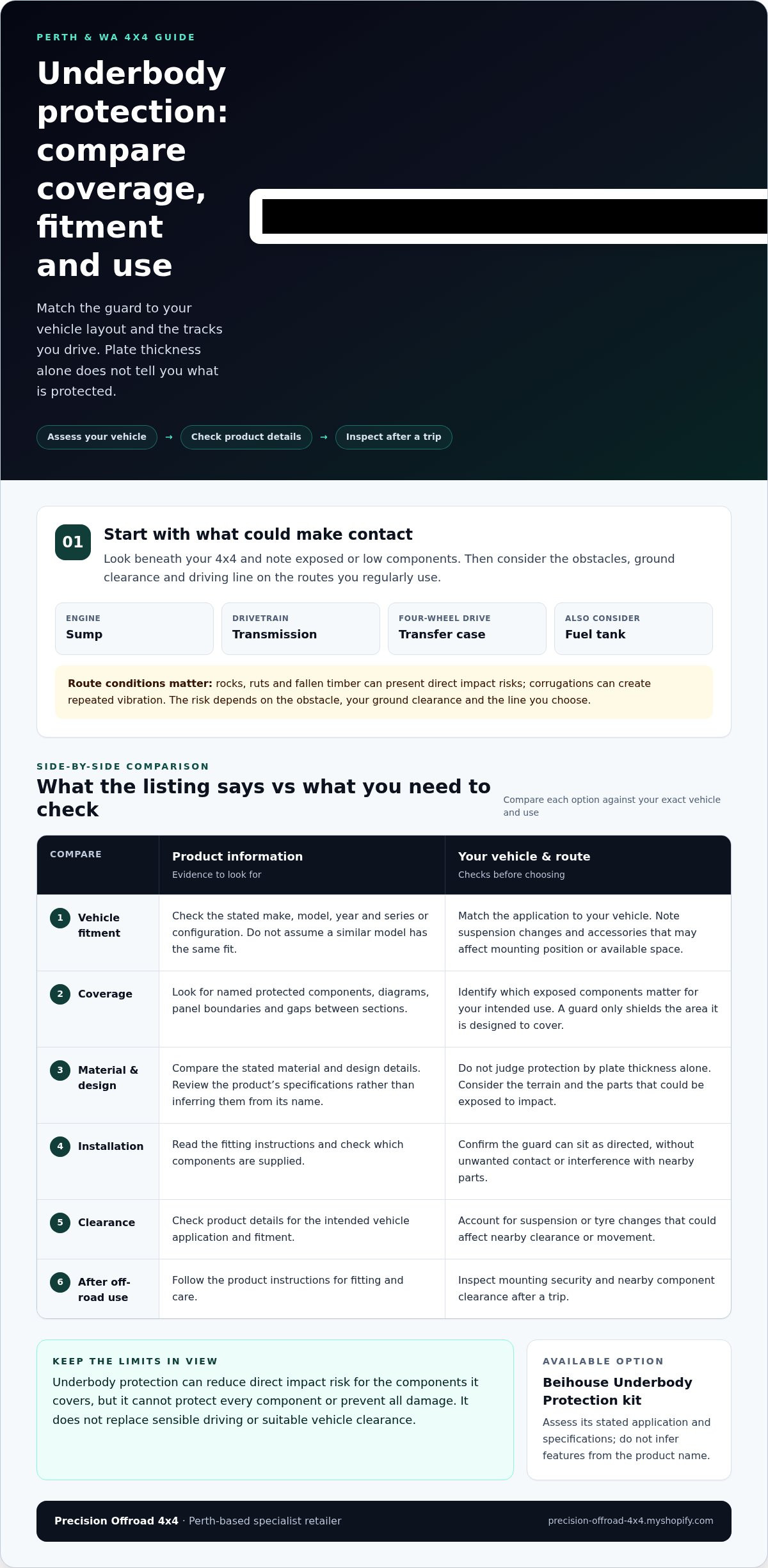
The engine sump, transmission, transfer case and fuel tank can face different risks depending on where they sit beneath your vehicle. A poorly matched guard may also interfere with existing accessories or leave important areas uncovered. Check the product’s stated vehicle application and coverage before comparing materials or design.
This guide explains how to assess coverage, fitment and practical trade-offs for Perth and WA conditions, including rocks, ruts and corrugated roads. You’ll also find a step-by-step approach to inspecting protection after a trip.
Precision Offroad 4x4 is a Perth-based specialist retailer, and the Beihouse Underbody Protection kit is among the available products. Use the guidance below to match protection to your vehicle and intended use, then compare the product information against your priorities.
Key Takeaways
- Choose 4x4 underbody protection Australia setups by matching product coverage to your vehicle’s exposed components and the tracks you drive.
- Compare vehicle fitment, named protected components, stated material and installation method. Don’t judge by plate thickness alone.
- Check whether existing modifications could affect compatibility, mounting or clearance.
- Follow the product instructions and inspect mounting security and nearby component clearance after off-road use.
- Use product information to assess options such as the Beihouse Underbody Protection kit without assuming specifications that aren’t stated.
Why 4x4 underbody protection matters on Australian tracks
Underbody protection is made up of panels or guards fitted beneath a vehicle to shield selected components from impacts and debris. A guard can help prevent a rock, stump or other obstacle from striking the area it covers, but it won’t protect every component or prevent all damage. For a basic explanation of this type of panel, see Skid plate.
The right coverage depends on your 4x4 and how you use it. Ground clearance, component position, suspension changes, other accessories, track surface and driving line all affect the risk of contact. Before comparing 4x4 underbody protection Australia options, inspect the vehicle’s underside and identify the lowest or most exposed components. Then consider which obstacles on your regular routes could reach them.
Which 4x4 components may need protection?
The engine sump sits low on the engine and contains its lubricating oil, so a direct impact can cause serious damage. Further back, the transmission transfers engine power through the drivetrain. In a four-wheel drive, the transfer case directs power to the front and rear drivetrains. The position and exposure of these components vary between vehicle models and configurations.
Don’t assume one layout, or one plate, applies to every 4x4. Start by looking beneath your vehicle and noting exposed areas such as the sump, transmission and transfer case. Prioritise components that are both exposed and relevant to your intended use. A guard’s appearance alone doesn’t tell you what it protects.
How Perth and WA track conditions affect your decision
Trips from Perth can involve very different surfaces, and conditions vary between routes. Corrugations can create repeated vibration through the vehicle, while rocky sections, ruts and fallen timber can present direct impact risks. The obstacle, your ground clearance and the line you choose all affect which parts may be exposed.
Base your decision on the tracks you actually drive. Think about whether you mainly use formed roads or regularly tackle uneven ground and obstacles. Driving technique matters too: wheel placement and speed influence the likelihood and force of contact. No single protection setup suits every route, vehicle or driver.
Use this assessment before comparing products:
- Identify: Note which components sit low or appear exposed on your vehicle.
- Match: Consider the surfaces and obstacles on your regular routes, not only occasional trips.
- Prioritise: Focus on components that are exposed and face a meaningful impact risk during your intended use.
Underbody protection can reduce direct impact risk for the components it covers, but it can’t guarantee your vehicle won’t be damaged. Treat that as a practical limit, not a reason to skip careful route planning. A guard is one part of managing risk. It doesn’t replace sensible driving or suitable vehicle clearance.
How underbody protection works and what it can cover
A protective panel sits between the terrain and the area it is designed to shield. Its position and shape determine how much of that area is covered and where gaps remain. A guard can reduce direct contact with obstacles, but it doesn’t make the underside impervious to damage. The result depends on the product’s design and how accurately it fits the vehicle.
Coverage depends on design and fitment, so check the stated application instead of assuming the product name describes its full reach. Look at product diagrams and details for panel boundaries and gaps between sections. If a kit includes separate guards, check what each piece covers and whether the product description names the areas you want protected.
Protection by component and vehicle layout
Vehicle layout affects the position of underbody components, available mounting points and surrounding space. Vehicles in a similar model range can differ by year, series or configuration, which may change the shape or position of a guard. Compare the exact vehicle application and stated coverage in the product information. A panel designed for a related model may not line up or cover the same area.
Check how the guard sits in relation to nearby parts. It should be fitted as directed and maintain the clearances intended for that vehicle. The product’s listed coverage describes what it is designed to shield. It doesn’t mean every area underneath the vehicle is protected.
Fitment, clearance and existing modifications
Compare your vehicle’s make, model, year and series with the product application. Then account for changes already made to the vehicle, including suspension alterations and accessories that could affect mounting position or available space. These details can influence whether a guard fits as intended, so don’t rely on visual similarity alone.
Review the fitting instructions and supplied components before installation. The guard should sit as directed without unwanted contact or interference with adjacent parts. If your vehicle has tyre or suspension changes, consider whether they affect nearby clearance or movement. For the Beihouse Underbody Protection kit, use the product information to assess its stated application and specifications rather than inferring features from its name. Explore underbody protection options as part of your comparison.
How to compare 4x4 underbody protection options
Product listings can look similar while describing different coverage or vehicle applications. Compare the stated specifications side by side, then weigh those facts against your own selection criteria. A product’s material or broad category doesn’t establish whether it suits your 4x4 or the routes you drive.
Start with vehicle fitment, protected components and intended use. Then compare the stated material and installation method. Record what the product information actually says. If a detail isn’t stated, treat it as unknown rather than guessing from a photograph or another product in the range.
| Comparison point | What to record | Why it matters |
|---|---|---|
| Vehicle fitment | Make, model, year and series named in the product information | Similar vehicles can have different underbody layouts or configurations. |
| Protected components | Each area the product explicitly says it covers | Coverage helps you judge whether the guard addresses your identified exposure. |
| Stated material | Material only when the listing identifies it | Material is one factor, not a substitute for checking fitment and design. |
| Installation method | The supplied instructions and any stated fitting requirements | These indicate how the product is intended to be fitted to the vehicle. |
Material and design: compare stated specifications
Compare materials only when the product information names them. Don’t infer material from a product image or assume one material is best for every vehicle and use. Design and coverage matter too. Material alone doesn’t tell you which components are protected, how the guard fits or how it relates to nearby parts. Treat each specification as a separate comparison point.
Protection can involve trade-offs. Added components may affect vehicle weight or available clearance, so check any stated weight and consider how the guard sits beneath your vehicle. Those effects can vary by product. If a specification isn’t provided, don’t guess. Compare the details that are stated and weigh them against your vehicle’s requirements.
Match coverage to your vehicle and driving
Think about your usual driving in practical terms. Regular road use may lead you to prioritise different coverage from touring on mixed surfaces or tackling more technical off-road routes. Match the product’s stated vehicle fitment and protected components to the areas exposed on your vehicle and the routes you plan to drive. The type of driving alone doesn’t determine the right setup.
Keep your comparison grounded in evidence:
- Confirm the application: Match the listed vehicle details to your own.
- Map the coverage: Note which components are named and which are not.
- Review practical trade-offs: Check stated weight, clearance and installation information.
- Separate fact from advice: Don’t treat general material guidance as a product specification.
For 4x4 underbody protection Australia options, this process helps you compare products without assuming that one guard covers every area. If you’re planning a broader trip setup, the guide to 4x4 accessories for Australian tracks covers equipment beyond underbody protection.
Fitment, Australian compliance and checks after off-road use
A suitable guard still needs to match the vehicle and be fitted according to its instructions. Use a clear sequence: verify the application, review the instructions and supplied components, fit the guard as directed, then inspect it after off-road use. Secure mounting helps keep the guard in its intended position. Adequate clearance is also important because contact with nearby components can cause interference or damage.
What to check before fitting a protection kit
Start with the product’s stated vehicle application. Match the make, model, year and series, then read the supplied instructions and check the listed components. Compare these details with your actual vehicle, including changes that could affect mounting points or clearance. If the product application doesn’t match your configuration, don’t assume the kit will fit as intended.
Account for existing modifications before fitting, including suspension changes, other underbody accessories or altered vehicle components. A suspension change can affect ride height and the space around a guard. If your setup includes suspension upgrades, the 4x4 suspension performance and reliability guide provides related context. Follow the protection product’s own fitting instructions. Don’t substitute guessed bolt sizes, torque settings or mounting methods for the specified procedure.
After fitting, check that the guard is seated as directed and that its mounts appear secure. Look for contact with nearby parts and confirm that the guard doesn’t obstruct components or their movement. If you can’t confirm a safe fit from the instructions, pause rather than forcing parts together. These checks help keep the installation consistent with the product’s intended application.
Post-trip inspection and compliance considerations
After off-road use, park on stable, level ground and let hot components cool before checking underneath. Never go beneath a vehicle supported only by a jack. Inspect the guard and visible mounting points for dents, cracks, loose or shifted parts, and signs of contact with nearby components. Remove mud or debris only where it’s safe, and follow the product’s care instructions.
Watch for new rattles, scraping or visible changes around the guard. If you notice movement, damage or interference, don’t assume the vehicle is ready for another trip until the issue has been assessed. A post-trip inspection doesn’t replace the product instructions, but it can help you spot changes caused by impacts or accumulated debris.
4x4 underbody protection Australia owners should also distinguish accessory fitment from broader vehicle modifications. Don’t assume a guard has the same regulatory status in every configuration. If the work forms part of a wider modification, check current WA Department of Transport requirements for your vehicle and the specific changes before making a compliance decision. Requirements can depend on the modification and vehicle details, so use current guidance rather than relying on a general claim.
Use the listed application and fitting instructions as your reference, then inspect the guard after demanding trips. Explore underbody protection options with your vehicle and intended use in mind.
Choosing underbody protection for your 4x4 in Perth
Once you’ve made a selection, keep a short record of what you chose and why. It gives you a reference if you later change accessories, prepare for a different trip or compare another option. For a Perth-based 4x4, this keeps equipment decisions tied to the WA travel you actually plan, rather than assumptions about a typical local setup.
A practical checklist before selecting a kit
Use this checklist to record your decision and make it easier to review later:
- Save the product information: Keep the listing and fitting instructions with your vehicle records.
- Note your reason for choosing it: Record your intended use and the protection priorities behind your decision.
- Update the record when the vehicle changes: Add relevant accessory or configuration changes so your notes stay useful.
This record doesn’t replace product instructions or current vehicle information. It helps you track the basis for your choice and assess future options against your vehicle’s actual setup.
Explore underbody protection options
The Beihouse Underbody Protection kit is one option available from Precision Offroad 4x4. Use its product information to understand the stated application and specifications, and keep those details with your decision notes. If your planned use changes, revisit your priorities rather than assuming the original choice suits every route or configuration.
Precision Offroad 4x4 is a Perth-owned and operated 4x4 specialist retailer. Explore the available 4x4 products and compare the product information with your vehicle and intended use. Keeping a clear record helps you review your setup as your vehicle and travel plans change.
Make your next trip a better-informed one
Before settling on 4x4 underbody protection Australia options, record your vehicle’s current setup. Note existing accessories and modifications, and keep the product information and fitting instructions with your vehicle records. That gives you a reference if you change the setup later or want to compare the guard’s condition after a demanding trip.
Choose protection based on your vehicle’s needs and intended use, not a broad claim or an assumption about product coverage. Precision Offroad 4x4 is Perth-owned and operated, and the Beihouse Underbody Protection kit is available to assess against its product details and your vehicle requirements.
Ready to compare options? Explore 4x4 protection options and match the available product information to your setup and the WA tracks you plan to drive.
Frequently Asked Questions
What does 4x4 underbody protection protect?
It helps shield the specific underside area named in the product information from direct contact. Check how much of that area the panel covers, including its edges and any gaps. “Underbody protection” doesn’t mean full coverage. Product descriptions and diagrams can help you judge what remains exposed.
Do I need underbody protection for a 4x4 in Australia?
Not every 4x4 owner needs the same setup. Consider how often your driving brings the vehicle into contact with obstacles, whether you can avoid those sections and the consequences of damage disrupting a trip. A driver who sticks to formed roads may weigh the decision differently from someone planning remote travel. Treat protection as one part of trip preparation, alongside route choice and driving within your vehicle’s limits.
Are bash plates and underbody protection the same thing?
The terms are often used for similar protective equipment, but a listing may use “bash plate” for one panel and “underbody protection” for a broader product or group of panels. The wording doesn’t establish what’s included. Read the product description and contents information to see whether it covers one guard or multiple pieces. Similarly named listings may have different coverage.
How do I know whether an underbody protection kit fits my 4x4?
Match the product application to your vehicle’s precise variant, not just its badge or model family. Drivetrain, factory options and later modifications can affect the underside layout. If the product information distinguishes variants, follow that distinction. Keep your vehicle details and relevant modification records handy while comparing listings. Fitment for a similar vehicle isn’t proof of compatibility with yours.
Can underbody protection affect ground clearance or vehicle weight?
It may affect both, depending on the product and where it sits. Added mass also uses part of the vehicle’s available payload, alongside passengers, luggage and other accessories. Consider the fully loaded vehicle rather than the guard in isolation. If the product information gives a weight figure, include it in your load planning. If it doesn’t, avoid estimating from appearance and compare the specifications that are stated.
How should I inspect underbody protection after a trip?
Take photos of the guard before its first trip, then compare them with photos after travel over rough sections. This can help you distinguish a new mark from an existing one and spot changes in position over time. Note where an impact occurred and whether the same route or obstacle may challenge the vehicle again. Follow the product’s care instructions when cleaning or checking it.
Do underbody modifications need approval in Western Australia?
There isn’t a single answer based only on the phrase “underbody protection”. The relevant question is whether the specific work changes the vehicle in a way covered by WA modification requirements. Check current Western Australian Department of Transport guidance for the accessory and any related vehicle changes. Keep the product information and details of other modifications available so you can assess the complete configuration, not just the guard on its own.