

Could a bigger tyre make your 4x4 less capable? Choosing 4x4 wheel and tyre packages Perth drivers can rely on starts with fitment, load and intended use, not appearance alone. Changes to wheel offset, tyre size and construction can affect clearance, handling and wear, so assess the whole setup before you choose.
This guide covers the details to check: your vehicle’s wheel specifications, wheel‑arch clearance, load‑carrying capacity and the conditions you drive in. You’ll also learn how all-terrain, mud-terrain and Rugged Terrain (R/T) tyres suit different uses, and how wheel and tyre changes can interact with suspension geometry.
Compliance matters too. In WA, suspension, tyre and body lifts count towards a combined 50mm threshold before engineering certification is required. Precision Offroad 4x4 is a Perth-based specialist retailer for wheel upgrades and Maxxis tyres, with authorised Dobinsons suspension options. Use the checks below to compare fitment, capability and compliance for your 4x4.
Key Takeaways
- Start with your vehicle’s specifications and existing modifications, then assess tyre size, wheel width, offset and wheel‑arch clearance together.
- Consider how increased unsprung mass may affect suspension response before choosing a heavier wheel-and-tyre setup.
- Compare A/T, M/T and Rugged Terrain (R/T) tyres against the roads and tracks you drive, balancing tread choice with noise and traction needs.
- Check your driving needs, fitment and compliance before settling on 4x4 wheel and tyre packages Perth drivers can use with confidence.
- Precision Offroad 4x4 offers wheel upgrades and Maxxis tyres to help you build a setup around your vehicle and intended use.
What makes a suitable 4x4 wheel and tyre package in Perth?
A wheel and tyre package pairs wheels and tyres selected for a specific vehicle. The right combination depends on your 4x4’s specifications, how you drive, the loads it carries and any existing modifications, as well as the appearance you want.
A setup chosen on looks alone can cause problems if the tyre contacts the bodywork, the wheel changes the vehicle’s track, or the components don’t suit the vehicle’s load requirements. Assess 4x4 wheel and tyre packages Perth drivers are considering against the individual vehicle, rather than treating one fitment as universal.
Start with your 4x4 and how you use it
Record your vehicle’s make, model and year, along with its current wheel and tyre specifications. Note modifications such as a suspension lift or bull bar, since they can affect available clearance and how the vehicle sits under load. A fitment used on a similar-looking 4x4 is not proof that it will suit yours.
Then describe how you use the vehicle. A daily commuter that occasionally travels on gravel has different priorities from a touring rig that regularly carries camping gear or a 4x4 used on demanding off-road tracks. General information about off-road tyre types can help explain tread differences, but your regular driving conditions should guide the choice.
- List regular occupants, accessories, tools and touring equipment.
- Separate everyday driving from the conditions you encounter on trips.
- Include modifications that may affect suspension height, clearance or weight.
Regular loads matter because they affect the vehicle’s load-carrying capacity: the weight it can safely support, considering its suspension, chassis and braking system. Compare wheel and tyre load ratings with your vehicle requirements and the loads you actually carry.
What a matched wheel and tyre setup needs to do
A suitable setup must fit and function through normal steering and suspension movement. Wheel‑arch clearance is the space between the tyre sidewall and the vehicle’s inner wheel arch, needed to prevent tyre scrub. Clearance can change as the suspension compresses or the wheels turn, so a check with the vehicle parked may not reveal every potential contact point.
Wheel track is the distance between the left and right wheels on the same axle. Changing wheel offset can move the tyres inwards or outwards, affecting clearance and legal tyre poke. A wider stance may change the vehicle’s appearance, but appearance alone doesn’t show whether the fitment is suitable or compliant.
Wheel diameter and width must also suit the selected tyre. Treat fitment examples as a starting point, then verify the wheel and tyre specifications against your exact vehicle and its existing modifications. This helps catch details a generic size recommendation may miss.
Wheel and tyre fitment in Perth: the technical factors that affect your rig
Wheel and tyre fitment is a system, not a matter of choosing a tyre diameter or wheel style in isolation. Tyre dimensions, wheel width and offset all influence where the tyre sits and how much room it has to move. A setup that clears the guard while parked may still contact the body or suspension during steering or compression.
When comparing 4x4 wheel and tyre packages in Perth, start with your exact vehicle specification, including fitted accessories and suspension changes. Similar models can differ, so a size that works on one rig doesn’t establish compatibility on another.
Wheel size, offset and clearance explained
Offset describes the wheel’s mounting face in relation to its centreline. Changing the offset moves the wheel and tyre inwards or outwards. That shift can reduce clearance to suspension components on the inside, or to guards and bodywork on the outside. Wheel width matters too: a wider rim changes the tyre’s position and profile, so assess it alongside the tyre’s actual dimensions.
Check clearance through steering and suspension movement, not only with the vehicle stationary and the wheels straight ahead. Consider possible contact at the inner guard, suspension components and bodywork. A wheel change can also alter wheel track, the distance between the left and right wheels on an axle. Check any track change against applicable WA requirements rather than assuming a particular offset is compliant.
Verify the specifications for your individual vehicle and the full combination of wheel, tyre and modifications. A generic fitment chart can narrow the options, but it can’t account for every difference in vehicle equipment or setup.
Tyre, suspension and handling interactions
A larger or heavier wheel-and-tyre combination increases unsprung mass, the weight of components not supported by the suspension. Added unsprung mass can affect how quickly the suspension responds to road inputs. The effect depends on the vehicle and its components, so don’t assume a heavier setup will behave like the original.
Tyre dimensions and wheel position can also influence steering feel and handling. A suspension lift changes ride height and can affect wheel alignment angles. Caster angle, the forward or backward tilt of the steering axis, contributes to directional stability and steering feel. Depending on the vehicle and lift, suspension geometry correction may be needed to restore suitable alignment. Some setups may call for upper control arms (UCAs), adjustable front suspension arms that allow caster and camber correction. They are not a universal requirement.
A professional wheel alignment is mandatory after any suspension or tyre change. Precision Offroad 4x4 can match wheel upgrades and Maxxis tyres to your vehicle, intended use and fitment requirements.
A/T, M/T or R/T tyres: compare options for Perth roads and tracks
Tread choice is a practical compromise between the roads you drive most and the terrain you want to tackle. All-terrain (A/T), mud-terrain (M/T) and Rugged Terrain (R/T) tyres have different tread designs, which affect road noise and traction in particular conditions. No one category suits every Perth driver or track.
Start with your regular routes. A 4x4 used for commuting and occasional gravel travel has different priorities from one that often encounters muddy or rough off-road sections. Tyre size, load rating and fitment must also suit your vehicle. Consider these alongside tread type when comparing 4x4 wheel and tyre packages in Perth.
When all-terrain tyres may suit your driving
A/T tyres are worth considering if your 4x4 splits its time between sealed roads and off-road travel. They offer a tread design intended for mixed use, but the balance between road manners and off-road traction varies between models. Consider the surfaces you encounter most, how often you leave sealed roads and your tolerance for road noise.
The Maxxis RAZR AT811 is an all-terrain tyre model described as offering a quiet ride on highways and good traction in deep ruts. Treat those attributes as a guide to intended use, not a guarantee for every vehicle, load or track. Check the tyre’s specifications against your vehicle’s requirements, including its load rating. An A/T tread doesn’t remove the need to assess fitment.
When mud-terrain or Rugged Terrain tyres may suit
M/T tyres may suit driving that regularly involves muddy or demanding off-road conditions. Their more aggressive tread is designed with off-road traction in mind, but can involve trade-offs on sealed roads, including increased tread noise. Factor in your daily commute, touring distance and time spent off-road.
Rugged Terrain (R/T) tyres combine the centre tread of an A/T with the aggressive shoulder blocks of an M/T. This hybrid design aims to balance road noise and off-road grip. It may suit drivers who want a more aggressive tread and shoulder design than an A/T, without choosing a full M/T pattern. Suitability still depends on the tyre model, vehicle and driving conditions.
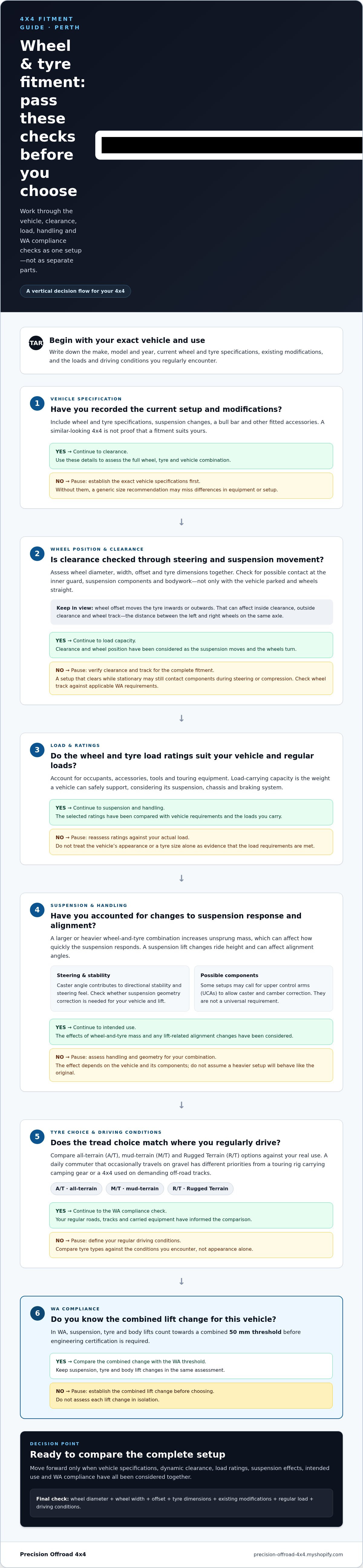
How to choose 4x4 wheel and tyre packages in Perth without overlooking compliance
Work from your driving needs to vehicle-specific fitment, then check compliance. Each step informs the next: a wheel or tyre that looks suitable on paper still needs to work with your vehicle’s existing setup and applicable requirements. Don’t base your choice on appearance or a fitment example from another vehicle.
A practical fitment checklist before you decide
Record your vehicle’s make, model and year, current wheel and tyre sizes, suspension changes, accessories and typical loads. Assess wheel-arch clearance and potential tyre scrub through steering and suspension movement. Then compare tyre construction and load requirements with your vehicle and use, from commuting to touring and off-road travel. This gives you a clear basis for reviewing options before purchase.
Work through the decisions in order:
- Define your use. Note the balance between sealed-road driving, gravel travel and off-road conditions, along with the loads you regularly carry.
- Identify your vehicle. Record its exact model and year, current wheel and tyre specifications, and existing modifications.
- Assess fitment. Review wheel width, offset and tyre dimensions together, including clearance at steering lock and through suspension movement.
- Compare tyre types. Choose a tread pattern and construction suited to your regular driving, traction needs and load requirements.
- Verify compliance. Check the proposed combination against current WA requirements and applicable Australian Design Rules for your vehicle and modifications.
Compliance, certification and post-fitment checks
Requirements depend on the vehicle and the changes being made. A tyre, wheel or suspension modification can affect several fitment factors, so check current WA Department of Transport guidance and applicable Australian Design Rules before finalising specifications. Guard clearance alone, or a similar 4x4 using the same setup, doesn’t establish compliance.
Review the complete vehicle setup when wheel and tyre changes are combined with a suspension lift or other modifications. This helps identify how the parts interact and whether the proposed changes need assessment or certification. Where a certified modification requires a modification plate, the plate records that the modification has been certified. Precision Offroad 4x4 holds Licensed Vehicle Modifier certification. That status doesn’t mean every modification is automatically approved; requirements depend on the vehicle and work involved.
A professional wheel alignment is mandatory after any suspension or tyre change. Alignment checks set wheel angles to the vehicle’s specifications and provide a baseline for assessing steering and tyre wear. For a vehicle-specific review of wheel and tyre fitment, discuss your 4x4 setup with Precision Offroad 4x4.
Find a Perth 4x4 wheel and tyre setup with Precision Offroad 4x4
Precision Offroad 4x4 is a Perth-owned and operated 4x4 specialist retailer. We offer wheel upgrades and Maxxis tyres selected for 4x4 owners looking to match their setup to their vehicle, driving and fitment requirements. Start with the details of your rig, not a one-size-fits-all package. A combination suited to highway driving and touring may not suit a vehicle used regularly on rough tracks.
What to bring into your setup discussion
Have your vehicle’s make, model and year ready, along with its current wheel and tyre sizes. Note any suspension changes, accessories and modifications that could affect fitment. Knowing what is already fitted makes it easier to focus on your vehicle’s actual requirements.
Describe your usual driving and the conditions you want your 4x4 to handle. Include daily road use, planned touring or off-road travel, and the loads you typically carry. Be specific about the balance: for example, whether gravel roads are an occasional part of a trip or a regular part of your driving. Those details help narrow down suitable wheel and tyre options without choosing by appearance alone.
- Your vehicle details and existing wheel and tyre specifications
- Suspension changes and other modifications
- Typical loads, regular road use and intended off-road conditions
Include fitment and compliance checks in your decision. The proposed combination needs to work with the vehicle as a whole, including its wheels, tyres and any suspension changes. If suspension is part of your plans, Precision Offroad 4x4 is an authorised Dobinsons and Fulcrum retailer. A suspension choice can affect the overall setup, but it isn’t automatically part of a wheel and tyre package.
Explore wheel upgrades and Maxxis tyres
Precision Offroad 4x4 offers wheel upgrades and Maxxis tyres for 4x4 owners configuring a setup around their vehicle and intended use. The Maxxis RAZR AT811 is one all-terrain option to consider when comparing tyre types. Your choice depends on vehicle requirements, driving conditions and how the components fit together.
Bring your vehicle details and priorities into the discussion, then explore the range with those needs in mind. This is a more useful starting point than relying on a generic fitment example. For 4x4 wheel and tyre packages Perth drivers can compare against their vehicle and intended use, Explore Precision Offroad 4x4.
Plan your next 4x4 upgrade with fitment in mind
Your wheel and tyre choice can shape future upgrade options. Before settling on a setup, note any changes you’re planning, such as suspension upgrades or added touring equipment. Planning ahead helps you sequence upgrades and consider how each change affects the others.
Keep a record of your vehicle’s configuration as it changes. That history helps you assess later upgrades against what’s already fitted and understand how one decision affects the next. A considered plan makes it easier to adapt your 4x4 to new travel plans without selecting components in isolation.
When you’re ready to plan your next step, explore options for your 4x4. Bring your vehicle details and plans to Precision Offroad 4x4 to compare wheel upgrades, Maxxis tyres and suspension options for your setup.
Frequently Asked Questions
Can I fit larger tyres to my 4x4 in Western Australia?
Possibly, but the suitable size depends on your vehicle and the complete modification. Before comparing 4x4 wheel and tyre packages in Perth, check the manufacturer’s information for your exact model and year, including any optional tyre sizes. Consider tyre diameter as well as width, and note whether your vehicle already has suspension or body modifications. Check current WA Department of Transport guidance for your circumstances.
Do I need a wheel alignment after changing my 4x4 tyres?
Yes. A professional wheel alignment is mandatory after any suspension or tyre change. Keep the alignment results with your vehicle records, particularly if your 4x4 has other modifications. After driving, check the tread for uneven wear and note any steering change or vibration. These observations can help flag a concern, but they don’t replace an alignment check or an inspection if something feels wrong.
Will new wheels and tyres affect my 4x4’s handling?
They can, so assess the vehicle after fitting rather than relying only on how it felt before. On a familiar, low-traffic route, note any new vibration, rubbing sounds or change in steering response. If safe, repeat your observations with the vehicle carrying its usual touring load. If you notice a problem, stop using the vehicle until the cause has been checked.
Are all-terrain tyres suitable for everyday driving around Perth?
They may be, but check the specific tyre’s information rather than relying on the A/T label. Review the manufacturer’s guidance on road use, noise and load rating, then compare it with your vehicle handbook and normal driving. Maintain pressures according to the vehicle or tyre manufacturer’s instructions, and inspect tread condition regularly. Both your commuting pattern and the tyre model matter.
What is the difference between A/T, M/T and R/T tyres?
Can a wheel and tyre change affect vehicle compliance?
Yes. Before fitting a different combination, record the current and proposed wheel and tyre specifications, along with details of existing modifications. Use those details when checking applicable WA requirements and Australian Design Rules. Keep product information and relevant certification records with your vehicle documents. This record helps identify what was fitted if the vehicle is assessed or you plan further modifications.