

What if the most aggressive tyre isn’t the right choice for your next beach trip? The best 4x4 tyres for sand driving depend on more than tread pattern. Your vehicle’s weight, touring load, tyre pressure and the sealed roads you drive between tracks all affect how a setup performs.
It’s worth comparing A/T, M/T and R/T tyres if you want sand traction without adding unnecessary road noise or compromising everyday handling. Incorrect pressure, unexpected load or a tyre size that hasn’t been checked for fitment can also create problems.
This Perth buyer’s guide compares the main tyre types and the practical factors to consider for WA trips. You’ll learn what to check in tread design and light truck (LT) construction, how to approach pressure and load, and why clearance, handling and Australian requirements matter before changing size. We’ll also look at the Maxxis RAZR AT811 as one model to assess against your vehicle and use, not a universal answer. Precision Offroad 4x4 is a Perth-based specialist retailer, and the focus here is choosing a compatible setup for the way you drive.
Key Takeaways
- The best 4x4 tyres for sand driving depend on your vehicle, touring load and how often you drive on sealed roads.
- Compare A/T, M/T and Rugged Terrain (R/T) tyres by their sand use, road manners, noise and trade-offs before choosing a tread style.
- Check your vehicle’s approved tyre size and load requirements, then assess wheel-arch clearance and wheel track before changing fitment.
- Set tyre pressures using your vehicle and tyre-maker guidance, then assess how the 4x4 responds to the sand and its load.
- Consider the Maxxis RAZR AT811 against your own fitment and driving needs rather than assuming one model suits every sand trip.
What makes a 4x4 tyre suitable for sand driving?
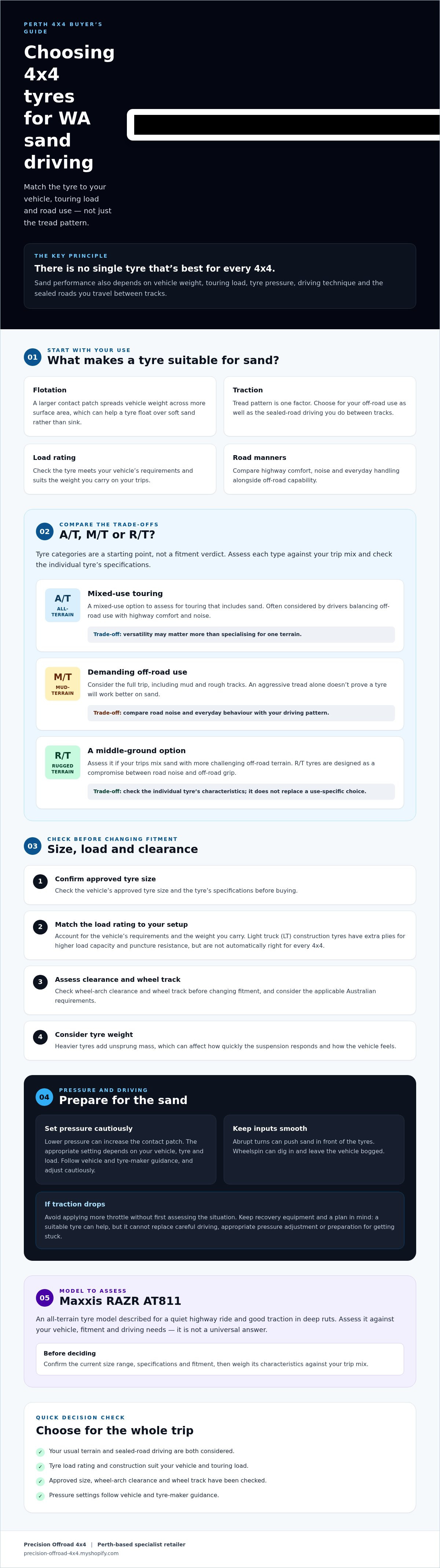
A suitable sand tyre balances flotation, traction, load rating and road manners for your vehicle and trips; there is no single tyre that’s best for every 4x4. Tread matters, but so do vehicle weight, touring load, tyre pressure and driving technique. Choose a tyre that suits soft sand and remains appropriate for the roads you travel to reach it.
Tyre choice is only one part of a suitable setup. Check that the tyre’s load rating meets your vehicle’s requirements and suits the weight you carry. Keep recovery equipment and a plan in mind, too—for heavy vehicle transport and recovery support across WA, visit Allout Towing. A suitable tyre can help, but it can’t replace careful driving, appropriate pressure adjustment or preparation for getting stuck.
How sand changes the tyre’s job
Soft sand can give way beneath a heavily loaded tyre. A larger contact patch spreads the vehicle’s weight over more surface area, which can help the tyre float across the sand rather than sink into it. Lowering pressure can increase the contact patch, but the appropriate setting depends on your vehicle, tyre and load. Follow vehicle and tyre-maker guidance, and adjust cautiously.
Keep steering inputs smooth. Abrupt turns can push sand in front of the tyres, while wheelspin can dig them in and leave the vehicle bogged. If traction drops, avoid applying more throttle without first assessing the situation. General features of Off-road tyres include tread and construction suited to unpaved surfaces, but a broad category description doesn’t guarantee performance on every type of sand.
Which tyre traits should you compare?
Look beyond an aggressive tread appearance. Compare tread pattern and sidewall construction with your usual terrain, expected load and time on sealed roads. A pattern suited to mixed off-road use may work for a touring 4x4 that spends much of its time on-road; a more specialised tyre may involve different noise and handling trade-offs.
- Tread pattern: Consider how the tread suits your off-road use as well as sealed-road driving.
- Sidewall construction: Match construction to the demands of your trips and the vehicle’s load.
- Load rating: Check it against your vehicle’s requirements and the weight you carry.
- Tyre weight: Heavier tyres add unsprung mass, which can affect how quickly the suspension responds and how the vehicle feels.
Light truck (LT) construction tyres have extra plies to support higher load capacity and puncture resistance, which may suit a heavy-duty touring setup. They’re not automatically the right choice for every 4x4. Consider the tyre’s load requirements alongside its weight and intended road use, then assess the complete setup rather than choosing by construction or tread alone.
A/T, M/T or R/T: which 4x4 tyre type suits sand?
Tyre categories are a starting point, not a fitment verdict. The best 4x4 tyres for sand driving for your setup depend on how often you travel on sand, what other terrain you tackle and how much sealed-road driving you do. A tread label alone can’t confirm suitability for your vehicle or a particular trip. Compare the tyre’s specifications and intended use, then check fitment for your 4x4.
| Tyre type | Sand use | Sealed-road use and noise | Typical trade-off |
|---|---|---|---|
| All-terrain (A/T) | A mixed-use option to assess for touring that includes sand. | Often considered by drivers balancing off-road use with highway comfort and noise. | Versatility may matter more than specialising for one terrain. |
| Mud-terrain (M/T) | Consider it in the context of trips that also involve mud and rough tracks; an aggressive tread alone doesn’t prove it will work better on sand. | Compare road noise and everyday behaviour against your tolerance and driving pattern. | A stronger focus on demanding off-road use may mean different on-road compromises. |
| Rugged Terrain (R/T) | A middle-ground option to assess if your trips mix sand with more challenging off-road terrain. | Designed as a compromise between road noise and off-road grip, but check the individual tyre’s characteristics. | It sits between A/T and M/T priorities rather than replacing a use-specific choice. |
All-terrain tyres for mixed touring
If your 4x4 covers long sealed-road distances between beaches or tracks, weigh highway behaviour and noise alongside off-road capability. The Maxxis RAZR AT811 is an all-terrain model to assess against those priorities. Confirm the current size range, specifications and fitment before selecting it; don’t assume a size or performance characteristic from the model name alone.
Mud-terrain and Rugged Terrain tyres on sand
M/T tread patterns are aimed at off-road use, but an aggressive appearance doesn’t guarantee better flotation or traction on sand. Consider how often you encounter mud and rough terrain, then weigh those needs against highway noise and everyday driving. Rugged Terrain (R/T) tyres are hybrid tyres combining the centre tread of an A/T with aggressive shoulder blocks of an M/T, offering a compromise between road noise and off-road grip. For a broader overview of the category differences, see this A/T and M/T tyre comparison.
There’s no universal winner. Choose by matching tyre type to your vehicle, terrain mix and road-use priorities. A Perth-based fitment discussion can help you assess Maxxis tyres and wheel upgrades against your requirements.
Check tyre size, load and clearance before buying in Perth
A tyre that suits sand in theory still needs to fit your 4WD, carry its load and meet applicable requirements. Before choosing a size, check the vehicle’s tyre placard and manufacturer information. Then confirm the tyre’s size, construction and load rating with a qualified tyre or vehicle specialist. This is particularly important if your 4WD carries accessories, passengers and touring gear, as their combined weight uses part of its load-carrying capacity.
A changed tyre or wheel fitment can affect clearance and handling, and an oversized or improperly fitted tyre may raise compliance and warranty concerns. Check the vehicle manufacturer’s warranty wording for your specific modification. A manufacturer may reject a claim if a non-compliant or improperly installed modification contributed to the failure.
Match tyre specifications to the 4WD
Start with the approved tyre sizes and load requirements for your vehicle. Don’t assume a tyre is suitable just because it fits the rim or has a higher load rating. Consider the vehicle’s usual load, including occupants, accessories and trip gear, and confirm that the chosen tyre and wheel combination is appropriate. If you’re comparing larger sizes for sand trips, have the full fitment checked before purchasing.
For background on how wheel choice and fitment interact, read this technical guide to 4x4 wheel upgrades.
Check clearance and Australian requirements
Wheel-arch clearance is the space between the tyre sidewall and the inner wheel arch. Check for potential contact through steering and suspension movement, not only when the vehicle is parked on flat ground. Tyre scrub can damage the tyre or vehicle, particularly when the steering is turned or the suspension compresses.
Wheel track is the distance between the left and right wheels on the same axle. A change in wheel offset can alter wheel track, affect clearance and push the tyre closer to or beyond the bodywork. Make sure the tread remains covered by the vehicle’s bodywork or securely fitted flares, and check the complete wheel-and-tyre combination rather than considering tyre width alone.
In WA, vehicle modifications are administered by the Department of Transport, with Vehicle Standards Bulletin 14 (VSB 14) providing a national modification framework. The applicable limits depend on vehicle eligibility and the proposed change. For eligible off-road 4WDs, the research guidance describes a maximum 50 mm overall diameter increase above the manufacturer’s largest specified optional tyre without certification, and up to 50 mm total wheel track increase. Confirm current requirements with WA Department of Transport before changing size. Complex modifications may require approval in principle before work starts. These checks help you choose the best 4x4 tyres for sand driving without overlooking fitment or compliance.
Set up tyre pressures and prepare your 4x4 for WA sand
There’s no single pressure setting that suits every 4WD, tyre and load. Before adjusting, check the vehicle and tyre-maker guidance, consider how much weight you’re carrying, and assess the sand and track conditions. Even the best 4x4 tyres for sand driving need a pressure setup that’s appropriate for your vehicle and trip.
A practical pressure-adjustment sequence
- Check the conditions: Confirm the surface and route, and make sure your vehicle is carrying its expected trip load. Check the relevant land manager’s current access advice before setting off.
- Use the right guidance: Refer to the vehicle and tyre-maker recommendations before changing pressure. Don’t rely on a universal figure or copy another vehicle’s setting.
- Adjust in measured steps: Make a cautious change, then travel slowly in a suitable area and reassess traction, steering and tyre behaviour. Continue only if the vehicle remains controlled.
- Stop if something’s wrong: If a tyre looks damaged, feels unstable or appears at risk of coming off the rim, stop in a safe place. Don’t continue driving on it.
Pressure changes affect how the tyre supports the vehicle. Be cautious, especially with a heavily loaded 4WD, and reassess if the surface, load or vehicle response changes.
Prepare for reinflation and the drive out
Carry a suitable compressor and an accurate pressure gauge, and know how to use both before you reach the sand. After your drive, reinflate the tyres to the vehicle and tyre-maker guidance before returning to sealed roads. Check each tyre with the gauge, then check pressures again after reinflation. Don’t rely on a quick visual check.
Plan the route as well as the tyre setup. In WA parks and on beaches, vehicles must stay on designated roads and tracks; driving on dunes is prohibited except at marked crossing points. Access permits are required in many parks, reserves and designated recreation areas, so confirm the rules and current conditions with the relevant land manager before travelling.
Tyres are one part of the vehicle’s overall setup. If suspension changes are also on your list, read this 4x4 suspension performance and reliability guide to understand how suspension setup fits into the wider build. You can also review tyre and wheel options when comparing your setup.
Choose the right sand-driving tyres with a Perth 4x4 specialist
The right choice comes from matching the tyre to your vehicle and how you use it, not from picking the most aggressive tread. Consider your 4WD’s approved fitment, typical loaded weight, how often you drive on sand and how many touring or everyday kilometres you cover on sealed roads. These priorities help narrow down the best 4x4 tyres for sand driving for your setup.
The Maxxis RAZR AT811 is an all-terrain model to assess if you want to compare a mixed-use option. Don’t assume a particular size will fit or suit your vehicle based on the model name. Check its current specifications, available sizes and fitment against your vehicle before making a decision.
Use this checklist before you decide
Have the key details ready before comparing tyres. This makes it easier to discuss fitment and intended use with a specialist.
- Vehicle and current setup: Record your 4WD’s make and model, current tyre size, wheel details and any relevant modifications.
- Trip load: Note your typical loaded weight, including passengers, accessories and touring gear. A tyre needs to meet the vehicle’s requirements for the load you carry.
- Driving mix: Estimate how your use divides between sand trips, touring kilometres, other off-road terrain and everyday sealed-road driving.
- Fitment checks: Confirm tyre specifications, wheel-arch clearance and wheel track for the proposed wheel-and-tyre combination.
- Requirements and warranty: Verify the current vehicle requirements that apply to your proposed fitment. Read the vehicle manufacturer’s warranty terms and ask how a modification could affect relevant claims.
Don’t leave those checks until after purchase. A tyre that suits your preferred tread category still needs to be compatible with the vehicle, wheel and intended load.
Get local fitment advice for your 4WD
A Perth 4x4 specialist can help you review tyre compatibility against your vehicle details and the way you travel. Ask them to confirm the proposed tyre’s current specifications and size availability, then check that the complete fitment meets applicable requirements. Precision Offroad 4x4 is a Perth-based specialist retailer offering Maxxis tyres and wheel upgrades.
For broader trip planning, see this guide to essential 4x4 accessories for Australian tracks. When you’re ready to compare options, explore 4x4 tyres and upgrades with Precision Offroad 4x4. Check fitment, specifications and warranty implications before you commit to a new setup.
Choose a setup that’s ready for your WA trips
The best 4x4 tyres for sand driving are those that suit your vehicle, typical load and mix of beach, touring and sealed-road use. Compare A/T, M/T and R/T priorities, then confirm tyre size, load rating and clearance before changing your setup. Pressure choice and careful driving still matter once you reach the sand.
The Maxxis RAZR AT811 is one all-terrain model to assess against your vehicle and intended use. Check its current specifications and fitment, and review any relevant warranty conditions before you buy. Precision Offroad 4x4 is a Perth-based specialist retailer offering Maxxis tyres and wheel upgrades.
Explore 4x4 tyres and upgrades with Precision Offroad 4x4 as you compare options for your rig. Check the details before purchase so your setup reflects the way you actually drive on WA trips.
Frequently Asked Questions
Are all-terrain tyres good for sand driving?
Yes, an all-terrain (A/T) tyre can suit sand driving if its size, load rating and construction are appropriate for your 4WD. A/T tyres are often considered by drivers who need one tyre for a mix of sealed roads and off-road trips. Sand performance still depends on vehicle load, pressure, surface conditions and driving technique. Check the tyre’s specifications and fitment rather than choosing by the A/T label alone.
Should I use mud-terrain tyres on sand?
You can use mud-terrain (M/T) tyres on sand, but an aggressive tread pattern doesn’t guarantee better traction or flotation there. Consider how often your trips involve mud and rough tracks, then weigh those needs against sealed-road noise and handling. If sand is your main off-road use, compare suitable options against your vehicle and load instead of assuming an M/T is the best choice.
What tyre pressure should I use for sand driving?
There isn’t one pressure figure that’s right for every 4WD, tyre and load. Follow the guidance from your vehicle and tyre makers, and consider the sand conditions and weight you’re carrying. Make cautious adjustments, then assess traction, steering and tyre behaviour at low speed in a suitable area. Carry a pressure gauge and compressor, and reinflate to the recommended road pressures before returning to sealed roads.
Are light truck tyres better for 4WD sand driving?
Not automatically. Light truck (LT) construction tyres have extra plies for higher load capacity and puncture resistance, which may suit a heavily loaded touring vehicle. However, check the tyre’s load rating against your vehicle requirements and consider how tyre weight affects unsprung mass and vehicle response. Choose based on your actual load and driving needs, not the LT marking alone.
Can I fit larger tyres to my 4WD for sand?
Possibly, but confirm the proposed size is suitable for your vehicle and complies with current requirements before buying or fitting it. Check the approved tyre information, load rating, wheel-arch clearance and wheel track. A size change can affect handling and may have warranty implications, particularly if a modification contributes to a component failure. In Perth, check applicable requirements with the WA Department of Transport or a qualified vehicle specialist.
Is the Maxxis RAZR AT811 suitable for sand driving?
The Maxxis RAZR AT811 is an all-terrain tyre model to assess for your vehicle and driving mix, but it shouldn’t be treated as a guaranteed best sand tyre. Confirm its current specifications and available sizes, then check load rating and fitment against your 4WD. Your load, pressure setup, sand conditions and sealed-road priorities all affect whether it’s an appropriate option for your trips.
What should I carry when driving a 4WD on sand?
Carry a suitable air compressor and pressure gauge so you can adjust and check tyre pressures, then reinflate before travelling at road speeds. Take recovery equipment appropriate to your vehicle and know how to use it. Before leaving Perth, check access rules and current conditions with the relevant WA land manager. In parks and on beaches, follow designated roads and tracks, and observe any permit requirements that apply to your destination.
Explore Maxxis tyres and wheel upgrades from Precision Offroad 4x4 when comparing options for your Perth-based 4x4 setup.