

What if the best off road suspension for daily driver use isn’t the setup with the tallest lift? For a 4x4 that handles weekday traffic and occasional WA tracks, spring rate and shock absorber tuning matter as much as ride height. The right choice depends on how you use and load your vehicle.
If you’re weighing up spring and shock options, consider more than off-road capability. A bull bar, canopy, drawers or touring gear can change vehicle weight and handling, while a lift can affect suspension geometry and tyre clearance. Choose for your regular payload, not just the occasional trip.
This guide compares suspension options by ride comfort, load-carrying capacity and handling, then explains the geometry and compliance checks to consider in WA. You’ll learn what to assess before selecting a kit, including how accessories affect the setup and why tyre size and wheel-arch clearance matter. Precision Offroad 4x4 is a Perth-based specialist retailer of Dobinsons and Fulcrum suspension. Confirm exact vehicle fitment and current WA requirements for your proposed modifications before buying.
Key Takeaways
- Choose the best off road suspension for daily driver use by matching spring rates and shock absorbers to your vehicle, regular load and driving routine.
- Compare standard-height, mild-lift and heavier-load options by their likely ride and handling trade-offs, then check the specifications for your vehicle.
- Assess Dobinsons and Fulcrum kits by confirmed fitment and intended load. Don’t assume one brand or setup suits every 4x4.
- Before choosing a lift or tyre combination, confirm current WA compliance requirements for your exact vehicle and proposed modifications.
- Use a practical shortlist of vehicle details, accessories, typical payload and routes when comparing options with a retailer.
What makes off-road suspension suitable for a daily driver?
Balanced daily-driver suspension supports your vehicle’s regular load, controls body movement on sealed roads and suits the off-road conditions you expect to encounter. It should work with your vehicle and driving routine, not just provide extra ride height.
A suspension kit is a collection of springs, shocks, hardware and sometimes control arms designed to change ride height and handling. Springs support the vehicle’s weight and influence how it sits under load. Shock absorbers control spring movement and help manage how the vehicle responds after a bump. Together, these parts affect comfort, stability and load support.
There’s no single setup that suits every 4x4. Your usual commute, passengers, accessories, cargo and off-road routes all influence the right spring and damping combination. Daily-road priorities may include controlled handling and comfort over uneven urban roads. Track priorities may place more emphasis on clearance, durability and managing repeated bumps or corrugations. The right balance depends on how you use your vehicle.
How does suspension affect everyday comfort and control?
Matching springs and shock absorbers helps limit excessive body movement over bumps and corrugations. A spring that doesn’t suit the vehicle’s weight may sit or respond poorly under its regular load. Damping that doesn’t suit the springs can leave the vehicle feeling unsettled. Because the result depends on the vehicle and kit specifications, check the intended application rather than choosing by lift height alone.
Tyres and wheels matter too. Heavier replacements can increase unsprung mass, the weight of parts such as wheels and tyres that the suspension doesn’t support. That extra mass can affect how quickly the suspension reacts to road impacts. On many modern 4x4s, independent suspension systems allow each wheel to respond separately, but the complete vehicle setup still determines ride and off-road behaviour.
What should you count as your vehicle’s regular load?
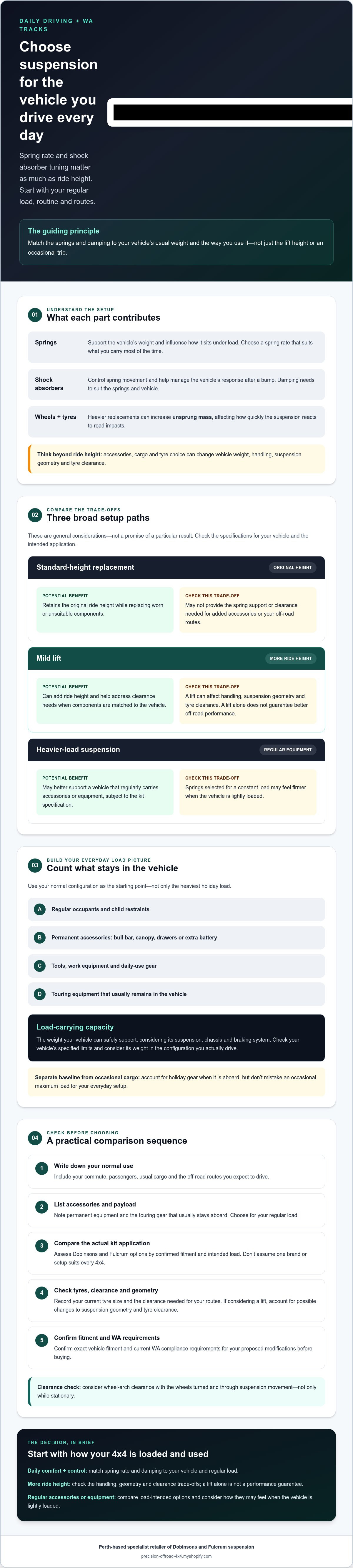
Base your suspension choice on what you carry most of the time, not only your heaviest holiday load. Include:
- Regular occupants and child restraints.
- Permanent accessories, such as a bull bar, canopy, drawers or extra battery.
- Tools, work equipment and daily-use gear.
- Touring equipment that usually stays in the vehicle.
Load‑carrying capacity is the weight your vehicle can safely support, taking its suspension, chassis and braking system into account. Occasional cargo still counts when it’s aboard, but keep it separate from your everyday baseline when comparing spring options. Check your vehicle’s specified limits and consider its weight in the configuration you actually drive. This gives you a more useful starting point for choosing the best off road suspension for daily driver use.
How do springs, shocks and lift height change daily-driver behaviour?
Changing suspension affects more than ride height. Spring rate, shock absorber damping, vehicle weight and tyre choice all influence how your 4x4 responds on sealed roads and uneven tracks. The table compares broad setup types, but actual results depend on your vehicle and the kit specifications.
| Setup | Potential daily-road benefit | Trade-off to check |
|---|---|---|
| Standard-height replacement | Retains the original ride height while replacing worn or unsuitable components. | It may not provide the spring support or clearance you need for added accessories or off-road routes. |
| Mild lift | Can provide additional ride height and help address clearance needs when the components are matched to the vehicle. | It can affect handling, suspension geometry and tyre clearance. A lift alone doesn’t guarantee better off-road performance. |
| Heavier-load suspension | May better support a vehicle that regularly carries accessories or equipment, subject to the kit specification. | Springs selected for a constant load may feel firmer when the vehicle is lightly loaded. |
When should you consider standard-height or lifted suspension?
Start with your current tyre size, regular load and the clearance you need for your usual routes. If standard ride height meets those needs, compare a replacement setup with a lift. If you’re considering more height, check wheel-arch clearance with the wheels turned and through suspension movement, not only while the vehicle is parked. Confirm fitment and applicable WA requirements for your exact vehicle and modification before choosing a lift.
What do spring rate and shock absorber tuning mean for you?
Spring rate affects how much a spring compresses under weight. Your shock absorber controls spring movement, helping manage body movement after bumps and corrugations. For an unladen commuter, a spring suited to a heavy, constant load may feel too firm. Regularly fitted accessories may need more support than standard springs provide. Compare manufacturer specifications with your vehicle and intended load. The basics of how suspension components work can help explain how these parts act together.
Progressive rate springs increase stiffness as they compress. They’re a design option to assess, not a promise of comfort; the result depends on the spring, vehicle and load. Also check how a shock absorber is specified for your use. Shock fade is reduced damping after overheating, which can mean less control during repeated demanding movement. Don’t assume every kit responds the same way.
To compare options, note your regular accessories and tyre setup, then check the manufacturer’s vehicle-specific fitment and load information. Precision Offroad 4x4 stocks Dobinsons and Fulcrum suspension kits to compare against your intended use.
Dobinsons or Fulcrum: how to compare suspension for mixed driving
Dobinsons and Fulcrum both offer suspension kits, but the brand name alone won’t tell you which setup suits your 4x4. Compare options against the exact vehicle, its regular load and your daily route. Precision Offroad 4x4 stocks both brands, giving you options to assess without assuming one is right for every application.
Start with manufacturer information for your vehicle’s make, model, year and variant. Then check the listed application, included components and intended load. The best off road suspension for daily driver use is the kit whose documented fitment and specifications align with your actual requirements, not simply the one with a particular lift height.
| Question to ask | Specification to check | Why it matters for daily use |
|---|---|---|
| Is this kit listed for my exact vehicle? | Manufacturer-stated vehicle compatibility, including model and variant details. | Fitment can differ across versions of the same vehicle. |
| What does the kit include? | Listed springs, shock absorbers and any other supplied components. | Component combinations affect ride height and handling. Confirm what is and isn’t included. |
| What load is the spring choice intended to support? | Manufacturer’s stated application and load information. | A setup intended for a sustained accessory load may not feel the same when your vehicle is unladen. |
| How does the setup account for a lift? | Any stated requirements for handling, alignment or suspension geometry correction. | Changes to suspension height can affect geometry and steering behaviour. |
Which suspension details should you compare before choosing a kit?
Make a shortlist of your permanent accessories and the load they add. Compare spring choices against that sustained weight, rather than treating lift height as a measure of load support. Check what the manufacturer specifies for your vehicle and whether the proposed components address any suspension geometry correction required by that configuration. Don’t assume two kits with similar advertised heights have the same fitment or application.
When might a Dobinsons IMS Lift Kit suit your shortlist?
The Dobinsons IMS Lift Kit can be one candidate to investigate, not a universal recommendation. Before comparing it with a Fulcrum option, verify current fitment, included parts and manufacturer specifications for your vehicle. Then check whether its documented application matches your regular accessories, expected load and commute. For broader context on choosing and maintaining a setup, consult 4x4 Suspension: The Ultimate Performance and Reliability Guide for 2026.
What compliance and post-fitment checks matter in Perth and WA?
Suspension and tyre changes can affect vehicle height, wheel track, tyre clearance and handling. Australian standards provide a national technical framework, including Vehicle Standards Bulletin 14 (VSB 14), while WA manages its own modification and inspection processes. Check the current requirements for your exact vehicle and proposed changes before ordering or fitting parts.
Use this sequence to check the details:
- Record your vehicle details. Note the make, model, year, variant, existing suspension, tyre and wheel specifications, and any fitted accessories.
- List the proposed components. Include the suspension kit, tyre size and wheel specifications. Check how they affect vehicle height, wheel track and clearance together, not in isolation.
- Confirm compliance requirements. Ask an appropriately qualified local professional, and check with the WA Department of Transport, which approvals, permits or inspections apply. Under WA guidance, a lift of up to 50 mm is classed as a Simple modification requiring a permit and inspection at an Authorised Inspection Station. The 50 mm height increase is a combined limit for suspension changes and tyre diameter before engineering certification is required. Confirm how the rules apply to your configuration.
- Plan post-fitment checks. Arrange a professional wheel alignment and verify the required documentation, including whether a modification plate applies to your specific modification.
What should you verify before ordering or fitting a suspension kit?
Confirm the kit’s exact vehicle fitment and ask how the proposed suspension, tyres and wheels work together. Wheel track is the distance between the wheels on the same axle; changes can affect tyre clearance and legal tyre poke. Check that tyres remain within the bodywork and that wheel‑arch clearance is adequate. For related wheel and tyre considerations, see the 4x4 wheel upgrade guide for Perth.
Which checks should follow suspension installation?
A professional wheel alignment is mandatory after any suspension or tyre change. Ask for caster, camber and toe to be assessed against the vehicle and modification. Then check for tyre scrub through steering and suspension movement, and watch for unexpected dog‑tracking, where the rear wheels don’t follow the front wheels and the vehicle pulls to one side. Don’t ignore new handling changes.
Keep the kit details, alignment results and any permit, inspection or certification records with your vehicle documents. Check warranty terms with the relevant manufacturer or supplier, as coverage can depend on the product and modification. To compare Dobinsons and Fulcrum suspension options, review suspension kits for your 4x4 and confirm fitment and compliance details before choosing.
How to choose a daily-driver suspension kit with a Perth 4x4 specialist
A useful shortlist starts with your vehicle as it’s actually driven. Bring accurate details about its current setup and regular load, then compare manufacturer specifications against your daily route and planned off-road use. The best off road suspension for daily driver use is the option that fits those details and meets the requirements for your exact vehicle and modification.
What information should you have ready when comparing options?
Write down the following before you compare suspension kits:
- Vehicle: make, model, year, variant and current suspension configuration.
- Weight and accessories: fitted equipment, regular cargo and the occupants you commonly carry. If accessory weight affects your choice, include items such as a bull bar, canopy or drawers. You can also review 4x4 accessories for Australian tracks when considering additions that change vehicle load.
- Wheels and tyres: current specifications and any planned changes, so fitment and clearance can be checked as part of the overall setup.
- Driving: describe your usual sealed-road commute and the off-road conditions you expect to encounter, such as corrugations or uneven tracks.
Separate everyday equipment from cargo carried only occasionally. This helps clarify the load the springs need to support most of the time, while keeping occasional touring weight in view. Check vehicle limits rather than assuming a suspension change increases your vehicle’s permitted load‑carrying capacity.
How can an authorised retailer help you narrow the shortlist?
Ask for the manufacturer’s stated fitment and application for your exact vehicle, plus details of the components included. Then ask how the proposed spring choice relates to your regular accessories and whether any suspension geometry correction needs to be considered. A retailer can help you compare the Dobinsons and Fulcrum options it stocks, but the brand alone doesn’t establish that a particular kit suits your vehicle or complies with every proposed modification.
Before deciding, confirm current WA requirements with the relevant authority or appropriately qualified professional. Ask which certification or inspection steps apply, whether a modification plate is required for the proposed configuration, and what records you should keep. Check the manufacturer’s warranty terms and how they apply to your planned setup; don’t assume coverage without reviewing the conditions.
Precision Offroad 4x4 is a Perth-based specialist retailer of Dobinsons and Fulcrum suspension. Confirm current vehicle fitment and specifications before choosing. Explore Dobinsons and Fulcrum suspension options.
Choose a setup that fits the way you drive
The best off road suspension for daily driver use comes down to a considered match between your vehicle, regular load and intended routes. Compare spring and shock absorber specifications, and don’t choose by lift height alone. Dobinsons and Fulcrum both offer suspension options, but the right fit depends on your exact vehicle and configuration.
Before deciding, confirm manufacturer fitment, your regular accessories and cargo, and the current WA requirements for the proposed modification. After any suspension or tyre change, arrange a professional wheel alignment and keep the relevant documentation. These checks help you make a more informed choice for commuting and off-road use.
Precision Offroad 4x4 is a Perth-based specialist retailer. Compare its Dobinsons and Fulcrum suspension options, then verify fitment and specifications for your 4x4. With the right information in hand, you can choose a setup with greater confidence.
Explore Dobinsons and Fulcrum suspension options, then verify fitment and specifications for your 4x4.
Frequently Asked Questions
Is off-road suspension comfortable enough for a daily driver?
Yes, off-road suspension can suit a daily driver, but comfort depends on your vehicle, spring and shock absorber specifications, tyre setup and regular load. A spring selected for accessories you rarely carry may feel firmer in everyday use, while different wheels and tyres can also change ride response. Match the kit to your normal commute and payload, then compare current manufacturer information for your exact vehicle. No particular ride quality can be promised without a vehicle-specific assessment.
What is the best suspension lift for a daily-driven 4x4?
There’s no single best lift for every vehicle. The best off road suspension for daily driver use depends on confirmed fitment, regular load, tyre clearance, handling goals and WA compliance, not lift height alone. A change in ride height can affect geometry and steering behaviour, so assess the complete setup before choosing. Confirm the proposed configuration with an appropriately qualified professional and check current WA requirements for your vehicle before ordering.
Do I need heavier springs if I add accessories to my 4x4?
Not automatically, but accessories add weight and can change how your suspension performs. List equipment that stays fitted, such as a bull bar, canopy or drawers, along with regular passengers and cargo. Then check your vehicle’s load-carrying capacity and the manufacturer’s stated spring application for your exact model and configuration. Don’t select a spring rate from accessory names alone; the correct choice depends on the actual vehicle and kit specifications.
Can a suspension lift affect my 4x4’s handling or alignment?
Yes. A suspension lift can affect suspension geometry and steering behaviour, including caster angle, so the result depends on your vehicle and components. Professional wheel alignment is mandatory after any suspension or tyre change. Ask for caster, camber and toe to be assessed, and confirm whether suspension geometry correction is needed. After fitment, check for tyre scrub and unexpected dog‑tracking, where the rear wheels don’t follow the front wheels and the vehicle pulls to one side.
Do I need a modification plate for suspension changes in WA?
Whether a modification plate applies depends on your vehicle and the specific suspension change. Don’t assume every lift or kit has the same approval requirements. Before work begins, confirm current WA requirements for your exact vehicle and proposed configuration with the WA Department of Transport or an appropriately qualified professional. Ask whether a permit, inspection, certification or modification plate applies, and keep the relevant documentation with your vehicle records.
Should I choose Dobinsons or Fulcrum suspension for a daily driver?
Neither brand is automatically the right choice for every 4x4. Compare the current manufacturer-stated fitment and application for your exact vehicle, then assess the spring choice against your regular load and driving conditions. Precision Offroad 4x4 is a Perth-based retailer of both Dobinsons and Fulcrum suspension. That gives you options to compare, not proof that a particular kit suits your setup. Verify current specifications before selecting.