

The tallest lift isn’t automatically the best suspension lift for touring. Spring rate and shock absorber control need to suit the weight your 4x4 carries most of the time, as well as the roads and tracks you drive.
When comparing standard and heavier springs, consider how the vehicle rides unloaded, how touring gear or towing changes its weight, and how a lift may affect handling. This guide explains how to assess those trade-offs for your 4x4 and Perth touring conditions.
You’ll learn what to look for in springs and shocks, including options from Dobinsons, and why lift height alone won’t determine the right setup. We’ll also cover wheel-arch clearance, suspension geometry correction, alignment and WA compliance considerations. Precision Offroad 4x4 is a Perth-based specialist and Licensed Vehicle Modifier, supplying Dobinsons suspension options for different vehicles and loads.
Key Takeaways
- Choose suspension around the weight your 4x4 carries regularly, including accessories, passengers and tow-ball download.
- Match spring support and shock absorber control to your routes, towing habits and how often your load changes.
- The best suspension lift for touring balances support and clearance with unloaded comfort and predictable handling.
- Before fitting a lift, account for loaded weight, tyre clearance, suspension geometry correction, wheel alignment and applicable WA compliance requirements.
- Use your vehicle details, regular and occasional loads, routes and towing needs to compare suitable Dobinsons or Fulcrum suspension options.
What makes the best suspension lift for touring? Start with your actual load
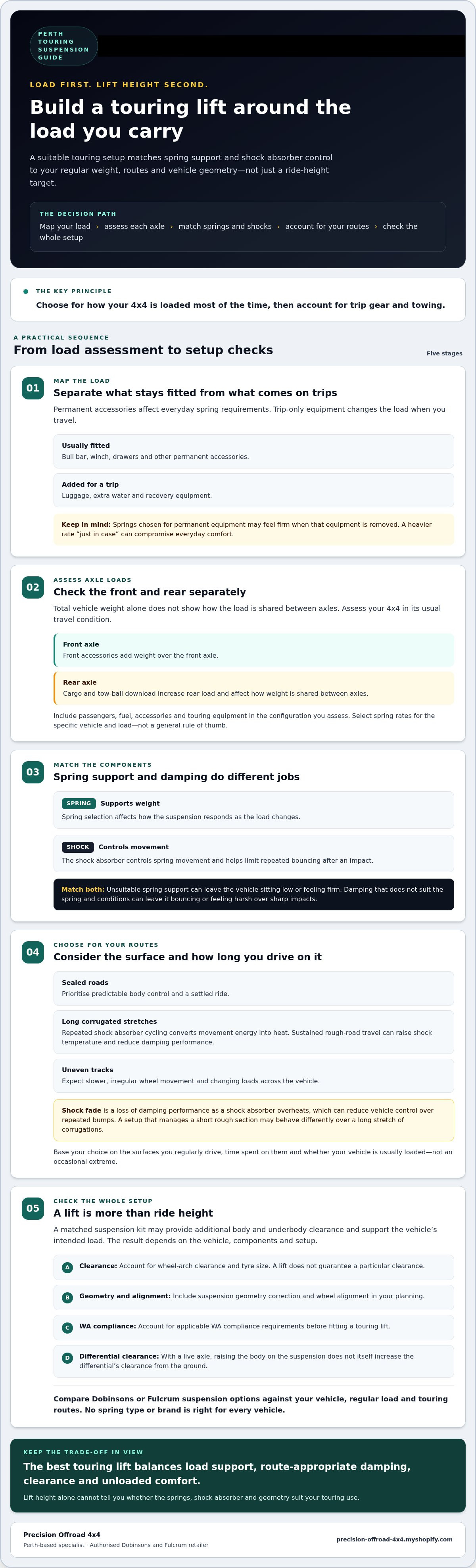
A touring lift is a vehicle-specific suspension setup selected for the weight you carry, your routes and the vehicle’s geometry. It isn’t simply a ride-height increase. In practical terms, touring suspension matches spring and shock selection to your regular load, vehicle geometry and real-world use.
A suspension lift raises a vehicle’s body and chassis relative to its wheels to provide additional clearance. That change alone doesn’t determine how the vehicle carries touring gear or behaves on the road. Your load‑carrying capacity depends on more than the springs: passengers, accessories, water, recovery gear and tow-ball download all contribute to the load the vehicle must support.
Separate what stays on the vehicle from what you pack only for trips. A bull bar, winch, drawers or other permanent accessories affect the everyday load. Luggage, extra water and recovery equipment add trip weight. Tow-ball download adds load and changes how weight is distributed between the axles. Springs selected to support permanent equipment may feel firm when that equipment is removed, so choosing a heavier rate “just in case” can compromise everyday comfort.
How touring weight changes spring selection
Assess front and rear axle loads separately. Front accessories add weight over the front axle, while cargo and tow-ball download increase the load at the rear and affect how weight is shared between the axles. The vehicle’s total weight doesn’t tell the whole story. Note its usual travel condition, including passengers, fuel, accessories and touring equipment, then assess axle loads in that configuration. Spring rates should suit the specific vehicle and load, not a general rule of thumb.
What a lift can and cannot change
A matched suspension kit may provide additional body and underbody clearance and support the vehicle’s intended load, but the result depends on the vehicle, components and setup. A lift doesn’t automatically improve handling or guarantee a particular clearance. With a live axle, the differential is part of the axle assembly, so raising the body on the suspension doesn’t itself increase differential clearance from the ground. Tyre size and other vehicle-specific factors also affect clearance. Lift height alone can’t tell you whether the springs, shock absorber and geometry suit touring.
For a Perth 4x4, start with how it’s loaded day to day, then account for the additional weight and routes planned for a trip. That gives you a better basis for comparing suspension options than ride height alone.
How touring suspension works across highway kilometres and rough tracks
Springs and shock absorbers have different jobs. Springs support the vehicle’s weight and set how the suspension responds as load changes. A shock absorber controls spring movement, helping limit repeated bouncing after the wheels hit a bump. Both need to suit your vehicle and its load so the 4x4 stays settled on sealed roads and controlled when the surface turns rough.
Corrugations place repeated demands on suspension. As a shock absorber cycles, it converts movement energy into heat. Sustained rough-road travel can raise shock temperature and reduce damping performance. Shock fade is a loss of damping performance as a shock absorber overheats, which can reduce the vehicle’s control over repeated bumps. A setup that manages a short rough section may not behave the same way over a long stretch of corrugations.
Why spring rate and damping need to work together
A spring supports the vehicle’s load, but it doesn’t control how quickly the suspension compresses and rebounds. The shock absorber manages that movement. If spring support doesn’t suit the load, the vehicle may sit low or feel firm when unloaded. If damping doesn’t suit the spring and conditions, the vehicle may keep bouncing or feel harsh over sharp impacts. Assess both components together rather than treating a heavier spring as a complete solution. For an overview of the trade-offs, see this guide to four-wheel drive suspension.
How touring routes affect suspension priorities
Highway travel calls for predictable body control and a settled ride. Corrugations test the suspension over repeated impacts, while uneven tracks bring slower, irregular wheel movement and changing loads across the vehicle. Routes around WA vary, so don’t choose a setup around an occasional extreme if most of your driving is on sealed roads. Consider the surfaces you regularly drive, how long you spend on them and whether the vehicle is usually loaded.
The best suspension lift for touring balances spring support for your regular load, damping suited to your route mix and control on both highways and rough surfaces. No setup removes every compromise between comfort and load support. Choose for the conditions you actually encounter, not a headline lift height.
Precision Offroad 4x4 is an authorised Dobinsons and Fulcrum retailer in Perth. Compare Dobinsons and Fulcrum suspension options against your vehicle, regular load and touring routes.
Compare touring lift setups by load, towing and vehicle use
Different load patterns call for different compromises. A vehicle that carries little weight most of the time has different spring-support needs from one with a canopy and touring equipment fitted year-round. Use this comparison to identify the questions that matter for your 4x4. No one brand or spring type is right for every vehicle.
| Touring use | Likely spring-support needs | Comfort trade-off and selection checks |
|---|---|---|
| Lightly loaded touring | Support suited to the vehicle’s usual passenger and accessory load. | A heavier spring may feel firm in everyday use. Account for the gear you carry most often, not only a fully packed trip. |
| Constant accessories or canopy | Include permanently fitted equipment in the regular load assessment. | Spring support needs to suit the added weight without choosing a rate by guesswork. Consider how the vehicle rides when trip luggage is removed. |
| Regular towing | Assess the loaded vehicle, including tow-ball download, passengers and touring gear. | Load distribution changes with the trailer and its contents. Consider the vehicle’s load-carrying capacity as well as how it sits and handles while towing. |
| Changing trip loads | Base the selection on the vehicle’s regular load, then account for the extra gear added for trips. | A setup biased towards occasional maximum load may compromise comfort when unladen. Work out how often the vehicle carries the heavier load and what it includes. |
Choose a setup for constant accessories or a canopy
A bull bar, winch, drawers or canopy fitted full-time belongs in your everyday load plan, not the occasional-trip column. If your 4x4 carries this equipment year-round, assess the loaded front and rear axles and consider how much unloaded comfort matters once trip gear is removed. The Dobinsons IMS Lift Kit is one option to assess alongside other Dobinsons and Fulcrum suspension kits. Compare it by vehicle fitment and load rather than assuming one model suits every touring setup.
Choose a setup for towing or variable trip loads
Include tow-ball download and packed gear when assessing a regular towing setup. Occasional heavy loads create a different compromise: springs selected around rare peak loading may feel firmer during everyday driving. If your planned load raises questions about the vehicle’s rated capacity, consider GVM upgrade suspension kits as a separate matter. A suspension kit alone doesn’t mean the vehicle’s capacity has changed.
Precision Offroad 4x4 is an authorised Perth retailer of Dobinsons and Fulcrum suspension. For broader context on setup and reliability, see 4x4 Suspension: The Ultimate Performance and Reliability Guide for 2026. Choose the setup for your usual load and use, while accounting for occasional demands without letting them dictate every drive.
Check geometry, tyres and WA compliance before fitting a touring lift
A lift changes more than ride height. It can affect steering geometry, tyre clearance and how the vehicle behaves under load. Work through these checks before selecting a setup, then assess the finished vehicle in its intended touring condition.
- Record the loaded weight. Include passengers, permanent accessories, trip gear and towing load. Consider front and rear axle loads, not just the vehicle’s total weight.
- Confirm vehicle and tyre fitment. Check that the suspension components suit your vehicle, then assess tyre size, wheel track and wheel‑arch clearance together.
- Assess suspension geometry. A lift can change caster, camber and toe. The correction required depends on the vehicle and the type and extent of the modification.
- Align the vehicle. A professional wheel alignment is mandatory after any suspension or tyre change. Alignment checks set steering angles for stable, predictable driving.
- Check applicable WA requirements. Requirements depend on the vehicle and the changes made. Establish whether certification or a modification plate applies to your proposed modifications before treating the setup as compliant.
Check steering geometry and tyre clearance
The caster angle affects steering feel and directional stability. If a lift changes it, the vehicle may feel different on the highway even if it sits level. Camber and toe also need assessment as part of vehicle-specific suspension geometry correction. Tyres need adequate wheel‑arch clearance through suspension movement, not just when the vehicle is stationary. Check for possible tyre scrub as the suspension compresses and the steering turns. For related tyre and wheel considerations, see The Technical Guide to 4x4 Wheel Upgrades in Perth (2026).
Treat WA compliance as a vehicle-specific check
Don’t rely on a universal lift-height rule to decide whether a modified 4x4 complies. The vehicle and combination of changes matter. Check current WA requirements for the specific suspension and tyre modifications, including whether certification and a modification plate are required. Precision Offroad 4x4 holds Licensed Vehicle Modifier certification, which is relevant when planning vehicle modifications. It doesn’t mean every setup follows the same approval path.
The best suspension lift for touring is only one part of a safe, road-ready setup. Include geometry, alignment, tyre clearance and applicable compliance checks in your plan. Review suspension options for your touring setup.
Choose your touring suspension lift and plan the next step
The best suspension lift for touring suits your completed vehicle, regular load and intended routes, while accounting for towing and applicable compliance requirements. Use this checklist to prepare a clear brief before comparing suspension options.
- Vehicle: Note the make, model, year and relevant vehicle configuration.
- Constant load: List permanently fitted accessories, such as a bull bar, canopy, winch or drawers, and your regular passenger load.
- Occasional load: Record trip equipment, water and recovery gear added for touring, and how often you carry it.
- Routes: Describe your usual mix of highway travel, corrugations and uneven tracks, including how long you spend on rough roads.
- Towing: Note whether you tow regularly and include tow-ball download in the loaded setup.
- Compliance: List other vehicle modifications and identify the WA requirements that apply to the specific combination of changes.
Prepare a useful touring setup brief
Be specific about what the vehicle carries in an ordinary week and what changes for a trip. For example, a 4x4 with a permanently fitted canopy and drawers has a different everyday load from one that carries luggage only during holidays. Add regular passengers, towing habits and route conditions. These details make it easier to compare suspension options with how you use the vehicle, rather than an assumed maximum load.
Compare available suspension options with confidence
With your brief prepared, compare Dobinsons and Fulcrum suspension options against your vehicle, load and touring use. Precision Offroad 4x4 is an authorised retailer of both brands and holds Licensed Vehicle Modifier certification. Vehicle-specific selection still matters: a product name or lift height alone doesn’t establish fitment, comfort or compliance.
Plan for the checks that follow suspension selection. A professional wheel alignment is mandatory after a suspension change. Check steering and tyre clearance, then assess how the vehicle sits and behaves with its usual touring load. Regular inspections can help you notice changes in ride height, handling or component condition before your next trip. If you handle your own ongoing vehicle maintenance and mechanical checks, learn more about Ellery Books to find dedicated Australian automotive workshop manuals.
A clear vehicle and load brief gives you a practical starting point for comparing touring setups. View suspension options for your 4x4.
Set up your 4x4 for the touring you actually do
The best suspension lift for touring starts with your real load, not a target ride height. Separate permanent accessories from trip gear, passengers and towing load, then match spring support and shock control to your regular roads and tracks. This helps you weigh comfort, clearance and load support without building the setup around an occasional extreme.
Before fitting, consider tyre clearance, suspension geometry and the WA compliance requirements that apply to your vehicle and modifications. A professional wheel alignment is mandatory after any suspension or tyre change. Keep the vehicle’s loaded weight and intended use in view when comparing options.
Precision Offroad 4x4 is a Perth-based specialist and authorised Dobinsons and Fulcrum retailer, with Licensed Vehicle Modifier certification. Its suspension range includes options from both brands for different vehicles and loads.
Use your vehicle details, load and route plans to narrow your options, then explore Dobinsons and Fulcrum suspension options.
Frequently Asked Questions
What is the best suspension lift for touring?
The best suspension lift for touring is the vehicle-specific setup that suits your regular load, routes and towing use. Start with usual passengers and permanent accessories, then account for trip gear and tow-ball download. Spring support and shock absorber control should work together, while the lift also needs suitable geometry and tyre clearance. For Perth touring, consider how often you drive highways, corrugations and uneven tracks, not just the most demanding trip.
Are heavier springs better for a touring 4x4?
Heavier springs aren’t automatically better. They suit vehicles carrying a greater regular load. Include a full-time bull bar, canopy or drawers when assessing spring support, but treat luggage and recovery gear carried only on trips as occasional load. Springs selected for a heavy load that’s rarely carried may feel firm when the vehicle is unladen. Match the spring choice to the vehicle and axle loads rather than guessing.
Is a 2-inch lift suitable for touring in WA?
A 2-inch lift may suit some touring vehicles, but lift height alone can’t establish fitment, handling or compliance. Consider your vehicle, loaded weight, suspension geometry, tyre size and wheel-arch clearance, along with the routes you regularly drive in WA. Modification requirements depend on the vehicle and the specific changes made. Check the current WA requirements for your proposed setup rather than assuming a particular lift height is suitable or compliant for every 4x4.
Can a suspension lift make my 4x4 ride harshly when it is unloaded?
Yes. A suspension lift can feel harsh when the vehicle is unloaded if the spring support is selected for weight it isn’t carrying. Permanent accessories and occasional touring gear affect the setup differently. Include passengers and everyday equipment in your regular load assessment, then consider how much extra weight you add for trips. Springs and shock absorber need to suit the vehicle and intended use. A taller ride height alone doesn’t guarantee comfort.
Do I need a wheel alignment after a suspension lift?
Yes. A professional wheel alignment is mandatory after any suspension or tyre change. A lift can alter steering geometry, including caster angle, camber and toe, and the correct adjustments depend on your vehicle and modifications. Alignment helps set appropriate steering and tyre behaviour, but it doesn’t replace a broader fitment or compliance assessment. Include alignment in your suspension plan, then monitor steering feel and tyre wear during use.
What suspension checks should I make before towing with a lifted 4x4?
Assess the vehicle in its towing configuration before setting off. Account for passengers, permanent accessories, trip gear and tow-ball download, and consider how those loads are distributed between the axles. Check that the suspension supports the loaded vehicle, steering and alignment are in order, and tyres have adequate clearance through suspension travel. Also consider the vehicle’s load‑carrying capacity and applicable requirements for its modifications. A suspension lift alone doesn’t establish suitability for towing.
Does a suspension lift require a modification plate in WA?
There isn’t one answer for every lift. Whether certification or a modification plate applies depends on the vehicle and the specific modifications. Check current WA requirements for your proposed setup before fitting, rather than relying on lift height alone. Precision Offroad 4x4 is Perth-based and holds Licensed Vehicle Modifier certification, which is relevant when planning vehicle modifications. It doesn’t mean every modification follows an identical approval path.