

The toughest-looking tread isn’t automatically the best choice for the Gibb River Road. The best tyres for Gibb River Road need to suit the changing surfaces, your 4x4 and its touring load, while remaining manageable on the highway.
Balancing highway comfort with puncture resistance and off-road grip is a practical concern. The 660-kilometre route is mostly unsealed, with corrugations, loose sharp rocks and rougher side tracks to consider. Conditions can change quickly, so tyre choice is only one part of preparing for the trip.
This guide compares all-terrain, Rugged Terrain (R/T) and mud-terrain options, and explains what to check before you buy: tyre construction, vehicle placard ratings, wheel-arch clearance and the weight you’ll carry. It also covers pressure planning, spares and repair gear, along with road-condition checks to make before leaving Perth. The aim is a considered tyre choice, not simply the most aggressive tread on the shelf.
Key Takeaways
- The best tyres for Gibb River Road depend on your vehicle, touring load and regular driving, not just how aggressive the tread looks.
- Compare A/T, Rugged Terrain (R/T) and M/T tyres for the balance of highway comfort, tread design and off-road use you need.
- Check tyre ratings against your vehicle placard, then assess wheel-arch clearance and load-carrying capacity before choosing a size or construction.
- Use a pre-trip checklist to inspect tyre condition, wheels, spares and repair gear, and plan pressures for your vehicle’s load and the road surface.
- Consider the Maxxis RAZR AT811 as an all-terrain option, then confirm its suitability for your vehicle and intended load.
Best tyres for Gibb River Road: what the route demands
Surfaces and driving conditions can vary across the Kimberley route. The Gibb River Road runs about 660 kilometres between Derby and Kununurra, with most of the route unsealed. Expect corrugations, rough sections and sharp stones, with potentially rougher conditions on tracks branching off the main road. For background on the route’s geography and history, see Gibb River Road.
That mix calls for a balanced choice. Tread needs to provide suitable traction, while tyre construction, pressure and driving speed all affect puncture risk. Comfort matters too, particularly if you’ll cover long highway distances before and after the trip. Your touring load is another key factor: a tyre must be appropriate for the weight it will carry, not just the terrain.
A suitable remote-touring tyre balances traction, construction, load rating and road comfort for your vehicle, route and driving conditions.
What road conditions should you plan for on Gibb River Road?
Plan for corrugations, rough surfaces and exposure to sharp stones, but don’t assume every section will be the same. Conditions can change with weather, grading and traffic, and information available before departure may not reflect what you encounter on the day.
Check current updates from Main Roads WA and the relevant local shires before setting out. This guide describes conditions to plan for, not a live assessment of the road. Adjust your driving to the conditions you find rather than relying on tyre choice to compensate for changes in speed or surface.
Why remote travel changes your tyre priorities
Distance from services makes puncture planning and spare capacity practical considerations. Before departure, think through what you’ll do if a tyre is damaged and whether your spare plan suits your route, vehicle and available space. No tyre construction can rule out punctures, particularly where sharp stones are present.
Account for passengers, fuel, water, camping equipment and other touring gear when checking tyre suitability. Confirm the tyre’s load rating meets the requirements on your vehicle’s placard, and consider the vehicle’s actual loaded condition. A setup that works for an unloaded daily driver may not suit the same 4WD carrying touring equipment.
Your regular highway use matters too. If you drive mostly on sealed roads, weigh highway comfort and noise alongside off-road traction. The best tyres for Gibb River Road aren’t automatically the most aggressive option. They’re the ones that suit your load and trip without making everyday driving a poor fit.
A/T, R/T or M/T: compare tyre types for the Kimberley
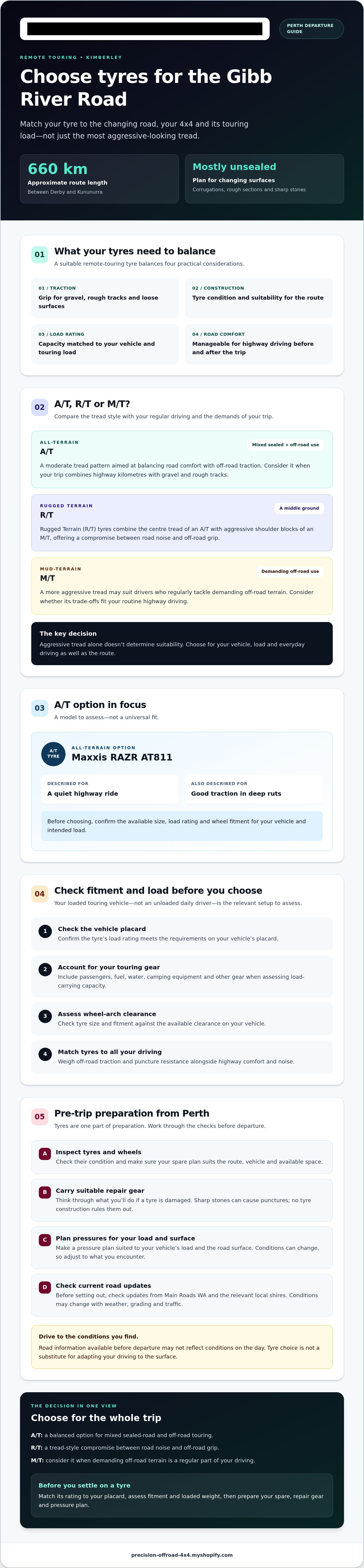
Each tread category involves different trade-offs. An all-terrain (A/T) tyre is designed for mixed sealed and unsealed driving. Rugged Terrain (R/T) and mud-terrain (M/T) options have more aggressive tread patterns. They may suit drivers who prioritise off-road use, but can involve compromises on regular highway trips. The best tyres for Gibb River Road depend on how much of your driving is on each surface, as well as your vehicle and load.
| Tyre type | Intended use | Tread and highway considerations |
|---|---|---|
| All-terrain (A/T) | Mixed sealed-road and off-road touring | Moderate tread pattern aimed at a balance of road comfort and off-road traction. |
| Rugged Terrain (R/T) | Drivers seeking a middle ground between A/T and M/T tread styles | Hybrid tread with aggressive shoulder blocks; consider possible road-noise and comfort trade-offs. |
| Mud-terrain (M/T) | Drivers who regularly tackle demanding off-road terrain | More aggressive tread; assess whether that trade-off suits your routine highway use. |
Aggressive tread alone doesn’t determine suitability. The right tyre also needs to match your vehicle, load and everyday driving.
When an all-terrain tyre is a practical touring option
If your trip combines highway kilometres with gravel and rough tracks, an A/T may offer a useful balance without committing to a more specialised tread. The Maxxis RAZR AT811 is one all-terrain option. It is described as offering a quiet highway ride and good traction in deep ruts. These characteristics don’t make it a universal fit, so confirm the available size, load rating and wheel fitment for your vehicle and intended load.
When R/T or M/T tread may suit your driving
Rugged Terrain (R/T) tyres combine an A/T-style centre tread with aggressive M/T-style shoulder blocks. This offers a compromise between road noise and off-road grip. An M/T may be worth considering if your regular driving includes demanding off-road terrain, but it isn’t an automatic upgrade for a touring trip. If most of your kilometres are on sealed roads, weigh the tread’s off-road focus against day-to-day comfort and use.
For trip-specific preparation, check Driving on Gibb River Road for current guidance from Main Roads WA. Treat route information and tyre selection as separate checks. Neither a tread category nor an aggressive pattern can replace matching tyres to your vehicle and driving conditions.
How to compare Gibb River Road tyres for your vehicle and load
Compare tyres against four factors: your vehicle, the weight it carries, the route you plan to drive and your regular use. A touring 4WD loaded with passengers and camping gear has different demands from a lightly equipped vehicle used mostly around Perth. Start with the vehicle’s tyre placard, then check the proposed tyre and wheel combination with a qualified specialist.
Tyre choice also affects suspension response. Tyres and wheels contribute to a vehicle’s unsprung mass, the weight not supported by the suspension. A heavier combination can make it harder for the suspension to respond quickly over bumps. Consider the complete wheel-and-tyre setup, not just the tread pattern.
Check tyre size, load rating and wheel-arch clearance
Use the placard as your first reference for the vehicle’s specified tyre information. Confirm that the replacement tyre’s size and load rating suit your vehicle and intended use. A qualified specialist can also assess the fitment against your vehicle’s actual setup, especially if you’re changing wheel dimensions or offset.
Wheel-arch clearance is the space between the tyre sidewall and the inner wheel arch. Insufficient clearance can allow the tyre to scrub against the body or suspension during steering or suspension movement. Check clearance across the range of movement, not only when the vehicle is parked on level ground.
Changing wheels can also alter wheel track, the distance between the left and right wheels on the same axle, and how far the tyre sits out from the bodywork. Check the combination against applicable WA requirements before fitting. For route preparation and current guidance, consult Main Roads Western Australia.
Match tyre construction to touring load
Touring gear adds weight, so assess the vehicle’s load-carrying capacity and the tyre rating together. List the gear, passengers and other items you expect to carry, then compare the tyre’s load rating with the vehicle placard and get vehicle-specific advice. There’s no suitable rating to recommend without checking those details.
Standard and light truck (LT) construction tyres differ in construction and intended load use. Light truck (LT) construction tyres use extra plies for higher load capacity and puncture resistance, which may suit a heavier touring setup. That construction doesn’t make a tyre immune to punctures, and it still needs to be correctly rated for your vehicle.
For further reading, consult a technical wheel-upgrade guide alongside your vehicle’s specifications. The best tyres for Gibb River Road are a vehicle-specific match, not a size or construction chosen by tread appearance alone.
Prepare tyres for Gibb River Road before leaving Perth
A careful pre-trip check can help you catch tyre, wheel and equipment issues before you’re remote. Use this checklist with the vehicle loaded as it will be for the trip. Even the best tyres for Gibb River Road need suitable fitment, sound condition and a pressure plan matched to your vehicle and load.
- Inspect every tyre. Check tread condition, sidewalls and visible damage, including the spare. Replace tyres that are worn or damaged, and make sure the spare is suitable for your wheel setup.
- Check wheels and fitment. Look for visible wheel damage and confirm the tyre doesn’t contact the body or suspension. Pay particular attention after changing wheel size or offset.
- Confirm your spare plan. Check the spare’s condition, compatibility and access once your touring gear is packed. Decide what spare capacity suits your vehicle, route and trip rather than relying on a one-size-fits-all number.
- Pack repair equipment. Carry a repair kit suited to your tyres and make sure you know how to use it. Check that your compressor and pressure gauge work before departure.
- Plan tyre pressures. Ask a qualified specialist for guidance based on your vehicle, loaded weight, tyre and terrain. There isn’t one pressure that suits every combination. Reassess as the surface changes, and avoid continuing at a pressure that’s unsuitable for your load.
- Check current information. Before leaving Perth, review current road status and restrictions through Main Roads WA and the relevant local shires. Check applicable WA tyre and vehicle-modification requirements against your specific setup.
Build a practical tyre and spare plan
Test access to your spare with the vehicle fully packed. Confirm you have the right tools to remove a wheel and that the spare can be fitted to the vehicle. Inspect repair gear as well as tyres. An incomplete or unfamiliar kit won’t help much if you can’t use it. Match your plan to the route and support available, without assuming a repair will always be possible.
Check fitment, alignment and legal considerations
Before departure, confirm tyre fitment, wheel-arch clearance and wheel position, particularly if you’ve changed the wheels. If you’ve changed tyres or suspension, a professional wheel alignment is mandatory after any suspension or tyre change. It helps ensure the wheels are set to the correct alignment specifications for the vehicle.
Don’t assume a modification is compliant based on appearance or a general rule of thumb. Check current WA requirements for your vehicle and exact tyre-and-wheel combination before travelling. For a suitable setup, check Maxxis tyres and wheel options against your vehicle and intended load.
Choose a Gibb River Road tyre setup with a Perth 4x4 specialist
Your choice comes down to how the route, vehicle and tyres work together. Consider the surfaces you expect to drive, the weight your 4WD will carry, the tyre’s construction and how it needs to perform on your usual roads. The best tyres for Gibb River Road aren’t necessarily right for every vehicle or daily commute, so check the whole setup before settling on a tread pattern or size.
The Maxxis RAZR AT811 is an all-terrain option to assess if you want a tyre for mixed highway and off-road use. It is described as offering a quiet highway ride and good traction in deep ruts. Treat that as a starting point for comparison, not a guarantee of fit or suitability. Confirm the exact size and load rating against your vehicle’s requirements and intended touring load.
Questions to resolve before choosing a tyre
- How much of your trip will be on sealed highway, gravel and rougher tracks? Be clear about the surfaces you expect, including access tracks beyond the main route.
- What vehicle are you driving, and what wheel size and tyre fitment does it currently use?
- What will you carry? Include passengers and touring gear when checking tyre ratings against your vehicle placard.
- Have you changed wheels, suspension or other parts that could affect clearance or fitment?
- Do these tyres also need to suit regular daily driving around Perth, or is the vehicle mainly set up for off-road touring?
Answering these questions gives a tyre specialist useful context. Bring your vehicle details, placard information and a realistic account of the load you plan to carry. If suspension changes or added equipment affect vehicle weight, address that as part of the wider setup rather than treating tyres as a separate decision.
Next steps for comparing Maxxis tyres
Compare product specifications with your placard and intended load. Ask a Perth-based specialist to check wheel and tyre fitment for your vehicle, then discuss the trade-offs that matter for your route and regular use. Precision Offroad 4x4 is a Perth-based specialist retailer offering Maxxis tyres and wheel upgrades. The right option depends on the details of your setup, not a general recommendation.
Ready to compare the available options? Explore Maxxis tyres for your 4x4.
Set up your 4x4 for the Kimberley trip
The best tyres for Gibb River Road are matched to your route, vehicle and touring load, while still suiting the way you drive at home. Compare A/T, R/T and M/T tread styles by their intended use, then check tyre size, load rating, clearance and construction against your vehicle’s requirements.
Before you leave Perth, inspect your tyres and spare, check your repair gear and plan pressures for your vehicle, load and terrain. Confirm current road information and applicable WA requirements rather than relying on assumptions about conditions or fitment.
Precision Offroad 4x4 is a Perth-based 4x4 specialist offering Maxxis tyres. The Maxxis RAZR AT811 is one all-terrain option to assess, not a universal fit. Compare its specifications with your vehicle and intended load.
Compare Maxxis tyres for your 4x4 and take the next step towards a considered touring setup. With the right checks and preparation, you can set off with greater confidence.
Frequently Asked Questions
Which tyres are best for Gibb River Road?
There isn’t one tyre type that suits every Gibb River Road trip. The best tyres for Gibb River Road depend on your 4WD, its loaded weight, the surfaces you plan to drive and how much highway use the tyres will get. Compare tread style and construction, then check size, load rating and fitment against your vehicle placard. Also check current road information before you travel, as conditions can change.
Are all-terrain tyres suitable for Gibb River Road?
All-terrain tyres can suit mixed touring that includes sealed highways and unsealed roads, but suitability depends on the particular tyre and vehicle setup. Consider the balance between everyday road comfort and the grip you need off-road. Before choosing, confirm the tyre size and load rating suit your vehicle and touring load, and check clearance. Review current official road updates before departure, since conditions may change after you select your tyres.
Are mud-terrain tyres better than all-terrain tyres for the Kimberley?
Not necessarily. Mud-terrain tyres may suit drivers who regularly tackle demanding off-road terrain, while all-terrain tyres are aimed at mixed sealed-road and off-road use. More aggressive tread isn’t automatically an advantage for a tour that includes long highway sections, where road comfort and everyday handling also matter. Choose based on the driving you’ll actually do, your vehicle and load, rather than treating M/T tread as a default touring upgrade.
Is the Maxxis RAZR AT811 suitable for Gibb River Road?
The Maxxis RAZR AT811 may be an option to assess, not a guaranteed fit for every 4WD. It is an all-terrain tyre described as offering a quiet highway ride and good traction in deep ruts. Confirm the specific tyre’s specifications, size and load rating against your vehicle placard and touring weight. Check wheel fitment and clearance too, then compare those details with your route and regular driving.
Do I need light truck construction tyres for Gibb River Road?
Not every vehicle or trip calls for light truck (LT) construction tyres. They use extra plies for higher load capacity and puncture resistance, which may be relevant for a heavier touring setup. That construction doesn’t prevent punctures, and the tyre still needs to suit your vehicle. Check the placard, expected loaded weight and tyre specifications together. Get vehicle-specific advice before selecting a load rating or construction type for your trip.
How many spare tyres should I take on Gibb River Road?
The right spare plan depends on your vehicle, route, trip length and access to support, so there’s no single count that suits every traveller. Check how many compatible spares you can carry safely and whether they’ll remain accessible once the vehicle is packed. Inspect their condition before departure, and carry repair equipment suited to your tyres. Make sure you understand how to use it, but don’t assume every tyre can be repaired.
What should I check before driving Gibb River Road on new tyres?
Inspect tread and sidewalls, confirm the tyres and wheels fit correctly, and check for adequate wheel-arch clearance. Verify load ratings against your vehicle placard and intended touring load. Check that your spare is compatible and serviceable, and test your repair kit, compressor and pressure gauge. Before leaving Perth, check current road status and restrictions with official WA sources. If you’ve changed tyres or suspension, a professional wheel alignment is mandatory.