

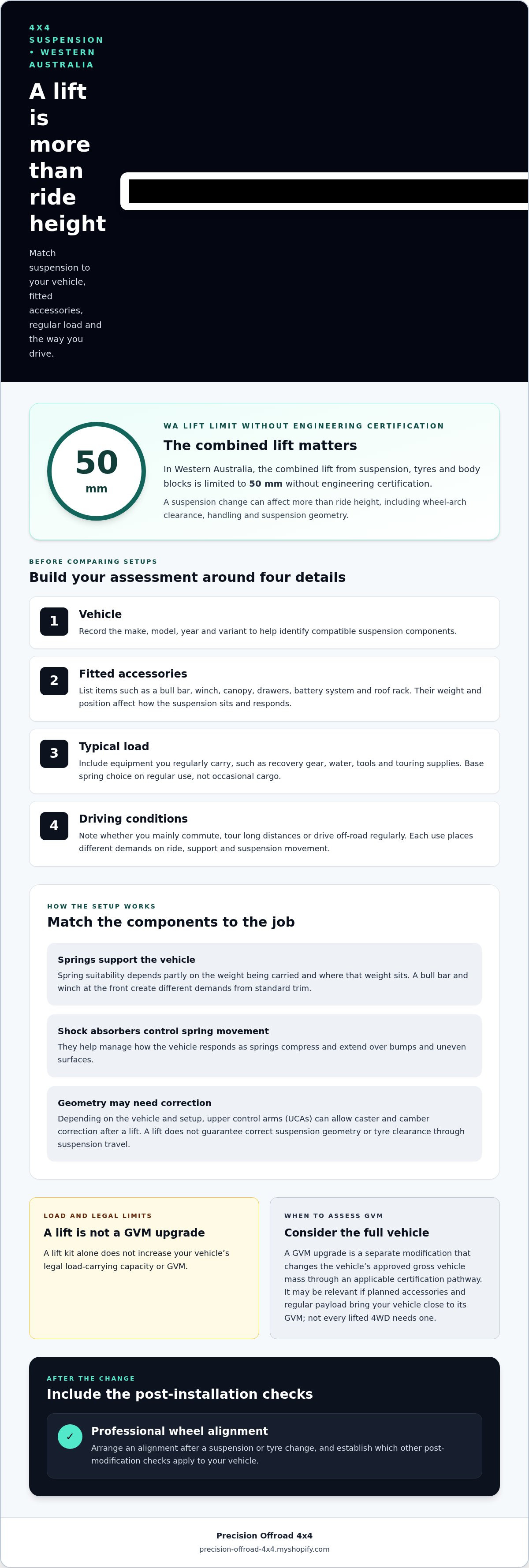
When comparing 4x4 lift kit cost Australia, look beyond the suspension kit itself: vehicle fitment, accessories, regular load and compliance all affect the scope of an upgrade. In Western Australia, the combined lift from suspension, tyres and body blocks is limited to 50mm without engineering certification, so a suspension change can have wider implications than ride height alone.
More tyre clearance and support for carrying gear can be useful, but the setup still needs to suit your vehicle and how you drive. The weight of bull bars, canopies, batteries and other accessories affects suspension requirements. A lift alone does not increase your vehicle’s legal load-carrying capacity.
This guide explains how to assess fitment and load, compare suspension setups, and identify relevant post-installation checks and compliance steps in WA. Precision Offroad 4x4 is a Perth-based specialist and authorised Dobinsons retailer. We can help you compare suspension options for your vehicle and intended use, with Licensed Vehicle Modifier certification knowledge to inform the compliance pathway.
Key Takeaways
- Assessing 4x4 lift kit cost Australia means considering the full scope of fitment, accessories, load and any applicable compliance steps, not just the kit.
- Record your vehicle details, fitted accessories, typical payload and intended driving conditions before comparing suspension setups.
- Match spring support and shock absorber control to your use, then assess whether suspension geometry correction is needed.
- Arrange a professional wheel alignment after a suspension or tyre change, and establish which other post-modification checks apply to your vehicle.
- Precision Offroad 4x4 is a Perth-based authorised Dobinsons and Fulcrum retailer, with Licensed Vehicle Modifier certification for relevant modification pathways.
What a 4x4 lift kit changes, and why lift height is only one factor
A suspension lift raises the vehicle’s body and chassis relative to its axles by changing suspension components. The Suspension lift overview explains the basic purpose and common methods. The quoted lift height, however, describes only one part of the change. A lift can also affect wheel-arch clearance, handling and suspension geometry. Choose a setup to suit your 4WD’s equipment and use, not just the height you want.
A suspension kit is a collection of springs, shock absorbers, hardware and sometimes control arms, designed to change ride height and handling. The components need to suit your vehicle and intended use. Two 4WDs of the same model may need different spring support if one carries a bull bar, canopy and touring gear while the other remains close to standard trim.
What components make up a 4x4 suspension kit?
Springs support the vehicle and influence ride height. Their suitability depends partly on the weight they carry and where that weight sits. A 4WD with a bull bar and winch at the front, for example, places different demands on its suspension from the same model in standard trim.
A shock absorber controls spring movement as the spring compresses and extends, helping manage how the vehicle responds to bumps and uneven surfaces. A kit may also include fitting hardware or upper control arms (UCAs). These adjustable front suspension arms can allow caster and camber correction after a lift, depending on the vehicle and setup. The components required vary with the exact 4WD and suspension configuration.
Why vehicle use matters more than lift height alone
Your driving pattern helps define what the suspension needs to do. A 4WD used mainly for daily driving may need a different balance of ride and load support from one regularly carrying touring gear. Frequent off-road use brings further demands, including suspension movement over uneven ground. There is no single setup that suits every vehicle and driver.
Accessories and cargo change the load the springs support. A bull bar adds weight at the front, while a canopy or packed touring gear can increase rear load. This can affect ride height and how the vehicle behaves under load. A lift may provide more clearance at rest, but it does not guarantee tyre clearance through suspension travel or correct suspension geometry.
Start with the vehicle’s regular load and intended use. Then assess lift height as one part of the fitment decision.
How to match a lift kit to your vehicle, load and driving
Assess your 4WD as it is configured now, not just by its make and model. A suitable suspension setup depends on what you carry, how often you carry it and where you drive. Preparing these details gives you a clearer basis for comparing Dobinsons and Fulcrum suspension options and helps identify the components that may suit your requirements.
- Identify your vehicle. Record its make, model, year and variant. These details help narrow down compatible suspension components.
- List fitted accessories. Include items such as a bull bar, winch, canopy, drawers, battery system and roof rack. Accessories add weight, and their position affects how the suspension sits and responds.
- Estimate your typical load. Include equipment you regularly carry, such as recovery gear, water, tools and touring supplies. Do not base your spring choice only on occasional cargo.
- Describe how you drive. Note whether the vehicle is mainly used for commuting, long-distance touring or frequent off-road trips. Each use places different demands on ride, support and suspension movement.
How accessories and touring load affect suspension choice
Choose suspension to suit the vehicle’s actual configuration and regular load. A 4WD carrying a bull bar and winch at the front has different demands from a lightly equipped vehicle. Touring gear adds further weight, particularly when packed into a canopy or rear storage. When comparing spring options, use the vehicle’s fitted equipment and typical payload rather than an assumed load rating.
Load-carrying capacity is the amount of weight a vehicle can safely support, considering its suspension, chassis and braking system. A suspension change may alter how the vehicle carries weight, but a lift kit alone does not increase its legal load-carrying capacity or GVM. For broader context on vehicle modifications and related considerations, see the Australian Automotive Aftermarket Association.
When a GVM upgrade suspension kit may be relevant
A suspension upgrade changes suspension components and may alter ride height or load support. A GVM upgrade is a separate modification that changes the vehicle’s approved gross vehicle mass through an applicable certification pathway. It may be relevant to assess if your planned accessories and regular payload bring your vehicle close to its GVM, but not every lifted 4WD needs one. The complete vehicle, including its chassis, suspension and braking considerations, must be assessed. Requirements depend on the vehicle and modification.
Compare the suspension and other fitment requirements for your vehicle and use, rather than comparing advertised lift heights alone. Explore 4x4 suspension options from Dobinsons and Fulcrum.
Compare lift-kit setups by ride, geometry and real-world use
Compare suspension setups by how you drive, not by lift height alone. The spring and shock absorber combination affects how the vehicle responds to load and uneven surfaces, while a lift can change suspension geometry. Use the comparison below as a starting point. The suitable components depend on your vehicle, its configuration and how you use it.
| Driving use | Spring considerations | Shock absorber and geometry considerations |
|---|---|---|
| Daily driving | Consider the vehicle’s usual load and the balance you need for regular road use. | Damping influences how the vehicle settles after bumps. A lift may alter geometry, so assess steering angles and alignment. |
| Touring load | Choose spring support to suit the weight regularly carried, rather than occasional packing. | Account for sustained loaded driving and how the dampers control spring movement. Check whether the lift calls for geometry correction. |
| Frequent off-road use | Consider how the springs support the vehicle over uneven terrain and under its normal load. | Repeated, demanding suspension movement can contribute to shock fade, a loss of damping performance due to overheating. Vehicle-specific geometry and component compatibility still matter. |
How springs and shock absorbers affect ride and control
Progressive rate springs increase stiffness as they compress. This can provide a softer ride when unladen and firmer support under load, though it does not guarantee a particular ride outcome. A shock absorber controls spring movement. Under sustained, demanding use, heat can reduce damping performance and cause shock fade. Match the spring and damper combination to your vehicle and the conditions it regularly encounters.
When geometry correction or upper control arms matter
Suspension geometry correction means adjusting components or settings to restore suitable caster, camber and toe angles after a lift. Upper control arms (UCAs) are adjustable front suspension arms that can allow caster and camber correction. Whether they are appropriate depends on the vehicle and suspension setup, so assess compatibility for the exact model and configuration.
Wheel and tyre changes also affect the upgrade plan. Larger tyres can alter clearance at the wheel arch and add unsprung mass, the weight of components not supported by the suspension. Check clearance and component fit as part of the complete setup, rather than treating wheels and suspension as separate decisions. For more detail, read the 4x4 wheel upgrade guide.
A useful 4x4 lift kit cost Australia comparison accounts for the suspension, geometry and wheel or tyre changes your intended use may call for, not just the advertised lift height.
What to check after fitting a 4x4 lift kit in Australia
Your 4WD is not finished once the new suspension is fitted. A professional wheel alignment is mandatory after any suspension or tyre change. Post-fit checks should also cover steering, tyre clearance and whether the modification needs certification under current Western Australian requirements.
Alignment, clearance and handling checks
Arrange an alignment check against the vehicle’s specifications. The caster angle, the forward or backward tilt of the steering axis, influences directional stability and steering feel. A lift can affect suspension geometry, so alignment helps identify whether the settings are within the applicable range.
Inspect wheel-arch clearance, the space between the tyre sidewall and the vehicle’s inner wheel arch. Check through steering movement and suspension travel, not only while the vehicle is stationary, to identify possible tyre scrub. Also assess wheel track, the distance between the left and right wheels on the same axle, particularly if you have changed wheels or tyres.
During a road test, pay attention to pulling or dog-tracking, where the rear wheels do not follow the front wheels and the vehicle pulls to one side. These are points to inspect, not inevitable results of a lift. If handling feels unusual, have the alignment and fitment assessed before relying on the vehicle for touring or off-road use.
Modification certification and warranty considerations
A modification plate is a permanent plate affixed to a vehicle to indicate that a suspension or GVM modification has been certified. A Lane Change test assesses vehicle behaviour during a lane-change manoeuvre as part of an applicable modification assessment. Whether certification, a plate or testing applies depends on the vehicle and the specific modification.
Precision Offroad 4x4 holds Licensed Vehicle Modifier certification. This is relevant to applicable modification pathways, but it does not guarantee that every proposed setup will receive approval. Requirements can change and vary with the vehicle and modification, so review current WA guidance before work begins. Keep records of the parts fitted and any assessment or certification documents. Review your vehicle and accessory warranty terms too, as coverage can depend on the item and circumstances.
A practical 4x4 lift kit cost Australia assessment should include alignment and any applicable inspection or certification steps, as well as the suspension components. For further suspension checks and setup context, read the 4x4 suspension performance guide.
To compare suspension options for your vehicle and intended use, explore 4x4 suspension kits.
Plan your Perth 4x4 lift-kit upgrade with the right fitment pathway
A well-planned lift starts with your actual vehicle, its equipment and the way you use it. Before comparing suspension options, record the 4WD’s current setup and typical load. This gives you a better basis for selecting components and identifying whether the proposed changes need a compliance pathway in Western Australia.
What vehicle details to prepare before selecting a kit
Record the details that affect fitment and suspension performance:
- Vehicle: make, model, year and variant.
- Existing changes: current suspension, wheels and tyres, plus any previous modifications.
- Accessories: fitted equipment such as a bull bar, winch, canopy, drawers or roof rack.
- Regular use: whether you tow, tour, commute or regularly drive off-road, and what you typically carry.
Include equipment that stays in the vehicle most of the time, not just gear packed for an occasional trip. This helps frame suspension selection around your 4WD’s real configuration instead of a standard vehicle assumption. You can then compare options against the required ride height, load support and driving conditions.
How a local specialist supports a considered upgrade
Precision Offroad 4x4 is a Perth-based specialist and an authorised Dobinsons and Fulcrum retailer. We help you consider suspension components against your vehicle and intended use, including existing accessories and modifications. No single kit or lift height suits every configuration.
Precision Offroad 4x4 also holds Licensed Vehicle Modifier certification. Where a particular modification requires certification, the applicable pathway, assessment and documentation depend on the vehicle and work involved. A modification plate records a certified modification where applicable. A Lane Change test may form part of an assessment when required. Neither should be assumed to apply to every suspension upgrade, and certification does not guarantee a specific outcome. Review current WA requirements for the proposed vehicle modification before work proceeds.
For a 4x4 lift kit cost Australia assessment, start with vehicle fitment and the full scope of your intended upgrade, including any relevant modification steps. Precision Offroad 4x4 can help you compare Dobinsons and Fulcrum suspension options against your vehicle details and use.
Explore 4x4 suspension upgrades
Choose a lift kit around your real-world driving
The right 4x4 lift kit starts with your vehicle’s fitment, accessories and regular load, not just the height you want. Match springs and shock absorbers to how you drive, then assess wheel and tyre clearance and whether the lift affects suspension geometry. A lift alone does not increase your vehicle’s legal load-carrying capacity.
Plan for the checks after fitting as well. A professional wheel alignment is mandatory after any suspension or tyre change, and modification requirements depend on the vehicle and work involved. When considering 4x4 lift kit cost Australia, assess the complete setup and any applicable compliance steps, rather than judging by lift height alone.
Precision Offroad 4x4 is a Perth-based specialist and authorised Dobinsons and Fulcrum retailer, with Licensed Vehicle Modifier certification. Compare suspension options with your vehicle, load and intended use in mind.
Explore 4x4 suspension upgrades and take the next step towards a considered setup for your driving.
Frequently Asked Questions
What does a 4x4 lift kit include, and how does it change the vehicle?
A 4x4 suspension kit typically includes springs, shock absorbers and fitting hardware. Some setups may also include control arms. Springs support vehicle weight and influence ride height, while a shock absorber controls spring movement. Kit contents vary with the vehicle and setup. A lift changes the relationship between suspension components, so consider handling, suspension geometry and tyre clearance when selecting the parts. The result depends on the vehicle and components chosen.
How do I choose the right lift kit for my 4x4?
Start with your exact vehicle, existing accessories, regular load and intended driving. A bull bar, canopy, towing use and touring gear can all affect suspension requirements. Lift height alone does not tell you which springs or shock absorbers suit your 4WD. Check vehicle-specific compatibility and whether suspension geometry correction is needed. For 4x4 lift kit cost Australia planning, consider the full fitment required, not just the kit’s advertised height. A vehicle-specific assessment helps clarify which options suit your setup.
Will a lift kit affect my 4x4’s handling?
It can. Changing suspension components may affect steering geometry, ride and handling. The result depends on the vehicle and setup. Caster angle is the forward or backward tilt of the steering axis, and it influences directional stability and steering feel. A lift may change this angle, so assess geometry as part of the fitment. A professional wheel alignment is mandatory after any suspension change. Alignment does not guarantee a particular handling outcome.
Do I need a GVM upgrade when fitting a lift kit?
No, a lift kit does not automatically mean you need a GVM upgrade. A suspension lift changes suspension components or ride height; a GVM upgrade relates to the vehicle’s approved gross vehicle mass and load-carrying capacity. Whether an upgrade is relevant depends on the complete vehicle, its accessories and the load it carries. You need a vehicle-specific assessment, and current Australian and WA requirements should be considered before making compliance decisions.
Is a modification plate required for a 4x4 lift in Western Australia?
Whether certification and a modification plate are required depends on your vehicle and the work undertaken. Do not assume the same answer applies to every lift. A modification plate is a permanent indicator that a suspension or GVM modification has been certified. A Licensed Vehicle Modifier can support applicable modification pathways, but this does not guarantee a particular approval. In Perth, review current WA guidance for your proposed modification before work begins.
Why is wheel alignment needed after a suspension lift?
A suspension change can alter alignment angles and affect steering behaviour. Professional wheel alignment is mandatory after any suspension or tyre change. The technician checks caster, camber and toe. Caster describes the steering axis tilt, camber is the wheel’s inward or outward tilt when viewed from the front, and toe describes whether the wheels point slightly inwards or outwards. Alignment checks these settings; it does not certify the vehicle or guarantee a particular handling result.
Can I fit larger tyres with a 4x4 lift kit?
Possibly, but a lift does not automatically make a larger tyre compatible or compliant. Fitment depends on your vehicle, wheel track and wheel-arch clearance, including space through steering movement and suspension travel. Insufficient clearance can cause tyre scrub. Consider wheel and tyre changes as part of the vehicle’s overall setup, and assess compatibility and applicable legal requirements for your specific 4WD before choosing a tyre size.