

A taller 4x4 isn’t automatically a better-performing one. The common mistakes when lifting a 4x4 often begin with choosing a height before considering the whole suspension system. Springs, shock absorbers, tyres, vehicle load and suspension geometry need to work together. A mismatch can affect handling, tyre scrub, driveline angles and component travel.
You may be looking for more clearance or better support for touring gear, and a lift can help achieve those goals. In WA, however, the combined ride-height increase from suspension, tyres and body lifts matters. The general uncertified limit is 50mm; going beyond it requires formal engineering certification and a modification permit. Load limits and road-use compliance also need attention.
This guide covers setup errors that can compromise control, clearance and durability, and what to check before and after a lift. You’ll learn how to match components to your 4x4, its load and the terrain you drive, and why alignment and compliance checks matter. The aim is a suspension system suited to your use, not just a particular lift height.
Key Takeaways
- Start with your vehicle’s intended use, accessories and typical load before settling on lift height.
- Understand how the common mistakes when lifting a 4x4 can affect steering geometry, tyre clearance and on-road behaviour.
- Compare springs, shock absorbers and tyre construction as a matched setup for your driving conditions.
- Use a post-lift inspection sequence to assess alignment, tyre scrub, handling and load limits.
- Consider WA compliance requirements and vehicle-specific needs when choosing a lift setup.
Common mistakes when lifting a 4x4 start with choosing height before purpose
If you’re unsure whether a lift suits your 4x4, start with how you use it, not a height figure. A lift can change ground clearance and suspension geometry, but the height alone doesn’t determine capability, suitability or compliance. Common mistakes when lifting a 4x4 often begin when the planned setup ignores daily driving, accessories, regular loads or the terrain you actually tackle.
A suspension lift changes ride height by modifying suspension components. For a foundational overview of what a suspension lift is, see Wikipedia. For your vehicle, the practical question is how the components work together. A suspension kit is a collection of springs, shocks, hardware, and sometimes control arms designed to modify a vehicle’s ride height and handling. Choose a kit by matching those parts to your vehicle and intended use, rather than focusing on lift height alone.
Why choosing lift height before defining the vehicle’s job goes wrong
A 4x4 used mostly for commuting and occasional trips has different demands from one regularly loaded for touring or driven on rough tracks. There’s no single setup for every use. A bull bar, winch, canopy, drawers and touring gear all add weight. Their position also affects how the vehicle sits and how much support it needs. If you don’t account for those additions, the setup may not suit the vehicle once it’s carrying its usual load.
Before selecting a lift, note your vehicle model, current modifications, fitted accessories, usual passengers and cargo, and the WA terrain you drive. Include any equipment you expect to add later. This gives you a practical basis for comparing suspension options, including Dobinsons and Fulcrum kits, against your actual requirements.
What a lift changes beyond ride height
Changing ride height can affect steering and suspension geometry. Suspension geometry correction means adjusting components or angles to restore suitable caster, camber and toe settings for the vehicle. The correction needed depends on the vehicle and setup, so don’t assume the same parts or adjustments suit every 4x4.
Check wheel‑arch clearance through appropriate suspension movement, not only while the vehicle is parked level. The tyre needs room as the suspension compresses and the steering turns, or it may scrub against the inner guard or other components. Changes to tyres and wheels can affect clearance too, so assess the complete combination.
Include load in your plan from the start. Load‑carrying capacity is the amount of weight a vehicle can safely support, considering its suspension, chassis, and braking system. A suspension change doesn’t, by itself, increase every part of that capacity or make an overloaded vehicle compliant. Match the setup to the vehicle’s actual load and check applicable WA requirements before settling on a lift height.
How mismatched 4x4 lift components affect geometry, handling and clearance
A lift changes the position of suspension components, which can also change steering and suspension geometry. The effect depends on the vehicle and parts fitted. You might notice altered steering feel, reduced directional stability or tyre contact where there wasn’t any before. These are common mistakes when lifting a 4x4: treating ride height as the only change instead of checking how the complete setup behaves.
Ignoring caster angle, UCAs and suspension geometry correction
Caster angle is the forward or backward tilt of the steering axis, and it influences directional stability and steering feel. If ride height changes the front suspension geometry, caster may shift. Depending on the vehicle and adjustment range, that can affect steering response or make the vehicle feel less settled on the road.
Upper control arms (UCAs) are one possible component for suspension geometry correction. They can allow caster and camber adjustment after a lift, but they aren’t required for every vehicle. Suitability depends on your vehicle, lift and measured alignment. Base the decision on the vehicle’s geometry and alignment results, not a blanket rule that every lifted 4x4 needs the same parts. When sourcing replacement suspension hardware or vehicle-specific items, platforms like carpartsmarket.co.nz offer a broad selection of parts for various makes and models.
Overlooking tyre clearance, wheel track and unsprung mass
Wheel‑arch clearance is the space between the tyre sidewall and the vehicle’s inner wheel arch, required to prevent tyre scrub. A tyre that clears while parked may still touch the guard or liner as the suspension compresses or the steering turns. Check clearance through appropriate suspension movement and across the steering range, with the intended wheel and tyre combination fitted.
Wheel track is the distance between the left and right wheels on the same axle, affecting tyre clearance and legal tyre poke. Wheel offset and tyre position can change how close the tyre sits to bodywork. Check the full combination against WA requirements; a lift alone doesn’t resolve clearance or compliance concerns. For broader context, consult the Australian Government’s national standards for vehicle modifications alongside the applicable state process.
Heavier wheels and tyres add unsprung mass, the weight of components not supported by the suspension. More unsprung mass can make it harder for the suspension to respond quickly to bumps, affecting ride and wheel control. If you’re comparing wheel and suspension upgrades, explore matched 4x4 suspension and wheel options as a complete setup rather than selecting each part in isolation.
Common lift mistakes when choosing springs, shocks and tyres
Choosing parts by brand name or advertised lift height alone can leave you with a setup that doesn’t suit your vehicle. Whether you are browsing international auto parts suppliers such as megabildelar.se for replacement components or consulting local fitters, compare suspension and tyre options against your vehicle, regular load and intended use. Common mistakes when lifting a 4x4 often come from treating springs, shock absorbers and tyres as separate choices rather than parts that need to work together.
Matching springs and shock absorbers to load
Springs support the vehicle and its load; a shock absorber controls spring movement, converting kinetic energy into heat to smooth vehicle motion. Spring rate affects how the vehicle sits and responds under weight. A spring that’s too firm for a mostly unladen daily driver may feel harsh, while a setup that doesn’t suit regular touring weight may not provide the support you need.
Progressive rate springs increase stiffness as they compress, providing a soft ride when unladen and firm support under load. Their suitability still depends on your vehicle and how you use it. Shock absorbers need to suit the springs and expected conditions too. Shock fade is a loss of damping performance in a shock absorber due to overheating, leading to reduced control. Don’t assume a shock’s appearance or advertised lift range tells you how it will behave in your loaded 4x4.
Changing tyres without checking construction and clearance
Light truck (LT) construction tyres are built with extra plies for higher load capacity and puncture resistance, suitable for heavy-duty rigs. That construction has trade-offs, including added weight and a different ride feel compared with other tyre types. Check the tyre’s suitability for your vehicle and its load, along with fitment and wheel-arch clearance. Don’t select a tyre by construction label alone.
The Maxxis RAZR AT811 is an all-terrain tyre model offering a quiet ride on highways and good traction in deep ruts. Whether it suits your 4x4 depends on the vehicle, wheel combination, load and intended driving. Don’t assume a tyre fits or meets your needs based on its description alone.
| Setup question | Potential risk | What to check |
|---|---|---|
| Is the vehicle usually loaded or unladen? | Spring rate may not suit regular use. | Compare spring choice with typical passengers, accessories and cargo. |
| Are the shocks matched to the springs and use? | Damping may not control spring movement as intended. | Check the suspension combination for your vehicle and driving conditions. |
| Does the tyre suit load and fitment? | Construction, weight or clearance may not suit the setup. | Check vehicle suitability, load requirements and clearance through suspension movement. |
Precision Offroad 4x4 is an authorised Dobinsons and Fulcrum retailer. We can help you compare suspension options as matched components, with your vehicle and intended use in view.
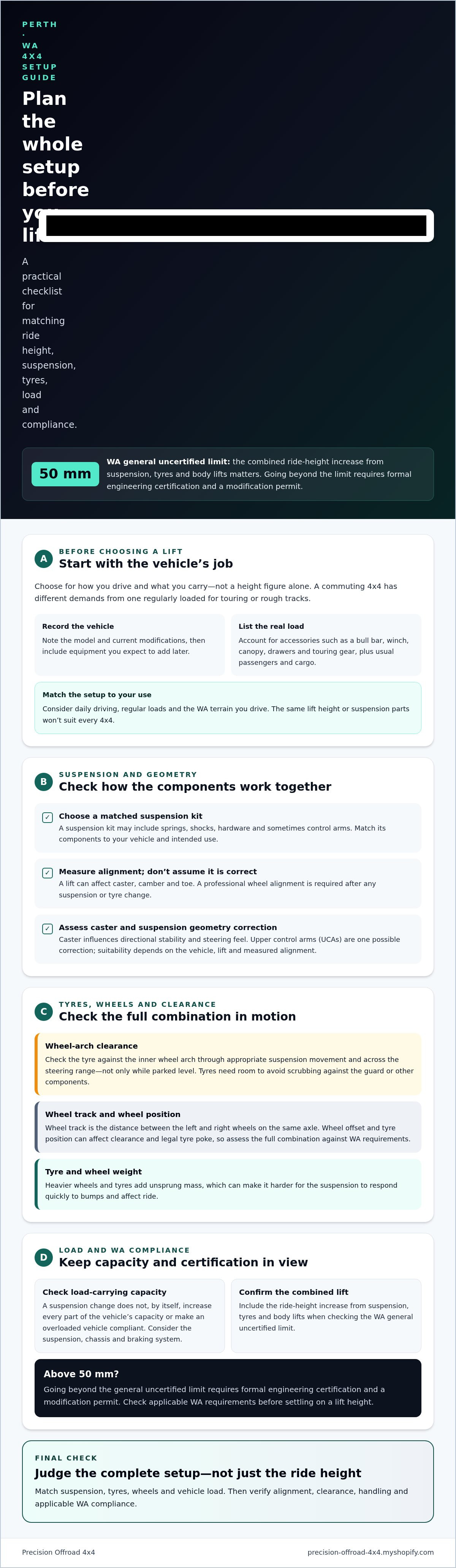
How to check a lifted 4x4 for handling, load and compliance issues in Perth
A lift needs more than a visual check. Follow this sequence to spot issues after the change, then have vehicle-specific measurements and compliance assessed by a qualified professional. Perth roads and local tracks vary, so a setup that works for one vehicle or route won’t automatically suit another.
Post-lift checks for alignment, tyre scrub and road behaviour
- Arrange a wheel alignment. A professional wheel alignment is mandatory after any suspension or tyre change. Keep the alignment results and have any out-of-range angles assessed against your vehicle’s specifications.
- Inspect tyre clearance. Look for signs of contact between the tyre sidewalls or tread and guards, liners or suspension components. Assess clearance through suitable suspension movement and steering positions, not just with the vehicle parked on level ground.
- Pay attention during a controlled road test. On a familiar, safe route, note pulling, wandering, vibration, unusual steering effort or noise. Stop if you notice contact or unsafe handling, and arrange an assessment before driving further.
- Watch for dog‑tracking. Dog‑tracking is a condition where the rear wheels do not follow the front wheels, causing the vehicle to pull to one side. If the vehicle appears to travel at an angle or consistently drifts, don’t try to correct it with steering input alone. Have the alignment and suspension geometry checked.
- Recheck after use. Look for fresh rubbing marks, loose or damaged components, and changes in how the vehicle sits under its usual load. A static inspection can’t confirm how the setup behaves under every driving condition.
Understanding certification, modification plates and load limits
Separate general checks from formal compliance assessment. A modification plate is a permanent plate affixed to a vehicle indicating that a suspension or GVM modification has been certified. It relates to the modification it records and doesn’t replace checking that the vehicle’s current configuration and use meet applicable requirements.
In WA, verify current Department of Transport requirements and the applicable Australian Design Rules before relying on a lift, tyre or GVM modification as compliant. Requirements and approval processes can depend on the vehicle and modification, so don’t apply a general height figure to every setup. Precision Offroad 4x4 holds Licensed Vehicle Modifier certification for assessment and certification within its authorised scope.
Finally, account for passengers, accessories and cargo. Load‑carrying capacity is the amount of weight a vehicle can safely support, considering its suspension, chassis, and braking system. Suspension changes alone don’t establish a higher safe load limit. For a vehicle-specific suspension and compliance discussion, review your 4x4 lift setup with Precision Offroad 4x4.
Choose a matched 4x4 lift setup with Perth off-road specialists
A suitable lift starts with the vehicle’s actual job. Your make and model, existing modifications, accessories, regular load and usual driving conditions all affect which suspension options make sense. Bringing these details into the selection process helps avoid common mistakes when lifting a 4x4, such as choosing components by height alone or overlooking the weight of fitted gear.
What to prepare before selecting a suspension kit
Before comparing options, record:
- Your vehicle’s make, model and year, plus any existing suspension, wheel or tyre modifications.
- Fitted accessories, such as a bull bar, canopy or drawers, and the passengers and cargo you regularly carry.
- Your typical driving conditions, from daily road use and touring to the off-road terrain you visit.
- The issue you want to address, such as limited clearance, a vehicle that sits unevenly under load or handling that changes when loaded.
Be specific about how you use the vehicle. A 4x4 carrying touring equipment most weeks has different suspension demands from one driven mainly unladen around Perth. Your intended terrain matters too, but no single setup suits every track or vehicle.
When quality suspension options enter the comparison
Once you’ve defined the vehicle and its use, compare available suspension options by vehicle fitment, accessories, load requirements and intended driving. As an authorised retailer of leading brands, Precision Offroad 4x4 can help you compare matched components against your vehicle’s requirements, rather than relying on brand claims alone. The right choice depends on the complete setup, not just a product name.
If your modification requires certification, it must meet the relevant requirements. Precision Offroad 4x4 holds Licensed Vehicle Modifier certification for modifications assessed within its authorised scope. Requirements can differ by vehicle and modification, so check the rules that apply to your specific setup.
Bring your vehicle details, accessory list, typical load and intended use together before settling on a suspension setup. That gives you a clearer basis for choosing components suited to how you drive. Explore 4x4 suspension options for a considered match to your vehicle and use.
Set up your 4x4 for the way you drive
Common mistakes when lifting a 4x4 often start with choosing a height before considering the vehicle’s load, accessories and intended terrain. A suitable setup matches springs, shock absorbers and tyres, then checks geometry, alignment and clearance as a complete system.
After a suspension or tyre change, arrange a professional wheel alignment and inspect for tyre contact and handling changes. Check load limits and verify the current WA requirements that apply to your vehicle and modifications. A lift that looks right still needs to work safely and compliantly on the road.
Precision Offroad 4x4 is a Perth-based specialist and an authorised Dobinsons and Fulcrum retailer. Its Licensed Vehicle Modifier certification applies to modifications assessed within its authorised scope. Start with your vehicle details, regular load and driving plans, then explore 4x4 suspension options suited to your setup.
Frequently Asked Questions
Can lifting a 4x4 affect its handling?
Yes. A lift can affect handling, depending on your vehicle and the components fitted. Changing ride height may alter suspension geometry and steering feel, and could affect stability. A professional wheel alignment and vehicle-specific checks help assess the finished setup. Before regular road or track use, arrange an assessment of how your 4x4 behaves under its usual load and driving conditions.
What happens if I lift my 4x4 without correcting its suspension geometry?
Changed suspension geometry can affect wheel alignment and steering behaviour, but symptoms vary by vehicle and lift setup. Caster angle, the steering axis tilt that influences directional stability and steering feel, is one measurement to assess. Suitable correction components, including upper control arms, may be relevant for some vehicles, but aren’t a universal requirement. Have the finished setup measured and assessed rather than assuming new suspension parts have restored the correct geometry.
Do I need a wheel alignment after lifting a 4x4?
Yes. A professional wheel alignment is required after any suspension or tyre change. Alignment checks steering and wheel angles after components have changed, helping identify settings that need attention. Correct settings depend on your vehicle, so don’t rely on generic figures. Keep the relevant workshop documentation and follow the vehicle’s requirements. If the 4x4 still pulls, wanders or feels unusual after alignment, arrange a further vehicle-specific assessment.
Can a suspension lift cause tyre scrub?
Yes. Tyre scrub can occur if the tyre contacts the inner guard, liner or suspension components. Tyre size, wheel track, suspension movement and wheel-arch clearance all influence the risk. A visual check with the vehicle parked may not show contact during steering or suspension compression. Have clearance assessed through suitable suspension movement with the intended wheel and tyre combination fitted. Don’t assume a particular lift height or tyre size will fit every 4x4.
Does a 4x4 lift affect load-carrying capacity?
Ride height alone doesn’t establish how much weight your 4x4 can safely support. Load-carrying capacity considers the suspension, chassis and braking system, while accessories, passengers and cargo all contribute to the vehicle’s total load. A heavier-duty spring doesn’t automatically change the vehicle’s certified capacity. Check the vehicle-specific limits and requirements that apply to your setup, especially if you regularly carry touring equipment or have fitted accessories.
Do I need a modification plate for a 4x4 suspension lift in WA?
Whether certification or a modification plate is required depends on the vehicle and the modification. A modification plate is a permanent plate affixed to a vehicle indicating that a suspension or GVM modification has been certified. Don’t assume one rule applies to every lift. Before making a compliance decision in Perth or elsewhere in WA, verify current WA requirements and the Australian Design Rules relevant to your vehicle and modification.
How do I avoid choosing the wrong suspension kit for my 4x4?
Start with your vehicle’s make, model and year, then record existing modifications, accessories, regular load and intended terrain. Compare springs and shock absorbers as parts of a matched suspension kit, rather than as isolated upgrades. Specifications and suitability vary between vehicles and setups. Precision Offroad 4x4 is a Perth-based authorised Dobinsons and Fulcrum retailer, with suspension options to compare against your vehicle’s fitment and how you use it.
What is shock fade, and why should 4x4 owners know about it?
Shock fade is loss of damping performance in a shock absorber due to overheating, leading to reduced control. Damping controls spring movement and helps manage how the vehicle responds to bumps. Terrain, load and suspension setup all influence component performance in real-world use, so there’s no single operating threshold for every 4x4. If control changes during use, have the suspension assessed for your vehicle and driving conditions. Explore 4x4 suspension options with Precision Offroad 4x4.