

A taller lift isn’t automatically the better fit. When looking at Fulcrum suspension kits Australia, the right choice depends on your vehicle, its load and how you use it; the Easy Lift kit for Holden Colorado RG and Isuzu D-Max vehicles provides 45 mm of lift at the front and rear. Compare the kit’s lift and components with your setup, rather than choosing by height alone.
It’s easy to focus on ride height, but spring and shock selection, installation and wheel alignment all affect how your 4x4 behaves on the road and tracks. This guide explains how to compare kit options, plan installation and alignment, and interpret reported ride changes without treating someone else’s experience as a guaranteed result. You’ll also see what to weigh up for sand driving and remote touring, where vehicle load and intended use matter to your setup. Use these points to narrow your options and make a more informed suspension decision.
Key Takeaways
- Match the kit to your exact vehicle and its accessories, not lift height alone.
- Plan installation and wheel alignment together so suspension geometry can be assessed after the lift.
- Assess ride reports against your own vehicle load and driving needs; an unladen setup can feel different from a touring rig.
- For sand and remote touring, consider how your regular load and terrain affect the suspension setup you choose.
Installation and wheel alignment considerations
Compare the lift, fitting method and alignment plan before choosing a kit. A suspension change alters ride height and can affect steering geometry.
Lift Kit Installation and Ride Height
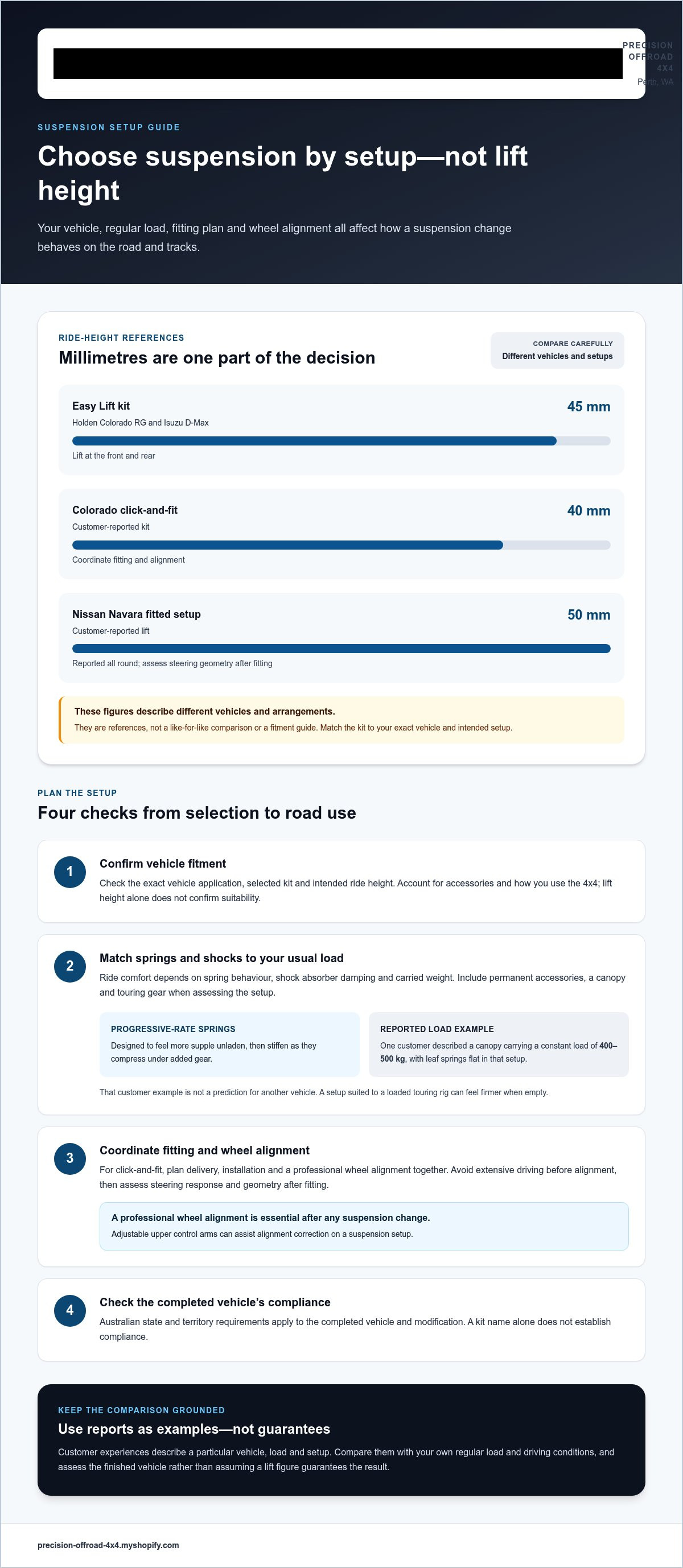
A lift kit changes the vehicle’s height through its suspension components. The result depends on the vehicle and selected kit, so figures from another model aren’t a fitment guide. One customer reported a 40 mm Colorado lift kit ordered through Fulcrum’s click-and-fit option; another reported a Nissan Navara lifted 50 mm all round after fitting Fulcrum suspension and parts.
These examples show why it’s important to compare vehicle-specific fitment and installation arrangements, not just headline lift measurements.
| Option | Ride-height reference | Alignment consideration |
|---|---|---|
| Colorado click-and-fit | Customer-reported 40 mm kit | Coordinate fitting and alignment |
| Nissan Navara fitted setup | Customer-reported 50 mm all round | Assess steering geometry after fitting |
| Adjustable upper control arms | Used with a suspension setup | Can assist alignment correction |
Choose an option that suits your vehicle, intended ride height and alignment needs.
With click-and-fit, coordinate delivery, installation and a professional wheel alignment. Avoid extensive driving before alignment. After fitting, assess steering response and alignment instead of assuming the lift figure guarantees the final result.
Installation Risks and Drawbacks
The main risks are unsuitable fitment, changed steering geometry and poor alignment after installation. These can affect handling and tyre wear, so select a Fulcrum kit for the specific vehicle and arrange alignment after fitting.
For a 2024 Nissan Navara Black Edition, a customer reported ordering adjustable upper control arms to help achieve correct wheel alignment. Another customer recommended fitting adjustable arms at the same time as the suspension, allowing alignment to be completed correctly on the first attempt.
For professional installation, have the suspension components fitted as a matched setup, then arrange alignment and assess steering geometry. The fitting process should account for the chosen kit and vehicle, not treat ride height as the only goal. A professional wheel alignment is essential after any suspension change.
Reported ride comfort and handling improvements
Ride comfort depends on spring behaviour, damping and the load the vehicle carries. Customer reports can offer useful examples, but compare each setup with your vehicle and driving conditions.
Are Fulcrum suspension kits legal under Australian state and territory vehicle rules? Legality depends on whether the completed vehicle and modification meet the requirements that apply in its state or territory. A kit name alone doesn’t establish compliance.
Spring rates, vehicle loads and ride comfort
A customer reported that Fulcrum lowered a 2012 Ford Fiesta by 30 mm using Whiteline springs, with improved handling and ride. That experience describes one vehicle and setup; it doesn’t predict how a 4x4 will respond. Vehicle type, spring selection, shock absorber damping and carried weight all shape the result.
Progressive-rate springs are designed to remain more supple when the vehicle is unladen, then stiffen as they compress under added gear. This can help balance everyday comfort with support when touring equipment is carried. The ride still depends on the spring rate selected for the vehicle’s regular load and how that weight is distributed.
Load matters. One customer reported a canopy carrying a constant load of 400-500 kg, with the leaf springs flat in that setup. That example shows why a ride assessment should include permanent accessories and touring gear, not just the empty vehicle.
To compare reports with your needs, record the vehicle’s usual load, including a canopy and regularly carried equipment. Note whether it spends more time unladen or loaded, then assess comfort and handling in those conditions. A setup suited to a frequently loaded touring vehicle can feel firmer when empty. A light-load choice, by contrast, may provide less support when gear is added. Judge reported improvements against the described load and use, not the headline result alone.
Online suspension kit ordering and product selection
Online selection works best when you match the vehicle, kit type and fitting plan. Compare the components and installation arrangements before ordering.
Fulcrum and Other Australian Suspension Brands
Compare Australian suspension brands by vehicle fitment, component design and intended use, rather than brand name alone. Fulcrum’s Formula 4x4 range uses twin-tube shock absorbers, while its Bilstein kits use high-pressure monotube technology. Those designs provide a practical comparison point, but don’t establish which kit suits every vehicle.
Check the exact vehicle application, spring type and shock design for each option. Then weigh those details against your usual load and driving conditions. This makes for a more useful comparison than relying on broad claims about ride quality or brand reputation.
Kit Costs and Installation
There’s no single installed amount that applies to every Fulcrum kit and vehicle. Kit selection and installation are separate parts of the decision, while the vehicle application and fitting arrangement affect what’s included.
Fulcrum’s online listings distinguish kit selection from fully installed options. Before ordering, identify your exact model and intended setup, then compare the listed kit with the installation arrangement you need. Include fitting and post-installation alignment in your plan.
Included Kit Components
Fulcrum describes its performance suspension kits as including lowering springs, sway bars and links, bushings, and installation hardware. Components vary by kit type: Formula 4x4 uses twin-tube shocks, while Bilstein kits use high-pressure monotube technology. Read the selected kit’s component details against your vehicle and intended use.
Warranty coverage follows the applicable kit terms. For servicing, suspension checks are recommended every 10,000 km or after a major off-road excursion.
For an online order, work through the details in sequence: confirm your vehicle’s make, model and variant; select the intended suspension application; review the listed components; then coordinate fitting and alignment. Matching the vehicle correctly matters because model-specific suspension and accessories can affect fitment. Keep the order details with your vehicle records so you can identify the installed components and future inspection needs.
Suspension choices for sand and remote touring
Sand driving and remote touring place different demands on a 4x4 suspension setup. Choose components around the vehicle’s regular touring load, terrain and time between service points, not lift height alone.
For sand driving, predictable suspension movement helps the tyres maintain contact across changing surfaces. Added equipment changes vehicle weight and spring compression, so assess the fully packed vehicle rather than an empty driveway setup. Include permanent accessories, water, fuel and recovery gear. Their placement also affects front-to-rear balance and suspension response.
Remote routes add another factor: heat and sustained rough-road use can challenge shock absorber damping. Fulcrum’s Formula 4x4 range uses twin-tube shock absorbers. Its shocks are described as having large bores and high-grade oil designed to dissipate heat quickly. This design detail is relevant when comparing options for extended driving, but your vehicle’s load and route still shape the required setup.
Before departure, inspect the suspension and note any changes in ride height, handling or noise. Look for visible damage, leaks or loose components, and check that the vehicle sits evenly under its touring load. Secure and distribute carried gear consistently. If the vehicle sits differently once packed, it may need a setup selected for that regular load rather than occasional light use.
Fulcrum suspension is recommended for inspection every 10,000 km or after a major off-road excursion. Build that interval into your maintenance plan, particularly after demanding remote travel. Inspect components after a rough section, and address changes before continuing farther from support. Regular checks help identify wear before it affects the next leg of a trip.
For a touring setup, list your permanent accessories and usual trip load, then compare kits against those demands. Explore Fulcrum suspension kit options to narrow your selection around the vehicle and its intended use.
Precision Offroad 4x4: Wheel Upgrades
Precision Offroad 4x4 can help you bring your suspension choice together with suitable wheel upgrades. This is useful when changing suspension and wheels as part of one build, since tyre size, clearance and vehicle use all affect fitment decisions.
Compare Fulcrum Suspension Kits with Dobinsons Suspension Kits, and consider how your wheel and tyre choices suit the vehicle and intended touring load. Maxxis Tyres are also available in the range. Keep your priorities clear: everyday road use, off-road terrain and carried equipment all affect the setup you need.
Use these comparisons to narrow your options, then contact Precision Offroad 4x4 to discuss your suspension and wheel upgrade requirements.
Set up your next suspension decision
Before committing to a suspension change, record the vehicle’s current setup. Note existing modifications, handling concerns and the kit details you’re considering. This gives you a useful reference after the work and helps make future maintenance discussions specific.
Think beyond installation day, too. Save the product information and alignment results with your vehicle records so you can compare later inspections with the original setup. If your vehicle’s use changes, those records help clarify what changed and when. Choosing Fulcrum suspension kits in Australia starts with knowing what’s already fitted and what you want the vehicle to do next.
For practical guidance on your options, contact Precision Offroad 4x4 for advice. A well-documented plan gives you a confident starting point for your next drive.
Frequently Asked Questions
What Fulcrum suspension kits are available in Australia?
Fulcrum’s Australian range includes vehicle-specific Easy Lift kits and performance suspension packages. Easy Lift is a distinct option for selected 4x4 applications, while performance kits suit different vehicle requirements. Selection is application-based, not a universal fit. Match the listed vehicle series and suspension type before comparing options. For a useful shortlist, separate the lift you want from the suspension setup your vehicle requires.
Which vehicle makes and models do Fulcrum suspension kits fit?
Available applications include Holden Colorado RG, Isuzu D-Max, Mitsubishi Triton ML-MN, Toyota Hilux GGN and GUN, and Nissan Navara D40. Fitment is model-specific: a Triton ML-MN application doesn’t establish fitment for another Triton series. Identify your vehicle’s exact model and series, then match those details to the kit listing. Don’t rely on the badge alone when comparing applications.
Where can I buy or install Fulcrum suspension kits in Australia?
In Perth, Precision Offroad 4x4 retails Fulcrum Suspension Kits through its dedicated online storefront. Buying a kit and arranging installation are separate steps. The retailer also offers Dobinsons Suspension Kits and Wheel Upgrades for owners planning a wider vehicle build. When organising the fitting, keep the kit’s application details available and include the required wheel alignment in your installation plan.
How much lift do Fulcrum suspension kits provide, and how does lift affect handling?
Lift depends on the kit and vehicle application. The Easy Lift kit for Holden Colorado RG and Isuzu D-Max vehicles provides 45 mm of lift at the front and rear. Raising a vehicle changes its centre of gravity, which can affect cornering response. Spring and damping setup also influence how the vehicle feels, so the lift figure alone can’t predict handling.
How do I choose the right Fulcrum suspension kit for towing, touring, or off-road use?
Start with the vehicle’s main job, then narrow your options by exact model application. For towing, consider how the trailer affects rear suspension behaviour. For touring, account for permanently fitted equipment. For off-road driving, compare the kit’s intended suspension design with the terrain you encounter. Assess wheel and tyre clearance through steering and suspension movement, too, rather than judging fitment from parked ride height alone.