

A lift doesn’t automatically mean you need adjustable control arms. So, do I need adjustable control arms after a lift? It depends on how the change has affected your front suspension geometry and whether an alignment can bring caster and camber within the correct range.
If your 4x4 feels vague through the steering, tracks poorly or has reduced tyre clearance after a lift, it’s worth investigating. These symptoms can point to a geometry issue, but they don’t confirm that upper control arms (UCAs) are the solution. Use a vehicle-specific assessment and alignment measurements to distinguish necessary suspension geometry correction from an optional upgrade.
This guide explains what adjustable UCAs change, when standard arms may be adequate and which measurements warrant further assessment. It also covers a compliance consideration in Western Australia: a lift calculation can include suspension, tyres and body lift together. Use the checks below to plan a complete lift assessment for predictable handling and applicable compliance requirements.
Key Takeaways
- Whether you ask “do I need adjustable control arms” depends on your vehicle, lift setup and measured alignment results, not lift height alone.
- Identify your vehicle and suspension components, then compare alignment readings with verified specifications before choosing a correction.
- Standard control arms may be suitable if the lifted vehicle can achieve the required alignment settings.
- Consider ride height, load and other modifications when assessing suspension geometry for Perth road and track use.
- Use a vehicle-specific assessment to decide whether adjustable upper control arms (UCAs) are needed as part of your suspension setup.
Do I need adjustable control arms after a 4x4 lift?
No. A lift alone doesn’t prove adjustable arms are necessary. The answer to “do I need adjustable control arms” depends on your vehicle’s suspension design, the lift setup and the alignment readings after the change. Some vehicles can achieve the required settings with standard arms. Others may need extra adjustment to bring front geometry within the vehicle’s specifications.
Adjustable arms are a possible correction, not an automatic requirement. Before choosing parts, identify the vehicle and suspension components, then measure alignment and compare the results with verified specifications for that model. Poor steering feel or uneven tyre wear are reasons to investigate, but symptoms alone don’t identify which component needs changing.
Suspension geometry correction means adjusting or changing components to restore suitable caster, camber and toe after a modification. These settings affect how the wheels meet the road and how the vehicle responds through the steering. A vehicle-specific assessment shows whether the existing adjustment range is enough or another correction is needed.
What adjustable upper control arms change
Adjustable upper control arms (UCAs) can provide a way to adjust front caster and camber. A control arm connects the wheel assembly to the vehicle’s suspension structure and guides its movement. The basic role of a control arm helps explain why its position affects wheel geometry. Adjustable designs vary in fitment and adjustment range, so check that an arm suits your vehicle and suspension setup.
Toe is a separate setting. It describes whether the front edges of the tyres point slightly towards or away from each other when viewed from above. UCAs don’t directly adjust toe. Toe is set through other steering and alignment adjustments, so it still needs to be measured and set during alignment.
This distinction helps when you read an alignment report. If caster or camber cannot be brought into the required range using the vehicle’s existing adjustment, adjustable arms may be one option to assess. If those settings are already within specification, arms may not be needed for geometry correction.
Why a lift can change front-end geometry
Raising ride height changes the resting position of suspension components. This can alter control-arm angles and shift alignment settings. The effect depends on the vehicle platform, suspension layout and parts fitted, so lift height alone isn’t a universal trigger for adjustable arms.
Caster angle is the forward or backward tilt of the steering axis. It influences steering feel and directional stability, but the effect of a lift depends on the vehicle and its final alignment. If the alignment shows caster outside the verified specification, assess the available correction rather than guessing from ride height.
Start with measured results. A recorded alignment gives you a clear basis for deciding whether standard arms retain enough adjustment or adjustable UCAs are needed.
How lift height and alignment results determine whether you need UCAs
Use measurements to guide the decision, not a lift-height rule of thumb. A modest lift can affect alignment differently across vehicle platforms. Even the same vehicle may respond differently depending on its suspension configuration and other modifications. To assess whether adjustable upper control arms (UCAs) are appropriate, follow a vehicle-specific sequence:
- Identify the vehicle and lift. Record the model, suspension components, ride height and any other changes that could affect the front end.
- Measure the alignment. Get current caster, camber and toe readings after the suspension work.
- Assess correction options. Compare the readings with the manufacturer’s specifications and determine whether the existing adjustment range can achieve them.
The alignment sheet shows whether the specified settings were achieved. That evidence is more useful than assuming a particular lift height automatically requires adjustable arms. If the settings are within specification, the alignment has achieved its target. If a setting remains out of range after adjustment, investigate further. That result doesn’t prove a UCA is the only possible cause or correction.
Read the alignment results before choosing parts
Caster is the forward or backward tilt of the steering axis. Camber is the inward or outward tilt of the wheel viewed from the front, while toe describes whether the tyres point slightly inwards or outwards viewed from above. Together, these settings affect tyre contact and steering behaviour. For a basic explanation of the functions of a control arm, see JD Power’s overview of its role in suspension and steering.
Compare each measured value with the specifications for your exact vehicle. Don’t use generic figures from another model or assume a value is acceptable because it is close. A reading inside the specified range is different from one that remains outside it after adjustment. This helps show whether standard arms retain enough adjustment or whether further geometry correction needs assessment.
Separate geometry symptoms from other faults
Tyre wear, steering pull, unsettled tracking or dog‑tracking are signs worth investigating, not proof that the arms are at fault. Worn bushes, incorrect installation and other suspension changes can also affect handling. A symptom can signal a need for diagnosis, but it can’t identify the faulty part by itself.
Start with the alignment report and a check of the suspension condition. If readings are out of specification, assess the full setup before selecting parts. If you’re planning a suspension change, explore quality components and complete suspension kits as part of a vehicle-specific lift assessment with Precision Offroad 4x4.
Standard control arms vs adjustable arms: what changes in practice?
If you’re asking “do I need adjustable control arms”, compare what standard arms can achieve with your vehicle’s alignment requirements. Standard arms have a fixed design and rely on factory adjustment points. Adjustable upper control arms (UCAs) provide another way to alter front caster and camber. Neither option is automatically right for every lifted 4x4.
| Consideration | Standard control arms | Adjustable control arms |
|---|---|---|
| Adjustment | Use the vehicle’s existing alignment adjustment points. | Allow additional adjustment of front caster and camber, depending on the arm’s design. |
| Fitment | Factory components, subject to their condition and the vehicle’s setup. | Must suit the specific vehicle and suspension configuration. |
| Alignment outcome | Can be suitable if the required settings are achieved within the available range. | May help if standard adjustment cannot achieve specified caster or camber. |
| Intended application | Vehicles whose existing geometry can be aligned to specification. | Setups that need extra adjustment as part of a considered geometry correction. |
Adjustable arms aren’t a general fix for every post-lift concern. They don’t directly set toe, and they won’t automatically resolve steering pull, tyre wear or wheel‑arch clearance issues. These problems may have other causes. Assess the full suspension and alignment rather than treating the arms as a cure-all.
When standard arms may be sufficient
Standard arms may remain suitable if an alignment brings the vehicle’s caster and camber within the manufacturer’s specifications, with toe set correctly through its own adjustment. That result shows the existing setup can achieve the required settings. Check the actual vehicle and lift configuration rather than assuming another model or setup will behave the same way.
When adjustable arms may be worth considering
Adjustable arms may be worth assessing if caster or camber remains outside the specified range after the available adjustments have been made. The lift configuration and intended use, including regular load and road or track driving, can inform the decision. Arm design and fitment must suit the vehicle and suspension setup. An incompatible part may not provide the correction required.
Make the choice by matching alignment evidence to the vehicle’s needs. If standard arms achieve the specified settings, replacing them may not be necessary for geometry correction. If they can’t, adjustable arms are one option to assess alongside the rest of the suspension and its condition.
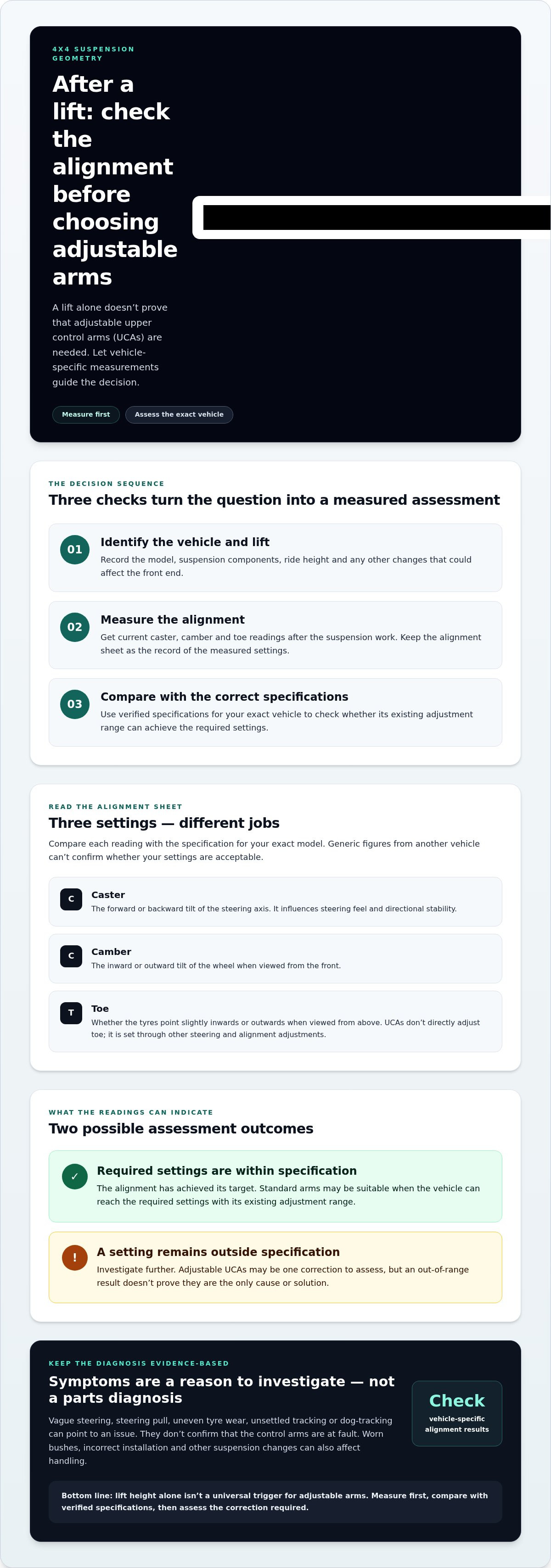
What to check after a lift before fitting adjustable control arms
Before deciding “do I need adjustable control arms?”, document the complete setup. Note your vehicle model, suspension components, measured ride height and other modifications, such as different wheels or tyres. These details make the assessment specific to your 4x4 rather than based on a general lift-height assumption.
Next, collect the wheel-alignment readings and compare caster, camber and toe with verified specifications for your vehicle. Record which settings are within range and whether the available adjustment has been used fully. An out-of-range result calls for further assessment, but doesn’t prove adjustable arms are the answer.
Check alignment, clearance and handling
Arrange a professional wheel alignment after a suspension change. It measures wheel angles and shows whether they can be set to the vehicle’s specifications. Also check wheel‑arch clearance and inspect for tyre scrub as the suspension moves through its relevant travel. Steering feel and tracking on the road are useful observations, but they don’t replace alignment measurements or a physical inspection.
Look for contact marks on the tyre or inner guard, and note whether handling changes with load or road conditions. Use a 4x4 suspension guide to understand how ride height, components and vehicle use fit into the wider setup.
Consider compliance and the full suspension setup
Suspension changes can have modification approval implications. Before fitting parts, verify the current Western Australian requirements that apply to your vehicle and proposed setup. Don’t rely on a general rule or assume a component’s description alone establishes compliance. Consider the complete modification, including suspension, tyres and other changes.
Precision Offroad 4x4 is a Perth-based specialist with Licensed Vehicle Modifier certification and modification plate capability. We take a vehicle-specific approach to suspension changes and their compliance considerations. A modification plate is relevant where a modification has been certified. It isn’t an automatic outcome for every lift or arm installation.
- Vehicle and parts: record the model, suspension components, ride height and other changes.
- Alignment: keep the readings and compare them with the correct vehicle specifications.
- Clearance: check for tyre contact through relevant suspension movement.
- Road behaviour: note steering feel and tracking for assessment alongside the measurements.
- Compliance: establish which current WA requirements apply before proceeding.
Use these checks to decide whether the standard adjustment range is adequate or adjustable arms should be considered as part of the full suspension setup. Precision Offroad 4x4 supplies Dobinsons and Fulcrum suspension options for vehicle-specific builds. Explore Dobinsons and Fulcrum suspension options.
Choosing adjustable control arms for a Perth 4x4 setup
The answer to “do I need adjustable control arms” should come from your alignment results and the demands of your complete setup, not an automatic parts upgrade. Consider your vehicle’s load, suspension components, wheel and tyre fitment, and how you use the 4x4 on Perth roads and WA tracks. If standard arms allow alignment to meet the vehicle’s specifications, adjustable arms may not be needed for geometry correction. If they don’t, assess compatible arms as one possible solution.
Include your intended load and driving conditions in the assessment. A vehicle used mainly for commuting has different demands from one regularly carrying touring gear or travelling on rough tracks. Added weight and suspension changes can affect how the vehicle sits and behaves. They don’t automatically mean you need UCAs, but they are relevant when evaluating the final setup.
Match the arms to the vehicle and suspension kit
Fitment depends on your vehicle platform and complete suspension configuration. Record the springs, shock absorbers, ride height and other front-end modifications before selecting arms. Don’t assume a particular suspension kit includes adjustable arms, or that an arm designed for one model suits another. Wheel and tyre changes also affect fitment, so review a 4x4 wheel upgrade guide when checking clearance and wheel fitment. Treat any proposed arm as part of the whole suspension system, not a stand-alone fix.
Precision Offroad 4x4 is an authorised Dobinsons and Fulcrum suspension retailer. These ranges are options when planning a lift, but the right configuration depends on your vehicle and the correction its alignment requires. Choose components after assessment rather than assuming every build needs the same parts.
Plan the next step after deciding
Keep a clear record before changing parts. Note your vehicle model, the exact suspension components fitted, any wheel or tyre changes, and the alignment readings. This provides a baseline for assessing what the setup needs and whether a proposed change addresses a measured issue.
A professional wheel alignment and applicable compliance checks remain necessary considerations after suspension modification. Confirm the current requirements for your vehicle and proposed changes in Western Australia. An alignment result alone doesn’t settle compliance. Where a modification needs certification, consider the relevant process for the complete setup.
In practical terms, consider adjustable arms when measured alignment and the specific suspension configuration call for additional caster or camber correction. If the existing adjustment achieves the vehicle’s required settings, fitting arms by default may not add a necessary correction. Match the choice to your load, wheel and tyre fitment, and intended road or track use. Explore 4x4 suspension options to plan a setup around your vehicle’s requirements.
Make your next suspension decision with confidence
Turn your alignment report into a practical plan for your 4x4. Keep the readings with a record of the suspension components, ride height, load and wheel or tyre changes. This gives you a useful baseline for future inspections and keeps decisions grounded in your vehicle’s actual setup.
So, do I need adjustable control arms? Consider them when measured geometry and the available adjustment show further correction is needed. If the vehicle reaches its specified alignment settings with standard arms, fitting adjustable arms may not be necessary. Include alignment and applicable WA modification requirements in your plan before driving with a changed setup.
Choose components to suit your vehicle and how you use it, then build from a sound assessment. Explore 4x4 suspension options and take the next step towards a well-matched setup.
Frequently Asked Questions
Do adjustable control arms improve handling on a 4x4 that has not been lifted?
Not automatically. Adjustable arms provide extra scope to alter front caster and camber, but that doesn’t guarantee better handling on a standard-height 4x4. Base the decision on the vehicle’s condition, alignment readings and intended setup. For example, worn bushes or joints may need attention before alignment adjustments can be assessed. Changing parts without a measured reason may not address the handling concern.
Can adjustable control arms fix uneven tyre wear?
They can help address uneven wear if incorrect caster or camber is contributing and the arms provide the adjustment your vehicle needs. Tyre wear can also relate to incorrect pressures, wheel balance, tyre condition, load or other mechanical issues. Note which tyres are wearing and where, then have the vehicle and alignment assessed. Don’t assume adjustable arms will solve the problem without first identifying its cause.
Do I need adjustable control arms for larger tyres?
No. Tyre size alone doesn’t determine whether adjustable arms are needed. Larger tyres raise separate questions about fitment and clearance, while arms are considered for front alignment correction. Check for contact at full steering lock and through relevant suspension movement, and assess the wheel and tyre combination on the vehicle. If alignment remains within the manufacturer’s specifications, the tyre change by itself doesn’t establish a need for adjustable arms.
Will adjustable control arms change my 4x4’s wheel track?
Their primary role is to provide adjustment for front suspension geometry, not to set wheel track. Wheel track is the distance between the left and right wheels on an axle, while caster and camber describe alignment angles. The effect on wheel position depends on arm design and vehicle fitment, so don’t assume every adjustable arm leaves track unchanged or alters it by the same amount. Check the installed setup and measurements.
Can I fit adjustable control arms without getting a wheel alignment?
You shouldn’t skip the alignment. Fitting arms changes suspension components and can alter front wheel angles, so arrange a professional wheel alignment after the work. The technician can measure caster, camber and toe, then compare the results with your vehicle’s specifications. Without those readings, you won’t know whether the settings are correct. In Perth, include alignment in the job plan rather than treating it as an optional final check.
Do adjustable control arms affect modification compliance or warranty?
It depends on your vehicle, the full modification and the current requirements in Western Australia. Check the relevant WA rules for the proposed setup, and read the vehicle and component warranty terms before changing parts. Don’t assume an adjustable arm automatically makes a lift compliant or that fitting one automatically cancels a warranty. Keep records of the parts fitted and work completed to support any later compliance or warranty assessment.