

Is a three-inch lift still the right choice if it compromises steering geometry, tyre clearance or compliance? In Western Australia, a 3-inch (75mm) suspension lift exceeds the 50mm combined lift limit permitted without engineering certification. This Dobinsons 3 inch lift kit review looks beyond advertised height to the complete vehicle setup, so you can weigh up fitment, handling and compliance before choosing a kit.
Whether the kit fits your 4x4 and delivers the clearance you want depends on more than its stated lift. Your vehicle’s load, tyre size, suspension geometry and intended terrain all affect the result. Use the checks below to compare the kit’s vehicle application, claimed lift height and supporting components with the way you actually drive.
We’ll also explain why suspension, tyre and body lifts count together in WA, and why a three-inch lift requires formal engineering assessment and certification. Precision Offroad 4x4 is a Perth-based specialist and authorised Dobinsons retailer. We focus on practical fitment, real-world driving and compliance, so you can judge whether this lift suits your vehicle and how you use it.
Key Takeaways
- Assess your vehicle’s fitment, accessories, typical load and terrain before deciding whether a three-inch lift suits your 4x4.
- A stated lift height isn’t a guarantee of the finished ride height. Vehicle load and setup can affect the result.
- This Dobinsons 3 inch lift kit review explains what to weigh up for road driving, touring loads and rough tracks.
- Check tyre and wheel-arch clearance, steering geometry and handling as part of the complete suspension setup.
- In WA, a three-inch lift exceeds the 50mm combined lift limit permitted without engineering certification. Factor applicable compliance requirements into your decision.
Is a Dobinsons 3-Inch Lift Kit Right for Your 4x4?
Start with your vehicle, its usual load, how you drive and the compliance pathway. Lift height alone isn’t enough to choose a setup. A three-inch lift may suit a 4x4 built for regular off-road use, but it may not be the best match for an unloaded commuter or a touring vehicle that spends most of its time on sealed roads. Your priorities determine which trade-offs matter most.
The lift figure is a stated target, not a guaranteed finished ride height for every vehicle. Model and configuration, accessories, carried equipment and spring selection can all affect the result. Before comparing Dobinsons options, confirm the application for your exact make, model and year. Then consider how the vehicle will sit and handle in your normal driving conditions.
Lift-kit suitability depends on vehicle fitment, actual load, intended use, tyre clearance, suspension geometry and the compliance requirements for the complete vehicle.
What a three-inch lift changes beyond ride height
A suspension kit changes more than the distance between the chassis and the ground. Springs support the vehicle, while a shock absorber controls spring movement. Changing their position and operating range affects how the suspension responds as the wheels move over bumps. For an overview of how these parts contribute to handling and ride quality, see this guide to vehicle suspension systems.
Raising the suspension can also change suspension geometry. Suspension geometry correction may need consideration to help restore suitable steering and wheel alignment angles. The required components depend on the application. Check tyre fitment separately: measure wheel‑arch clearance and consider where the tyre could move through suspension travel. A lift doesn’t guarantee clearance for a larger tyre.
Match the lift to your vehicle and driving
For unloaded commuting, ride comfort, predictable steering and stable behaviour on sealed roads may matter more than maximum clearance. A touring vehicle has different requirements. Bull bars, recovery gear, drawers, a canopy and trip equipment add load, which can affect ride height and suspension response. Assess the vehicle as you drive it, not only in its empty setup.
Regular off-road driving may make extra clearance useful, but the terrain and the rest of the build still matter. Tyres, wheel choice and carried equipment influence the finished setup. No lift height removes the need to check fitment and handling. In Perth, consider the mix of highway kilometres, touring loads and the tracks you plan to tackle.
Match those needs to the Dobinsons application for your exact vehicle. Check the stated lift, spring specification and listed supporting components against your model and load, rather than treating “three-inch” as a universal result. Compliance also depends on the complete vehicle and applicable WA requirements, so include that assessment before committing to a lift height.
How a Dobinsons Lift Kit Affects Suspension, Geometry and Ride
A lift changes how the suspension supports and controls the vehicle, not just its stance. In a useful Dobinsons 3 inch lift kit review, separate the manufacturer’s stated specifications from results measured on a particular 4x4. A catalogue lift figure describes the intended application. It doesn’t establish the final ride height or handling on a vehicle with its own accessories and load.
Lift height, vehicle configuration and carried load all influence the finished suspension position. Assess the geometry on the vehicle as it will be driven.
Springs, shock absorbers and load-carrying capacity
Springs support the vehicle and compress under weight. Their spring rate describes how much force is needed to compress them by a given amount. A spring selected for regular touring equipment may behave differently from one suited to a lightly loaded daily driver. Too little support for the usual load can leave the vehicle sitting lower. A setup that is too firm for its normal use can affect comfort and wheel response. Match the spring application to the vehicle and its intended load, not lift height alone.
A shock absorber controls spring movement as the suspension compresses and rebounds. It helps manage body movement, but it doesn’t increase the vehicle’s legal load limit. Load‑carrying capacity depends on the complete vehicle, including its chassis and braking system, as well as the suspension. A spring choice can help the vehicle carry its intended load, but it doesn’t by itself raise the vehicle’s approved capacity.
Record the vehicle’s accessories and typical carried equipment before reviewing specifications. A bull bar, canopy, drawers and touring gear change the load the suspension supports. Check the Dobinsons specification for your exact application rather than assuming a particular spring rate or shock design applies to every kit.
Geometry, steering feel and tyre clearance
A suspension lift can alter steering geometry. One key measurement is caster angle, the forward or backward tilt of the steering axis. Caster influences directional stability and steering feel, including how the vehicle tracks and returns towards centre after a turn. A wheel alignment gives you measured angles for the vehicle, rather than relying on appearance or a nominal lift figure.
Upper control arms (UCAs) may be considered where the lift and vehicle application make additional suspension geometry correction necessary. They aren’t required for every vehicle or kit. The appropriate parts and alignment targets depend on the vehicle’s suspension design and final setup.
Check tyre clearance with the wheels straight and at full steering lock, then inspect through suspension travel. Look for contact with the inner guards, suspension components and bodywork. A tyre that clears while parked may scrub as the suspension compresses or the steering turns. Wheel choice and tyre dimensions also affect clearance, so assess them with the complete setup.
Precision Offroad 4x4 is an authorised Dobinsons retailer in Perth. Explore Dobinsons suspension kits with your vehicle application and intended load in mind.
Dobinsons 3-Inch Lift Kit Review: Trade-Offs for Road and Track
A higher lift isn’t automatically better for handling or off-road capability. Extra ride height may help meet a clearance goal, but it doesn’t guarantee improved grip, comfort or control. This Dobinsons 3 inch lift kit review separates general suspension principles from findings that require measurements on a specific vehicle. Assess the manufacturer’s specifications alongside the vehicle’s actual configuration before drawing conclusions about road or track performance.
Start with the manufacturer’s specifications for the exact vehicle application. Check the listed lift height, components and any stated load or fitment information. Separate those details from owner expectations and general mechanical effects. Claims about ride comfort, steering response or control need evidence from a vehicle in the relevant configuration, not just a product description.
Compare the setup with your driving priorities
Use the table to frame the trade-offs, not as a promise of a particular outcome. Potential benefits are points to assess; the actual result depends on the vehicle, equipment and complete suspension setup.
| Use | Potential benefit | Trade-off | Verify for your vehicle |
|---|---|---|---|
| Daily road use | More ride height may support a clearance goal. | A changed suspension setup can affect steering feel, ride and body movement. | Alignment, tyre clearance and road behaviour in your normal configuration. |
| Touring loads | A suitable spring choice may better match regular accessories and gear. | Added equipment changes the load the suspension supports; lift alone doesn’t establish capacity. | Typical touring load, listed spring application and the vehicle’s load limits. |
| Rough tracks | Additional height may help address some clearance needs. | Height alone doesn’t confirm wheel travel, tyre clearance or controlled suspension response. | Tyre fitment, suspension movement and handling with the vehicle loaded. |
When a different lift height may suit better
A two-inch lift is a useful comparison if it could meet your clearance needs with less ride-height change. That doesn’t make it right for every 4x4, just as a three-inch option isn’t a universal upgrade. Consider roof loads, touring gear, tyre dimensions and daily driving together. A tall roof load can affect how the vehicle behaves, while tyre choice can change clearance and steering feel.
Compare the exact vehicle application and listed Dobinsons specifications, then assess the full modification package. A useful review reports measured ride height and describes the vehicle’s load and equipment before treating an outcome as repeatable. Without those details, performance claims remain unverified. Precision Offroad 4x4 can help you assess Dobinsons suspension options against your intended use.
Compliance and Fitment Checks Before Buying a Three-Inch Lift
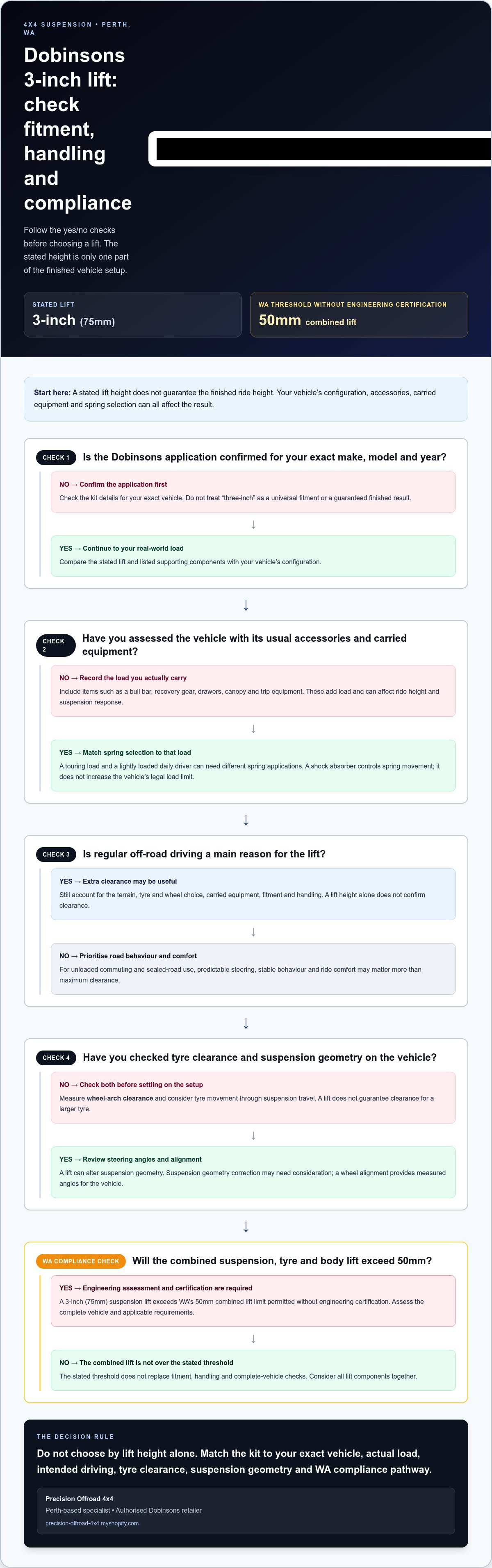
A three-inch lift is a major vehicle modification, so work through fitment and compliance before selecting a kit. For Perth owners, the key point is that WA assesses the combined height change, not just the suspension figure. The Department of Transport’s stated limit without engineering certification is 50mm for the combined lift from suspension, body blocks and larger tyres. A nominal 75mm suspension lift exceeds that threshold, but the requirements for your vehicle depend on the complete modification.
Use this sequence to organise your pre-purchase checks:
- Identify the vehicle. Match make, model, year and variant to the exact Dobinsons application. Note existing suspension changes and factory configuration differences.
- Record the load. List permanent accessories and typical touring equipment. This gives you a realistic basis for assessing spring application and ride height.
- Read the kit specification. Confirm the stated lift, listed components and application notes for your vehicle. Keep manufacturer specifications separate from predictions about your finished setup.
- Check clearance. Assess tyre position and body clearance with the steering turned and suspension moving, not only while the vehicle is parked.
- Confirm compliance needs. Check current Australian and WA requirements for the proposed changes to your specific vehicle before purchase or installation.
Check fitment, wheel track and wheel-arch clearance
Wheel track is the distance between the left and right wheels on the same axle. Wheel offset and tyre choice affect where the tyre sits relative to the guards and suspension, which can change clearance and tyre poke. Check wheel‑arch clearance at full steering lock and through suspension travel, including where the tyre may approach inner guards or suspension parts. A parked vehicle’s appearance can’t establish that it will avoid tyre scrub on the road or track.
Plan certification, alignment and warranty considerations
In WA, a lift that takes the combined height change beyond 50mm requires formal engineering assessment and certification under the applicable modification requirements. The National Code of Practice for Light Vehicle Construction and Modification, also known as VSB14, guides vehicle modifications, but the pathway depends on the vehicle and proposed work. An approved engineer or authorised signatory assesses the complete setup. Certification, a modification permit or a modification plate applies where required, not automatically to every kit purchase.
Precision Offroad 4x4 is a Perth-based specialist with Licensed Vehicle Modifier certification. This credential supports applicable certified work, but it doesn’t mean every vehicle or kit has identical approval requirements. A professional wheel alignment is mandatory after any suspension or tyre change. Read the Dobinsons kit warranty terms and your vehicle manufacturer’s warranty conditions too. Don’t assume either remains unchanged after modification.
Before you choose a lift, review Dobinsons suspension options against your vehicle application, load and compliance pathway.
Choosing a Dobinsons Suspension Kit with Precision Offroad 4x4
The practical takeaway from this Dobinsons 3 inch lift kit review is to match a verified vehicle application to your load, driving needs and compliance requirements. A lift figure alone can’t tell you how the complete vehicle will sit or behave. Precision Offroad 4x4 is a Perth-based specialist and authorised Dobinsons retailer, helping you assess product information against the vehicle you actually drive.
How to narrow down your Dobinsons setup
Before comparing options, gather the details that affect fitment. Record your vehicle’s year, model and variant, current suspension setup, accessories and usual carried load. Include permanent items such as a bull bar, canopy or drawers, then note equipment you carry regularly for touring. A vehicle that’s usually unladen has different requirements from one that carries gear most days.
Next, describe how you use the 4x4. Separate commuting on sealed roads from loaded touring and regular off-road driving. Be specific about the outcomes you need, such as additional clearance or suspension support for a consistent load. This keeps the decision tied to how you use the vehicle, not just its appearance or a lift-height claim.
Then compare Dobinsons specifications for your exact vehicle. Read the listed lift and components as manufacturer information, not a promise of identical ride height or handling across all configurations. If wheel and tyre changes are part of the build, consider their fitment alongside the suspension choice. The parts work as one setup, so don’t make a suspension decision in isolation from the rest of the vehicle.
Keep a short record of the details used to compare options. This helps identify assumptions, such as estimating load from an empty vehicle or relying on tyre clearance checked only while parked. It also gives you a clear basis for refining the setup if your planned accessories or use change.
Next steps for Perth 4x4 owners
Build the complete picture before settling on lift height. Your wheel and tyre choice affects clearance and the vehicle’s final configuration, so review it alongside suspension fitment. A broader 4x4 suspension guide can help you compare priorities across different setups, while a wheel-upgrade guide can help you think through wheels and tyres as part of the same build. Neither a larger tyre nor a higher lift guarantees the result you want.
Include compliance in the selection process, not as an afterthought. Requirements depend on the vehicle and full modification package. Keep the relevant specifications together and account for any assessment that applies to your configuration before committing to parts. This gives you a clearer path from product selection to a finished vehicle suited to its intended role.
Take the next step at your pace. Explore Dobinsons suspension options with Precision Offroad 4x4 and compare them with your vehicle, load and intended use.
Set Up Your Next Step with Clear Measurements
Before changing the suspension, record a baseline for your 4x4. Note its ride height at each corner, current tyre size and accessories. Keep the figures with your build notes. After the work, comparable measurements can help you understand how the vehicle’s stance has changed and give you a reference for future adjustments.
Use this Dobinsons 3 inch lift kit review to plan the whole build, not just select a lift figure. If your tyres, accessories or touring load change later, revisit how the vehicle sits and drives rather than assuming the original setup still suits. A measured approach gives you a clearer basis for deciding what to change next.
Precision Offroad 4x4 is a Perth-based 4x4 specialist, an authorised Dobinsons retailer, and holds Licensed Vehicle Modifier certification. We can help you consider suspension options in the context of your vehicle and intended use, without treating one kit as the right answer for every build.
Explore Dobinsons suspension options with Precision Offroad 4x4 and take the next step towards a setup planned around your 4x4.
Frequently Asked Questions
Will a three-inch lift give every 4x4 exactly three inches of extra ride height?
No. The stated lift is not a guarantee of the finished ride height on your vehicle. Results can vary with the vehicle’s existing condition, configuration, accessories and spring application. For a useful comparison, measure from the wheel centre to a fixed point on the guard before and after installation, on level ground. Record the vehicle’s load at both measurements so you’re comparing like with like.
Can I fit larger tyres after installing a Dobinsons three-inch lift?
Possibly, but a lift alone doesn’t establish which tyre size will fit. The result depends on tyre dimensions, wheel offset, vehicle configuration and clearance as the steering turns and suspension moves. A tyre may contact an inner guard at full lock or under compression even if it looks clear while parked. Check the proposed tyre against the vehicle’s requirements and assess the complete wheel and suspension setup before fitting.
Does a three-inch lift change how my 4x4 handles on the road?
It can. Raising the vehicle changes its suspension setup and may affect steering feel, body movement and stability. The outcome depends on the vehicle and complete modification, so don’t treat lift height as proof of better or worse handling. After installation, pay attention to pulling, unusual steering response or vibration during a controlled road drive. Have the alignment and setup assessed if the vehicle doesn’t track or steer as expected.
Do I need a modification plate for a three-inch lift in Western Australia?
A three-inch suspension lift exceeds WA’s 50mm combined lift limit permitted without engineering certification. It requires formal engineering assessment and certification under the applicable pathway. Whether a modification plate is issued depends on the approved modification process for your vehicle. Suspension, body lift and increased tyre diameter can all contribute to the total lift, so assess the whole vehicle and check current WA Department of Transport requirements before proceeding.
Can a suspension lift affect my vehicle warranty?
It may affect warranty claims related to modified components or damage associated with the suspension change, but the outcome depends on your vehicle’s warranty terms and the circumstances of a claim. Read the Dobinsons kit warranty terms alongside your vehicle manufacturer’s warranty conditions before purchase. Keep product and installation records, alignment results and any engineering documents. These records help explain what was changed if a warranty question arises later.
Will a three-inch lift support extra touring accessories and gear?
Not by itself. A lift changes ride height, but it doesn’t automatically increase your 4x4’s approved load limit. A bull bar, canopy, drawers, passengers, water and recovery gear all contribute to the vehicle’s total load. For touring, consider the fully equipped vehicle, including axle loads and the manufacturer’s limits, rather than relying on how high it sits. A Dobinsons 3 inch lift kit review should not treat lift height as a load rating.
Is a Dobinsons three-inch lift suitable for everyday driving in Perth?
It may suit your Perth driving if its ride, steering and compliance requirements work for your vehicle and daily use. Consider how often you drive on sealed roads compared with rough tracks, and whether the vehicle carries touring equipment every day. A test drive after installation can help reveal changes in steering response or comfort on your usual routes. Suitability is vehicle-specific, not guaranteed by the kit name.