

Could your 4x4 be close to its factory payload limit before you load your touring gear? A bullbar, canopy, passengers and cargo all add weight, and it is easy to underestimate their combined effect. Dobinsons GVM upgrade kits are more than a suspension lift: when a suitable upgrade is approved and certified for your vehicle, it can change the vehicle’s approved load-carrying capacity. A standard lift does not change its legal GVM.
Before choosing a setup, understand how the change affects usable payload, axle loads, ride and compliance. This guide explains what a GVM upgrade changes, what it does not change, and how to match a kit to your vehicle and real-world load. It also explains the difference between GVM and GCM, and the certification and post-fitment steps that may apply in Western Australia.
For Perth 4x4 owners, a sound plan starts with the vehicle’s actual use and the applicable approval pathway. Precision Offroad 4x4 is a Perth-based specialist and authorised Dobinsons retailer, with Licensed Vehicle Modifier certification. We help you consider the key details so your upgrade is planned as a complete, compliant vehicle build, not simply a spring-and-shock change.
Key Takeaways
- Separate GVM, payload and axle limits to understand which weight limit your loaded 4x4 may reach first.
- Dobinsons GVM upgrade kits combine suspension changes with a certified increase to approved load-carrying capacity; a standard lift alone does not change GVM.
- Build a realistic load inventory that includes accessories, passengers, touring cargo and towball load before selecting a setup.
- Understand the approval pathway for your vehicle and upgrade in Western Australia, including what certification and a modification plate record.
- Precision Offroad 4x4 helps plan upgrades around your vehicle, axle loads and intended use as a Perth-based authorised Dobinsons retailer.
What Dobinsons GVM upgrade kits change for your 4x4
A suspension lift changes ride height. By itself, it does not change the vehicle’s legal mass limits. A GVM upgrade is a certified change to a vehicle’s approved maximum loaded mass, supported by specified components and the required approval for that vehicle. That distinction matters: Dobinsons GVM upgrade kits are intended for an approved GVM change, while a conventional suspension kit may change ride height or load support without changing the legal limit.
GVM, or Gross Vehicle Mass, is the maximum permitted mass of the loaded vehicle. For a neutral overview of vehicle mass terminology, see Gross Vehicle Mass (GVM). For your 4x4, refer to the figure in its vehicle documentation and, where a certified upgrade applies, the relevant approval documents and modification plate.
GVM, payload and axle loads: how the figures relate
Payload is the capacity available for the load you add to the vehicle. It is commonly considered in relation to GVM and tare mass, but a generic calculation may not reflect your vehicle’s configuration. Use the figures in its documentation. Passengers, a bull bar, canopy, drawers, cargo and towball load all contribute to vehicle mass, and their positions affect how weight is distributed between the axles.
Front and rear axle limits apply separately. Your vehicle can be within its overall GVM and still exceed an axle limit if too much weight sits at one end. Use vehicle-specific documentation and, where needed, measured axle loads to assess the actual setup. A single total vehicle weight cannot show whether the load is unevenly distributed.
What a Dobinsons GVM upgrade changes, and what it doesn’t
The suspension supports the vehicle in its approved configuration. A GVM upgrade uses components specified for the relevant vehicle and load rating, but suspension components alone do not make a modification legal. The approved rating and required compliance process determine the legal limit, not the presence of heavier springs or a lift.
A GVM upgrade does not automatically increase towing capacity or Gross Combination Mass (GCM), the permitted combined mass of the vehicle and trailer. Other limits still apply, including tyre and wheel ratings, chassis capacity, braking limits, axle ratings and any applicable towing limits. Plan around the lowest applicable limit, and use the specific kit documentation and vehicle approval details rather than assuming one upgrade changes every rating.
How Dobinsons GVM upgrade suspension kits work
A GVM suspension setup has to do more than raise ride height. The springs support the vehicle’s load, while each shock absorber controls spring movement as the wheels respond to bumps, braking and cornering. The components need to work together for the vehicle configuration and intended load. A lift alone does not establish a higher approved GVM, and a GVM rating does not guarantee a particular ride height.
Kit specifications must match your exact vehicle and load plan, because spring and damper suitability depends on both. Dobinsons GVM upgrade kits are specified for particular applications. Match the vehicle’s details against the relevant fitment and approval information rather than assuming a kit suits every model in a range.
Springs, shock absorbers and load distribution
Spring rate describes how much force is needed to compress a spring. A spring selected for a vehicle carrying a steady accessory load may respond differently from one intended for a vehicle that is usually lightly loaded. The right setup depends on the vehicle and how its weight is carried, not just its total mass.
Accessories also change axle loading. A bull bar and winch add weight at the front; a canopy, drawers or touring gear can add weight at the rear. This changes the balance the suspension has to manage. A shock absorber damps spring movement, helping control repeated compression and rebound. Under sustained, demanding use, overheating can cause shock fade, meaning reduced damping performance and less control. Select kit components to suit the real load and driving conditions.
Vehicle fitment and intended use
Before choosing a kit, identify your vehicle’s make, model, variant and relevant build details. Then match them against the kit documentation. Consider how you use the vehicle:
- Daily driving: account for regular accessories and how often the vehicle is driven unladen.
- Towing: include the load carried by the vehicle and the towball load, and consider how towing changes axle distribution.
- Touring: plan for the loaded configuration, including passengers, cargo and permanent accessories.
These uses can involve different compromises in ride and load support. Do not assume the vehicle will behave the same when empty, loaded and towing. For broader suspension context, read 4x4 Suspension: The Ultimate Performance and Reliability Guide for 2026. Precision Offroad 4x4 is a Perth-based authorised Dobinsons retailer, with Dobinsons suspension kits selected as part of a considered vehicle build.
GVM upgrade compliance in Perth: certification, testing and warranty
A suitable Dobinsons kit is one part of a compliant GVM upgrade. The approval pathway depends on your vehicle and whether it is already licensed. In Western Australia, GVM upgrades are assessed under applicable state requirements, including Vehicle Technical Bulletin 180A (VTB-180A). Establish the pathway for your specific vehicle before installation.
For an already licensed vehicle, the WA process involves approval through the Department of Transport and Major Infrastructure (DTMI), with a modification permit issued for the approved modification. A new, unlicensed vehicle may follow a different pathway. Use this sequence to plan the work:
- Identify the vehicle: record its make, model, variant, build details and licensing status.
- Confirm the pathway: establish which approval and assessment process applies to that vehicle and upgrade.
- Fit the specified components: use components approved for the exact application and have the work completed through the appropriate workshop pathway.
- Complete required assessment: arrange the applicable certification and obtain the approval documents and modification plate required for the vehicle.
Dobinsons GVM upgrade kits need to be considered alongside this process, not as approval on their own. Precision Offroad 4x4 is a Perth-based authorised Dobinsons retailer with Licensed Vehicle Modifier certification. Its ADR compliance and Lane Change testing credentials are relevant when planning an upgrade, but the approval pathway and testing requirements depend on the vehicle and modification.
What the modification plate and certification tell you
A modification plate is a permanent record affixed to a vehicle to show that a suspension or GVM modification has been certified. Keep the associated approval and certification documents with your vehicle records. The information recorded and documents required depend on the vehicle and applicable pathway.
Compliance depends on the complete certified vehicle setup, not the suspension kit alone. The approval must relate to the specific vehicle and modification.
Warranty and post-upgrade checks
A modification can affect warranty considerations, but it does not automatically cancel every warranty or guarantee full protection. Review the relevant vehicle and component warranty terms, and keep installation and certification records.
After fitment, check suspension components and vehicle behaviour under the intended load. A professional wheel alignment is mandatory after any suspension or tyre change. Pay attention to steering response, handling and unusual noises, then follow the inspection guidance in 4x4 Suspension: The Ultimate Performance and Reliability Guide for 2026.
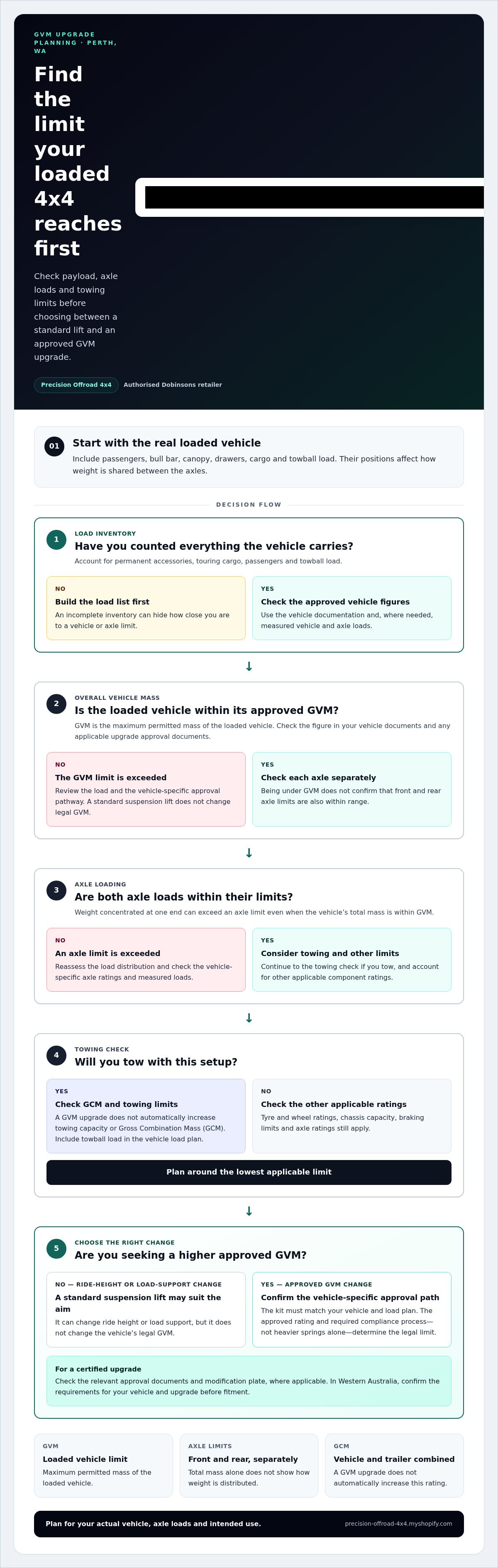
How to choose a Dobinsons GVM upgrade for your load and driving
Choose a setup for your actual vehicle and how you use it, not a generic payload estimate. This process helps you compare your load with the vehicle’s limits and the relevant upgrade documentation before selecting a kit.
- Identify your vehicle. Record its make, model, variant, build details and current configuration. Match these against Dobinsons fitment and upgrade information. Similar-looking variants can have different specifications.
- List every load. Separate permanent accessories from passengers, touring gear and temporary cargo. Include the bull bar, canopy, drawers, spare wheel, tools, food, water and towball load, as applicable.
- Consider where the weight sits. Note which items load the front or rear axle. A whole-vehicle estimate will not show whether weight is unevenly distributed or an axle limit could be reached first.
- Measure the vehicle as used. If you need accurate figures, weigh it in its configured state. Include the people and equipment you expect to carry, and obtain axle loads as well as total mass.
- Compare like with like. Check measured total and axle loads against the vehicle-specific limits and proposed upgrade documentation. Do not assume an approved GVM increase also changes axle ratings or other limits.
- Match the setup to the job. Consider whether the vehicle mainly commutes, tows, tours or does a mix of these. Check the kit’s fitment and approval details against that intended use.
Build a realistic load list before selecting a kit
Permanent accessories stay on the vehicle; passengers, touring gear and cargo vary from trip to trip. Record both. A bull bar and spare wheel may affect one axle differently from a rear canopy and drawers. Towball load also adds weight to the vehicle and affects distribution. Account for the full travel configuration, not just the vehicle unloaded at home.
If wheel or tyre changes are part of your build, include those components in the load plan. A Perth specialist can bring vehicle details, load distribution and kit fitment into one plan, rather than treating the suspension as an isolated change.
Match the setup to Perth and WA use
Daily commuting, regular towing and remote touring place different demands on load support and handling. Be clear about how often your vehicle is unladen, what it carries on a typical trip and how it behaves when fully loaded. A practical assessment should reflect your use rather than assume one setup will feel identical in every condition.
Plan your vehicle and load requirements with Precision Offroad 4x4’s GVM upgrade setup, then compare the proposed Dobinsons GVM upgrade kits with the vehicle-specific limits and documentation.
Planning a Dobinsons GVM upgrade with Precision Offroad 4x4
A well-planned upgrade starts with your vehicle and its real load, then moves through kit selection, installation and the certification pathway for your specific build. Precision Offroad 4x4 is a Perth-based specialist and authorised Dobinsons retailer. Its Licensed Vehicle Modifier certification and compliance capabilities support the process, while the approval requirements remain specific to the vehicle and upgrade.
What to prepare for a vehicle-specific upgrade discussion
Bring details that describe how your 4x4 is configured and used. That gives the assessment a practical starting point, rather than relying on a broad model description or estimated payload.
- Vehicle details: make, model, variant, build information and licensing status.
- Load information: permanent accessories, typical passengers, touring cargo and any towing use.
- Measurements: available total vehicle mass and front and rear axle weights, ideally recorded with the vehicle carrying its usual load.
- Existing records: modification plates, approval documents and relevant vehicle or suspension documentation.
With this information, kit selection can be matched to the vehicle’s fitment, intended load and use. Dobinsons GVM upgrade kits are not a standalone answer to every load issue, so the selected components, approved ratings and certification requirements need to align as one setup.
Next steps for Perth 4x4 owners
Precision Offroad 4x4 helps Perth owners assess their vehicle and load profile, identify suitable Dobinsons kit options, and plan the upgrade alongside the applicable WA assessment and certification steps. The approval pathway can differ between vehicles and circumstances, so establish the requirements for your specific build before work begins. Where applicable, the process may include assessment and a modification plate recording the certified modification.
Before finalising the setup, review the product and approval documentation for vehicle fitment, approved GVM, axle limits and included components. This clarifies what the upgrade changes and which vehicle limits remain relevant. Keep the documents with your vehicle records after installation and certification.
For a vehicle-specific plan, explore Dobinsons suspension options with Precision Offroad 4x4.
Plan your GVM upgrade around the whole vehicle
A suitable GVM upgrade starts with your actual load, not just a suspension choice. Account for accessories, passengers and touring or towing gear, then compare measured total and axle loads with the vehicle-specific limits. Dobinsons GVM upgrade kits can support a certified change to the vehicle’s approved GVM, but they do not automatically change towing capacity, axle limits or every other vehicle rating.
Kit fitment, installation and certification need to align with your vehicle and the applicable Western Australian approval pathway. Keep the relevant product and certification documents with your vehicle records, and consider warranty implications before modifying your 4x4.
Precision Offroad 4x4 is a Perth-owned and operated specialist and an authorised Dobinsons retailer. Its Licensed Vehicle Modifier certification, modification plate, ADR compliance and Lane Change testing credentials are relevant when planning a compliant build. These credentials do not mean every vehicle follows the same approval process.
Ready to plan a setup around your vehicle and load? Explore Dobinsons suspension options with Precision Offroad 4x4. Bring your vehicle details and load information to start planning a setup for your real-world use.
Frequently Asked Questions
What does a Dobinsons GVM upgrade kit include?
The components depend on the vehicle and the specific approved application. A GVM upgrade suspension kit may include springs and shock absorbers selected for that setup, but not every kit has the same parts or rating. Check the product and approval documentation for your exact make, model and variant, including approved GVM, axle limits and the component list. The kit is one part of the complete certified modification.
Is a GVM upgrade the same as a suspension lift?
No. A suspension lift changes ride height, while a GVM upgrade is a certified change to the vehicle’s approved maximum loaded mass. A lift on its own does not increase legal GVM or load-carrying capacity. A GVM upgrade uses specified components and must follow the approval pathway that applies to your vehicle. A taller stance or heavier springs alone do not show that the vehicle has an increased rating.
Can a GVM upgrade increase my vehicle’s towing capacity?
No, not automatically. A GVM upgrade changes the vehicle’s approved maximum loaded mass only where the modification is certified for that purpose. It does not by itself increase towing capacity or Gross Combination Mass (GCM), which relates to the combined mass of the vehicle and trailer. Your vehicle’s towing and axle limits still apply. Check the vehicle and upgrade documents, and account for towball load when assessing the vehicle’s loaded mass.
Do I need a modification plate for a GVM upgrade in WA?
For an already licensed vehicle, a post-registration GVM upgrade in WA follows a state-based approval process that includes DTMI approval, a modification permit and a modification plate. The applicable process depends on the vehicle and upgrade, so establish the pathway before work begins. The plate is a permanent record that the modification has been certified. Keep the associated approval and certification documents with your vehicle records.
Will a GVM upgrade affect my vehicle warranty?
It may affect warranty considerations, but a modification does not automatically cancel every warranty or guarantee full protection. The outcome depends on the relevant warranty terms and the circumstances of a fault or claim. Before proceeding, review the vehicle and component warranty information. Keep records of the kit, installation and certification, and follow any maintenance guidance that applies to the modified suspension.
How do I know whether my 4x4 needs a GVM upgrade?
Compare the vehicle’s actual loaded mass and front and rear axle loads with its documented limits. Include passengers, accessories, cargo and towball load. If you regularly approach or exceed a limit, a GVM upgrade may be worth assessing, but heavier suspension alone does not make overloading compliant. For your Perth 4x4, use vehicle-specific measurements and Dobinsons GVM upgrade kit documentation to plan a suitable setup.
Can I fit larger tyres with a Dobinsons GVM upgrade?
A GVM upgrade does not automatically approve larger tyres. Tyre and wheel changes have separate fitment, load-rating and compliance considerations. Check that the proposed tyres and wheels suit your vehicle and modified setup, including wheel-arch clearance, wheel track and relevant WA requirements. A tyre change can also affect how the vehicle drives, so assess it as part of the whole build. Precision Offroad 4x4 is a Perth retailer of wheel upgrades and Maxxis tyres.