

A Dobinsons parts catalogue can show a match for your 4x4, but that does not automatically mean the part suits your vehicle or how you use it. Catalogue listings need to be considered alongside your exact vehicle details, current accessories and expected load. A spring and shock combination that suits an unladen daily driver may not suit a touring vehicle carrying extra gear.
Before looking up parts, note your make, model, year and variant, along with existing modifications, regular payload and intended use. This gives you a sound basis for comparing catalogue references and suspension options instead of relying on a vehicle name alone. You’ll also need to consider handling, wheel‑arch clearance and Western Australian modification requirements.
This guide explains what to gather before searching, how to compare catalogue entries and what affects a complete suspension choice. Precision Offroad 4x4 is a Perth-based authorised Dobinsons retailer. Use the catalogue to narrow down options, then consider them in the context of your 4x4 and its intended use.
Key Takeaways
- Use the Dobinsons parts catalogue to identify relevant components and applications, not as proof that a complete setup suits your 4x4.
- Follow a clear lookup process: match your vehicle to the catalogue, then compare the listed parts with your requirements.
- Understand the different roles of springs and a shock absorber when assessing suspension kit options.
- Consider wheel‑arch clearance, caster angle and suspension geometry correction when evaluating a lifted vehicle.
- Shortlist catalogue entries, then discuss the full suspension setup with Perth-based Precision Offroad 4x4.
What the Dobinsons parts catalogue can tell you about 4x4 suspension
A parts catalogue helps identify components and the vehicle applications they relate to. It can narrow down relevant options, but it does not confirm that a particular combination will suit your vehicle, load or intended use. Check that you’re using the current Dobinsons parts catalogue before relying on an application entry, as catalogue information can change.
Treat the catalogue as a starting point, not a complete build plan. A listing for an individual component answers a different question from selecting a complete suspension setup. The catalogue guides your research; your vehicle’s configuration and how you use it shape the final decision.
Catalogue, parts listing and suspension kit: what is the difference?
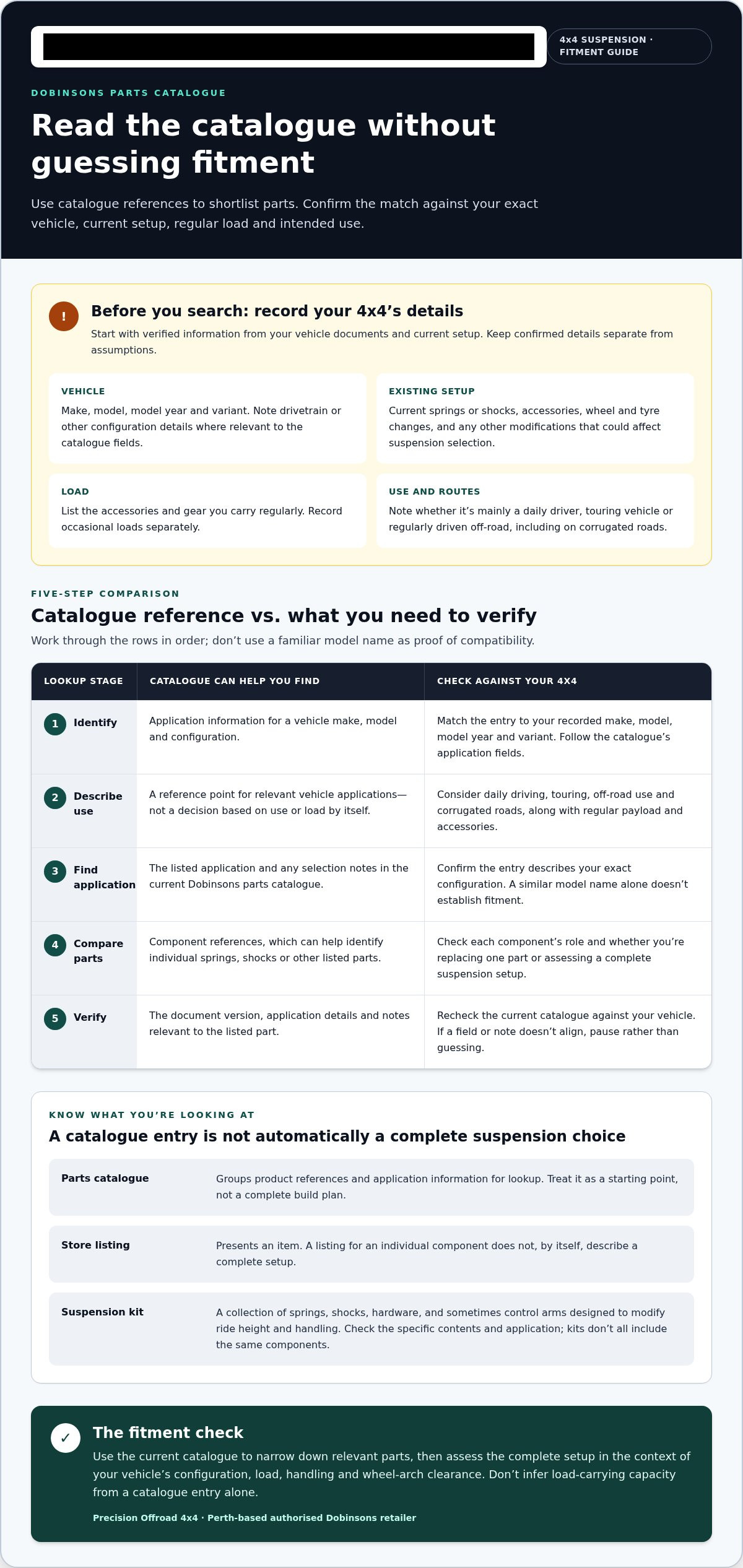
A catalogue groups product references and application information for lookup. A store listing presents an item for purchase, while a suspension kit describes a group of parts intended to work together. A suspension kit is a collection of springs, shocks, hardware, and sometimes control arms designed to modify your vehicle’s ride height and handling.
That definition describes the category, not the contents of every kit. Don’t assume a catalogue entry for one spring or shock absorber represents a complete kit, or that all kits include the same components. Dobinsons Suspension Kits are a product category, but you still need to understand the specific parts and application in the current listing. For background on how a lift can affect vehicle height and handling, see this overview of Suspension lift for 4x4 vehicles.
This distinction matters when you’re planning a change. If you’re replacing one component, identify the relevant part and its application. If you’re changing ride height or preparing for extra touring load, assess the complete suspension setup rather than treating one catalogue reference as the answer.
Why vehicle application matters when browsing Dobinsons parts
Start with the vehicle, not the part name. A catalogue application is useful only when it corresponds to the vehicle configuration it describes. Before comparing entries, record the details shown in your vehicle documents, such as make, model, model year and variant. Note drivetrain or other configuration details where relevant, following the fields in the catalogue.
Next, record existing changes that could affect suspension selection: current springs or shocks, added accessories, wheel and tyre changes, and other modifications. Keep confirmed details separate from assumptions. This gives you a practical reference when comparing an application with the vehicle in front of you, especially if it has changed since leaving the factory.
Match those details against the current catalogue’s application information. If an entry doesn’t clearly describe your configuration, don’t infer fitment from a similar model name. Treat the reference as a shortlist, then assess how the proposed parts work together on your vehicle. This makes catalogue browsing a more considered starting point for choosing suspension in Perth.
How to read a Dobinsons parts catalogue without guessing fitment
Use the same lookup process each time instead of choosing a part based on a familiar model name. The Dobinsons parts catalogue is a reference point: your exact vehicle application, existing modifications and day-to-day load all affect whether a listed option belongs on your shortlist. Differences in model or configuration can affect which suspension parts suit your vehicle.
Start with your vehicle and its current setup
Before opening the catalogue, write down your vehicle’s make, model and variant. Note any suspension changes already fitted, along with other modifications that could affect the setup. Separate details you can verify from assumptions, such as expecting a part to fit because it suits a similar-looking model. Follow the application fields and selection notes in the current catalogue.
Then work through the lookup in order:
- Identify the vehicle. Use its recorded make, model and variant as your starting point.
- Describe how you use it. Note whether it’s mainly a daily driver, a touring vehicle or regularly driven off-road, including on corrugated roads.
- Find the application. Locate the entry that matches your vehicle details and configuration in the current document.
- Compare the listed parts. Consider each component’s role and whether you’re looking at an individual replacement or a broader suspension selection.
- Verify the details. Recheck the document version, application information and notes against your vehicle before treating an entry as a fitment match.
If a catalogue field or note doesn’t align with the details you have, pause rather than filling the gap with a guess. A similar model name alone doesn’t establish compatibility. The Vehicle Suspension System Design and Analysis resource explains how springs, shock absorbers and suspension layouts work as a system. This is useful context when comparing parts by function.
Match catalogue information to load and driving use
Choose suspension with the vehicle’s real operating conditions in mind, not just how it sits when parked. List the accessories and gear you carry regularly, then record occasional loads separately. Load‑carrying capacity is the amount of weight a vehicle can safely support, considering its suspension, chassis and braking system. Don’t infer a vehicle’s capacity from a catalogue entry alone.
Your usual routes matter too. A vehicle carrying touring gear on long trips has different demands from one used mostly unladen on sealed roads. Describe those conditions clearly when comparing options, but don’t assume a spring rate or shock specification unless the current listing states it for your application. Precision Offroad 4x4 is a Perth-based authorised Dobinsons retailer, and its Dobinsons Suspension Kits are one option to consider as you narrow down a suitable setup.
Compare Dobinsons catalogue parts with a complete suspension kit
An individual component listing helps you investigate one part. A complete suspension kit needs a broader assessment: its parts must suit the vehicle application and work as a coordinated setup for your intended use. The Dobinsons parts catalogue can inform that comparison, but a listing alone doesn’t confirm legal compliance or guarantee a particular handling result.
Use the table to separate what you can identify from what still needs assessment. Consider vehicle application, regular load and intended use as distinct factors.
| Catalogue-listed component or option | Role to verify | Application to compare | Questions for the selection process |
|---|---|---|---|
| Spring | Supports vehicle weight and contributes to ride height. | Check the exact vehicle application and the load you regularly carry. | Does the listing suit your vehicle configuration and expected use? |
| Shock absorber | A damper that controls spring movement. | Compare the application with your vehicle and the spring setup under consideration. | Is it intended to work with the selected suspension components? |
| Individual suspension component | Performs a specific function within the suspension system. | Check whether you’re replacing a part or planning a wider change. | What other components may need to be considered as part of the setup? |
| Suspension kit | Groups components intended to modify ride height and handling. | Assess the complete application against vehicle, load and use. | What parts are included in this specific kit, and what else needs assessment? |
When comparing springs, shocks and suspension kits
Springs and a shock absorber perform different jobs. A spring supports the vehicle, while the shock absorber controls spring movement. Knowing a component’s role doesn’t establish that it suits every vehicle or will work as intended with any other part. Check the application information and assess components together rather than selecting each item in isolation.
The Dobinsons IMS Lift Kit is a named option to compare, but its name alone doesn’t establish its current parts, specifications or fitment. Use the current product information to assess its application and contents. Consider those details separately from how the complete suspension setup suits your vehicle.
How intended load can change the comparison
Compare your vehicle’s usual operating conditions. An unladen 4x4 used mainly for daily driving presents a different selection context from one that regularly carries touring equipment. Neither description identifies a suitable spring or shock by itself; the vehicle application and parts combination still matter.
If a current listing identifies progressive rate springs, the term describes springs that increase stiffness as they compress, providing a soft ride when unladen and firm support under load. Don’t assume a particular Dobinsons option uses this spring type unless the product information says so. A catalogue match isn’t a compliance assessment either. Check the complete modification against applicable Western Australian requirements and assess the finished setup on the vehicle before drawing conclusions about handling or performance.
Check fitment, handling and compliance before choosing Dobinsons parts
A catalogue match is only one part of the decision. Before choosing components, consider how the suspension will work with your vehicle’s current setup, regular load and intended driving. This is especially relevant if you’re changing ride height or tyre size, as those changes can affect clearance, steering geometry and compliance.
- Vehicle: Record the make, model, variant and configuration that match the catalogue application.
- Existing modifications: Note current suspension parts, tyre size and accessories that may affect the setup.
- Load: List what the vehicle carries regularly, then separate occasional touring or work equipment.
- Use: Describe your typical driving, including whether the vehicle is mostly unladen, regularly loaded or used off-road.
- Compliance: Identify the proposed changes and verify the requirements that apply to your vehicle and modification in Western Australia.
What a suspension change can mean for vehicle geometry
After a lift, check more than ride height. Caster angle is the forward or backward tilt of the steering axis, influencing directional stability and steering feel. Changes to suspension height can affect alignment settings, so assess the geometry for your specific vehicle rather than assuming a catalogue component will correct it.
Wheel‑arch clearance is the space between the tyre sidewall and the vehicle’s inner wheel arch, required to prevent tyre scrub. Consider clearance through steering movement and suspension travel, not only with the vehicle parked straight ahead. Suspension geometry correction means adjustments or components added to a lifted vehicle to restore proper caster, camber and toe angles. The appropriate correction depends on the vehicle and modification; don’t prescribe parts based on lift height alone.
What Perth owners should verify before proceeding
Use the Dobinsons parts catalogue to identify relevant options, then assess the proposed change against current Australian requirements. In Western Australia, the guidance referenced here sets a 50 mm combined height increase limit without engineering certification, counting suspension lift, half the tyre diameter increase and body lift together. Requirements depend on the vehicle and modification, so verify the applicable WA Department of Transport guidance before work begins. A modification plate, test or approval isn’t automatically required for every suspension change.
For a Perth 4x4, base selection on its actual application and intended use, not broad assumptions about local roads or tracks. A professional wheel alignment is mandatory after any suspension or tyre change. Review the vehicle on the road and in practical use, then address handling or clearance concerns before further travel.
Bring your vehicle details, modification notes and shortlist together before settling on a setup. Explore Dobinsons suspension kits as you compare options for your 4x4.
Choose a Dobinsons suspension solution with Precision Offroad 4x4
A catalogue reference becomes useful when you connect it to the vehicle you own and how you use it. Before choosing a Dobinsons suspension option, organise your vehicle information, note current modifications and shortlist the entries that appear relevant. Then assess the proposed setup as a whole instead of treating one part number as a complete recommendation.
Precision Offroad 4x4 is a Perth-based specialist and an authorised Dobinsons retailer. Dobinsons has been a fixture of the Australian off-road industry since 1953. That background provides context for the brand, while your vehicle’s application, load and planned changes remain the practical basis for selection.
What to bring into a suspension selection discussion
Have these details ready so you can consider catalogue references alongside your vehicle’s complete configuration:
- Vehicle identification: Make, model, year and variant, using the details recorded for your vehicle.
- Current modifications: Existing suspension changes, accessories and wheel or tyre changes that may affect the setup.
- Typical load: Equipment and accessories carried regularly, plus any occasional touring or work load.
- Intended use: How you drive the vehicle, including its usual balance of commuting, touring and off-road use.
- Catalogue shortlist: The current application entries and component references you want to compare.
Keep confirmed details distinct from assumptions. Record a wheel or tyre change as part of the vehicle’s current configuration, not as proof that a suspension component will suit. If you’re planning wheel changes alongside suspension work, assess those choices together so the full setup can be considered. The selection discussion should connect catalogue information with application, load and intended use, without assuming every listed part forms a complete kit.
Find the next step for your Dobinsons suspension choice
Use your shortlist to frame the decision: which catalogue application matches your vehicle, what parts are you considering, and how will the complete setup relate to your regular load and driving? Include related accessories in the plan because added equipment can affect the vehicle’s overall configuration. Keep suspension selection, wheel changes and accessories linked to the same vehicle details.
This gives you a practical path from catalogue browsing to a considered suspension choice in Perth. Precision Offroad 4x4 can help you explore Dobinsons suspension options in the context of your 4x4 and its intended setup. Explore Dobinsons suspension options.
Turn your shortlist into a considered suspension choice
Keep your vehicle details and shortlisted catalogue references together as your build evolves. A clear record of current modifications, typical load and planned changes gives you a useful baseline for reviewing options, rather than relying on memory or a part name alone. The Dobinsons parts catalogue is most useful when you consider its entries alongside the whole vehicle and how you intend to use it.
Before making a selection, use that information to discuss the complete setup. This connects the catalogue reference with the parts under consideration and your vehicle’s real configuration, while keeping fitment, handling and applicable compliance requirements in view.
Ready to take the next step? Explore Dobinsons suspension options with Precision Offroad 4x4 and move forward with a clearer plan for your 4x4.
Frequently Asked Questions
Where can I find the current Dobinsons parts catalogue?
Look for the latest catalogue through Dobinsons’ official website or product resources, and check its revision or publication details before using it. Catalogue documents can be updated, so an old saved copy may not reflect current applications. When comparing an entry with a suspension option available through Precision Offroad 4x4 in Perth, keep the document reference with your vehicle notes.
Does a Dobinsons parts catalogue confirm that a part fits my exact 4x4?
No. A catalogue application helps identify a potentially relevant part, but it doesn’t assess every detail of your vehicle or its modifications. Two vehicles with similar model names, for example, may differ in configuration. Use the listed application as a starting point, then compare it with your vehicle records and current setup before treating the part as a fitment match.
What vehicle details should I have ready before using a suspension catalogue?
Have your make, model, year and variant available, along with details of existing suspension and wheel changes. Note accessories or equipment that may affect the vehicle’s configuration. Follow the fields shown in the current catalogue rather than assuming it needs a particular identifier. If a field doesn’t match the information you have, record that uncertainty instead of guessing.
What is the difference between a suspension part and a suspension kit?
A suspension part is an individual component, such as a spring or shock absorber. A kit groups components for a broader suspension change, but its contents can vary. If you’re replacing one worn item, focus on that component’s application and role. If you’re changing the vehicle’s suspension as a whole, compare the kit contents and how the parts relate to your vehicle configuration.
Can a catalogue tell me whether a suspension modification complies with Australian requirements?
No. A catalogue provides product and application information, not a vehicle compliance assessment. Requirements depend on your vehicle and the specific changes proposed, including related tyre or body modifications. For a Perth 4x4, check current Western Australian Department of Transport guidance before proceeding and establish what assessment or approval applies to your modification.
What does load-carrying capacity mean when comparing suspension options?
Load-carrying capacity is the weight a vehicle can safely support, considering its suspension, chassis and braking system. When comparing options, distinguish regular equipment from occasional cargo and account for accessories already fitted. A suspension catalogue entry alone doesn’t establish the vehicle’s safe capacity. Keep load details alongside the vehicle application when assessing Dobinsons suspension options.
Does changing suspension affect wheel-arch clearance or vehicle geometry?
It can. A change in ride height may alter alignment geometry, while tyre size, wheel choice and suspension travel can affect clearance around the arches. For example, a tyre that clears when parked straight ahead still needs assessment through steering movement and suspension travel. After suspension or tyre changes, arrange a professional wheel alignment and check the vehicle’s clearance and handling.