

A remote reservoir can help a shock absorber manage heat on long, demanding tracks, but it won’t automatically make your 4x4 handle better. In this Dobinsons remote res shocks review, the key question is whether that design suits your vehicle, load and driving conditions.
If you’re comparing remote-reservoir shocks with standard options, look beyond product claims. Check what the reservoir changes, what it can’t guarantee, and whether the suspension setup matches how you drive. This guide covers the practical trade-offs, including heat management, shock fade, vehicle fitment and the demands of towing, carrying gear or travelling corrugated roads around Perth and WA.
You’ll also learn what to consider before choosing a Dobinsons suspension option, from vehicle load and existing modifications to WA compliance. Precision Offroad 4x4 is a Perth-based authorised Dobinsons retailer, with product expertise to help you compare suspension options for your vehicle and use. A professional wheel alignment is mandatory after any suspension or tyre change, and the full setup needs to work as a system.
Key Takeaways
- A Dobinsons remote res shocks review should weigh heat management against your actual driving needs, not assume a reservoir guarantees better handling.
- Match your shock choice to how you use your 4x4, including commuting, touring, towing and repeated rough-road driving.
- Check your vehicle variant, existing suspension changes, accessories and typical load before assessing shock fitment.
- Consider caster angle, camber and toe when planning suspension geometry correction, and arrange a professional wheel alignment after any suspension or tyre change.
- Account for WA modification requirements as part of your suspension decision, especially when changes affect ride height or other vehicle modifications.
Dobinsons remote reservoir shocks: what the design changes
A remote reservoir shock absorber has an additional oil chamber connected to the main shock body by a hose or mounted alongside it. The extra chamber can provide more oil volume and help manage heat during sustained, demanding use. Layout and internal features vary by model, so the design principle alone doesn’t confirm a particular Dobinsons shock’s specifications.
A remote reservoir describes an added fluid chamber intended to support heat management. It doesn’t, by itself, confirm a shock’s fitment, adjustability or performance. Keep that distinction in mind when reading a Dobinsons remote res shocks review. Check the manufacturer’s specifications for the exact model and vehicle application before drawing conclusions about its features.
How a remote reservoir shock absorber works
A shock absorber controls spring movement by damping the suspension’s up-and-down motion. This helps manage how the vehicle responds to bumps, braking and cornering. For an overview of the wider system, see this explanation of vehicle suspension systems.
As a shock works, its oil heats up. A reservoir may increase the system’s oil volume, which can assist heat management; some designs also separate the oil and pressurised gas. The exact arrangement depends on the shock. If heat reduces damping performance, the result is shock fade. A reservoir may help limit that risk during sustained use, but it can’t eliminate it in every condition.
What a product review should confirm about Dobinsons
Start with the exact Dobinsons model and vehicle application. Don’t assume that a shock listed for one 4x4 variant, suspension configuration or load will suit another. Check the manufacturer’s current information for fitment, front or rear application and the components supplied.
Then verify the details that affect how you’ll use and maintain the setup:
- Reservoir configuration: confirm how it connects to the shock and how it can be mounted on your vehicle.
- Adjustment: check whether damping is adjustable and which settings the specific model offers.
- Service: follow the manufacturer’s stated inspection and maintenance requirements.
These checks separate documented Dobinsons specifications from general claims about remote-reservoir design. Don’t infer ride comfort, control or durability from the reservoir alone. The full suspension setup, vehicle load and driving conditions all matter.
What remote reservoir shocks can change on Perth 4x4 trips
Your suspension faces different demands on the school run, a touring trip and a rough stretch of road. A remote reservoir may be worth investigating if your shocks work hard for extended periods, but it isn’t a blanket upgrade for every 4x4. Shock choice depends on your vehicle setup, carried load and driving duty, not the reservoir alone.
For everyday commuting and light use, your priorities may be predictable handling and a suitable ride with the vehicle’s usual load. Touring adds sustained distance and extra gear. Towing changes the vehicle’s load and can place more demand on the suspension. Repeated rough-road travel, such as long stretches of corrugations on a WA trip, can keep the shocks cycling continuously, particularly at higher speeds. That may increase heat and the chance of shock fade. These are factors to assess, not proof that a particular shock will perform a certain way.
A general guide to types of shock absorbers and their functions can help you understand the design differences. For your own setup, weigh those principles against the exact Dobinsons model and its confirmed vehicle fitment.
When the remote reservoir format may suit your use
If you regularly tow, carry touring equipment or drive rough roads for long stretches, consider whether the remote reservoir’s potential heat-management benefit addresses a real demand in your use. Vehicle weight matters: bull bars, accessories, passengers and cargo all contribute to the load the suspension must control. Check the vehicle’s load‑carrying capacity and the suspension specification against the load you actually carry. A design advantage in principle isn’t evidence of a proven result for a specific Dobinsons model in your vehicle.
When standard shocks may be the more suitable comparison
If your 4x4 mainly commutes and sees occasional light off-road use, a standard shock may meet the duty without the added reservoir hardware. Compare options by fitment, intended load and driving pattern rather than assuming the more complex setup is automatically better. Added hardware is useful only when it addresses a genuine requirement. For wider suspension planning, read 4x4 Suspension: The Ultimate Performance and Reliability Guide for 2026 alongside this Dobinsons remote res shocks review.
Use your actual routine to guide the decision: note how often you tow, how much gear you carry and whether rough-road driving is brief or sustained. Precision Offroad 4x4 is a Perth-based authorised Dobinsons retailer, with suspension options for different vehicle uses. Explore Dobinsons suspension options as part of your assessment.
Dobinsons remote reservoir shocks vs standard shocks: weigh the trade-offs
A remote reservoir isn’t automatically necessary for every 4x4. In this Dobinsons remote res shocks review, the useful comparison is whether the design matches your vehicle’s suspension setup and workload, not which format sounds more advanced.
Dobinsons offers different monotube options, including the non-reservoir IMS and remote-reservoir MRR and MRA. The MRR adds an external reservoir to the IMS-style design for heat management, while the MRA adds adjustment features. Treat these as model distinctions, not a guarantee of a particular result. Exact specifications and fitment depend on the vehicle-specific product.
| Check | Standard or non-reservoir shock | Remote-reservoir shock |
|---|---|---|
| Design | No external reservoir. Internal layout and damping vary by model. | Additional reservoir connected to or mounted beside the shock. Configuration varies by model. |
| Potential use | May suit a vehicle whose normal driving and load don’t call for the reservoir design. | May be worth assessing for sustained, demanding use where heat management matters. |
| Fitment checks | Confirm vehicle variant, front or rear position and compatibility with existing suspension changes. | Check those details plus reservoir location, hose routing and clearance for the exact application. |
| Service details | Follow the current manufacturer instructions for inspection and maintenance. | Verify service requirements and warranty wording for the exact model; don’t assume they match another shock. |
Which suspension setup matches your vehicle and load?
An unladen 4x4 used mainly for daily driving has different spring and damping demands from an accessory-heavy touring vehicle that regularly tows. Progressive rate springs can provide a different balance as they compress, but spring choice must suit the vehicle’s load‑carrying capacity and intended use. Springs support the vehicle; shocks control spring movement. Assess both as a system rather than expecting a shock change alone to correct an unsuitable setup.
For a broader vehicle setup view, the article The Technical Guide to 4x4 Wheel Upgrades in Perth (2026) covers related wheel and tyre considerations. Changes to wheels or tyres can affect wheel‑arch clearance, so consider them alongside suspension fitment.
What to check in an exact-model review
Before choosing, check the exact Dobinsons model’s vehicle application, front and rear fitment, manufacturer-listed specifications and adjustment method. Confirm installation requirements and read the current warranty wording. Keep each claim tied to that model and application. Precision Offroad 4x4 is an authorised Dobinsons retailer, with suspension options to compare against your vehicle and load.
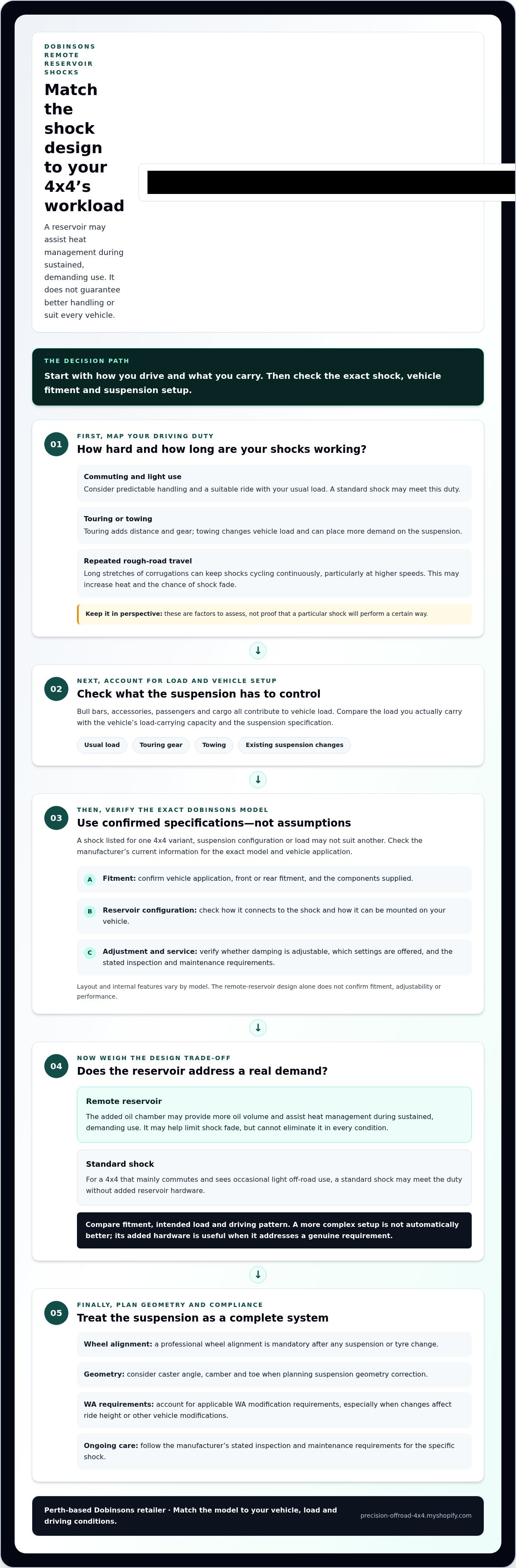
Fitment, geometry and WA compliance checks before choosing shocks
A shock that bolts onto a 4x4 isn’t automatically the right match for its suspension setup. Before choosing from a Dobinsons remote res shocks review, work through the vehicle details, current modifications, added weight and intended use. This helps distinguish a shock replacement from a broader change to ride height or suspension geometry.
Check fitment and suspension geometry
Use current manufacturer fitment information for your exact vehicle variant and suspension configuration. Check front and rear fitment separately, and account for existing lifts, springs, wheels and tyres. Then review the setup step by step:
- Record the vehicle variant and any previous suspension changes.
- List accessories and typical loads, including passengers, touring gear and towing demands.
- Check physical clearance around the shock, tyres and wheel arches throughout suspension movement.
- Assess intended use so the selected spring and shock combination suits the vehicle’s real load and driving duty.
A lift can alter suspension geometry and steering behaviour. At the front, the caster angle affects directional stability and steering feel; camber and toe also need to be assessed as part of the alignment. Don’t assume a particular setting or correction suits every vehicle. Suspension geometry correction may be needed, and upper control arms (UCAs) are relevant only where the vehicle setup requires them. A professional wheel alignment is mandatory after any suspension or tyre change.
Keep modification and safety details in view
Replacing a shock absorber doesn’t necessarily change vehicle height. Fitting a different spring or suspension kit may alter ride height and bring separate fitment, handling or compliance considerations. Treat those changes distinctly. Check current WA requirements for the actual modification before work begins, including whether certification or a modification plate applies. Requirements and outcomes depend on the specific vehicle and work, so don’t rely on a general threshold from an unrelated build.
Precision Offroad 4x4 is a Perth-based specialist with Licensed Vehicle Modifier certification. That certification doesn’t mean every proposed modification receives automatic approval. The vehicle, parts and proposed work still need to meet applicable requirements.
For a Dobinsons suspension option matched to your vehicle and load, explore Dobinsons suspension kits.
Is a Dobinsons remote reservoir shock setup right for your 4x4?
A remote reservoir setup may suit your 4x4 if its verified fitment and features match the way you use the vehicle. Consider your regular load and driving pattern, then weigh any potential heat-management benefit against fitment and maintenance needs. If your use is mainly commuting with occasional light off-road trips, compare non-reservoir options too.
Use this decision checklist before choosing:
- Identify your vehicle: record its make, model, year and variant, then check front and rear fitment against current manufacturer information.
- List existing changes: note suspension modifications, wheels, tyres and accessories that may affect fitment or vehicle height.
- Account for weight: include passengers, touring gear and towing demands when assessing the suspension setup.
- Describe your driving: distinguish everyday use from repeated, sustained rough-road driving to judge whether reservoir design addresses a real need.
- Check the exact model: compare its specifications, adjustment features, service requirements and warranty wording with your vehicle and intended use.
- Consider compliance: check current WA requirements for any proposed vehicle modification.
Dobinsons has been part of the Australian off-road industry since 1953. Precision Offroad 4x4 is a Perth-based authorised Dobinsons retailer, with product expertise to help you assess suspension options for your vehicle and load.
Explore Dobinsons suspension options and compare verified fitment with the demands of your driving.
Choose suspension that suits your next trip
A remote reservoir can help manage heat during sustained, demanding use, but it doesn’t guarantee better handling or make it necessary for every 4x4. Match the shock to your vehicle’s verified fitment, usual load and driving conditions. Check current product specifications, warranty terms and WA modification requirements before deciding. After any suspension or tyre change, a professional wheel alignment is mandatory.
This Dobinsons remote res shocks review is a starting point for comparing options against your real setup. Precision Offroad 4x4 is a Perth-owned and operated 4x4 specialist, an authorised Dobinsons and Fulcrum retailer, and holds Licensed Vehicle Modifier certification.
Explore Dobinsons suspension options with Precision Offroad 4x4 and take the next step towards a setup suited to your 4x4 and the way you drive.
Frequently Asked Questions
What are Dobinsons remote reservoir shocks?
Remote reservoir shocks are dampers with a separate fluid chamber connected to the main shock body. The reservoir is a general design feature, not proof of a particular Dobinsons specification or result. Dobinsons offers different suspension options, and not every shock uses a remote reservoir. In this Dobinsons remote res shocks review, check the exact model, vehicle fitment and features against current manufacturer information. The design alone doesn’t promise a particular ride or performance outcome.
Are remote reservoir shocks worth it for touring?
They may be worth considering for touring if your vehicle regularly carries a heavy load or faces sustained demanding roads. Suitability depends on your 4x4’s weight, accessories, touring load, road conditions and driving style. A remote reservoir may support heat management, but it isn’t a universal upgrade. Compare the exact shock specifications and vehicle fitment with your touring setup. Don’t choose by the reservoir label alone.
Do remote reservoir shocks prevent shock fade?
No. A remote reservoir may contribute to fluid capacity and heat management, but it can’t guarantee that shock fade won’t occur. Damping performance depends on the shock’s design, the vehicle setup, its load and driving conditions. Treat general design benefits separately from claims about a particular Dobinsons model. For model-specific details, use current manufacturer specifications, including any information about reservoir layout and damping features.
Can I fit Dobinsons remote reservoir shocks to any 4x4?
No. Shock fitment depends on your exact make, model, variant and suspension configuration, as well as the intended setup. Match the product to current vehicle-specific fitment information and check front and rear applications separately. Include existing modifications, accessories and regular load in your assessment. A shock that suits one 4x4 configuration may not suit another, so don’t assume universal compatibility from the Dobinsons name or reservoir design.
Do I need a wheel alignment after changing suspension shocks?
Yes. A professional wheel alignment is mandatory after any suspension or tyre change. Suspension changes can affect steering geometry and tyre behaviour, so alignment is part of completing the work safely. The caster angle is one geometry factor that influences steering feel and directional stability. Poor alignment may contribute to dog‑tracking, where the rear wheels don’t follow the front wheels. Use vehicle-specific alignment information rather than assumed settings.
Will fitting remote reservoir shocks make my 4x4 lift legal in WA?
No. Fitting shocks alone doesn’t establish whether a vehicle modification complies with current WA requirements. Replacing shocks is distinct from changing ride height with springs or other suspension components, and the applicable requirements depend on the vehicle and the work carried out. If you’re planning a lift in Perth or elsewhere in WA, check the current rules before making changes. Don’t assume a shock choice guarantees compliance.