

The spring rating matters as much as the lift. Dobinsons suspension for towing can suit your 4WD when the kit is matched to its permanent accessories and the load it carries. The right spring rate helps manage sag under tow without making the unladen ride unnecessarily firm. A lift alone doesn’t determine towing performance.
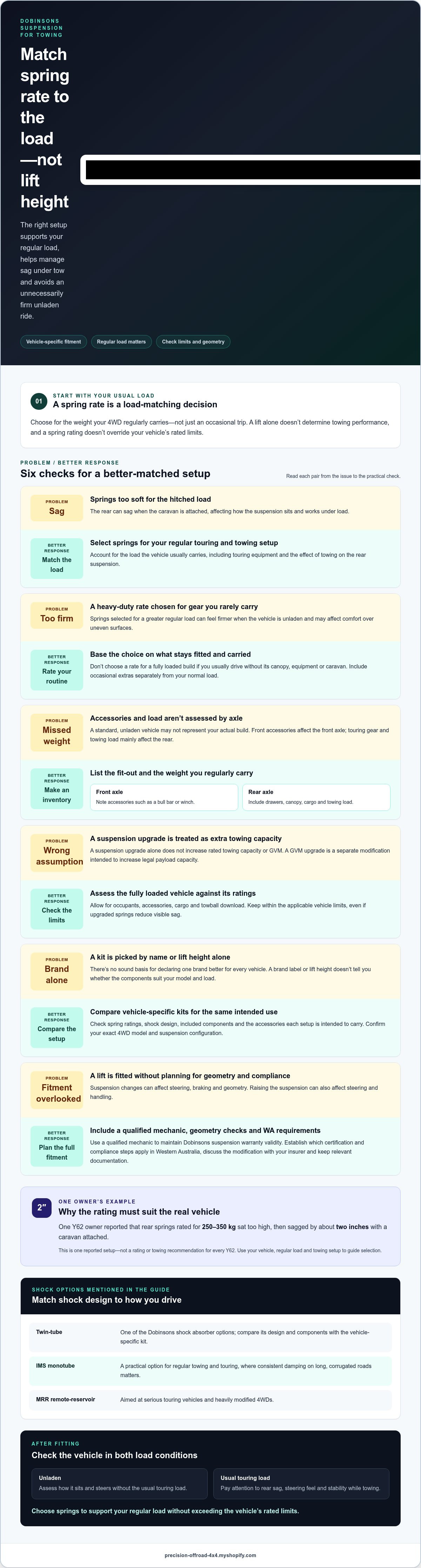
If you’re considering Dobinsons suspension for towing, the key question is whether the setup suits your vehicle and regular load. Springs that are too soft can let the rear sag when hitched, while springs that are too stiff for your usual load can make the ride less comfortable when you’re unladen.
This guide explains how spring ratings affect sag, what IMS suspension offers for towing and touring, and what to consider when choosing and fitting a vehicle-specific kit in Perth. You’ll also learn why your complete setup, including accessories, load distribution and suspension geometry, matters for controlled towing on roads and corrugations.
Key Takeaways
- Match the suspension setup to your 4WD model, permanent accessories and usual towing load, not lift height alone.
- Choose a spring rating for the weight your vehicle regularly carries to help manage sag without an unnecessarily firm unladen ride.
- Consider IMS monotube shocks for towing and touring where consistent damping on long, corrugated roads matters.
- Plan for installation, suspension geometry and alignment as part of the upgrade, and use a qualified mechanic to protect warranty validity.
- Compare kits by vehicle application and component setup so the suspension suits your 4WD and how you use it.
Is Dobinsons suspension any good?
Dobinsons suspension can suit towing when the springs and shocks match your vehicle, accessories and regular load. Compare the complete setup, not just the brand or lift height.
Towing kit suitability and brand comparisons
Dobinsons offers twin-tube, IMS monotube and MRR remote-reservoir shock absorbers. IMS is a practical option for regular towing and touring; MRR is aimed at serious touring vehicles and heavily modified 4WDs. Choose according to your vehicle, load and driving conditions, including long outback trips and corrugated roads.
There’s no sound basis for declaring Dobinsons better or worse than another brand for every vehicle. Compare kits for the same model and intended load. Check spring ratings, shock design, included components and the accessories each setup is intended to carry. Those details matter more than a brand label.
Towing capacity, GVM and compliance
A suspension upgrade alone does not increase your vehicle’s rated towing capacity or GVM. A GVM upgrade is a separate modification intended to increase legal payload capacity. Usable payload still needs to account for occupants, accessories, cargo and towball download, so assess the fully loaded vehicle rather than the suspension alone.
Suspension changes can affect steering, braking and geometry. Before fitting a lift or changing vehicle ratings, establish which certification and compliance steps apply in Western Australia. Discuss the modification with your insurer and keep relevant documentation. A kit’s spring rating does not override the vehicle’s towing limits.
Vehicle, load and accessory fitment
Start with your exact 4WD model and suspension configuration. Then list the accessories fitted now, such as a bull bar, winch, drawers or canopy, alongside the load carried regularly. Front accessories add weight to the front axle; touring gear and towing load affect the rear. This inventory helps select springs for the actual vehicle rather than a standard, unladen example.
Dobinsons suspension systems are tailored to vehicle applications, loads and driving styles. A reviewer reported improved ride in a Triton fitted with a Dobinsons 2-inch IMS kit carrying a 300 kg load rating. That example describes one setup, not a rating for every Triton or a universal towing recommendation.
Steering response after a lift
A lift can alter suspension and steering geometry, which may affect handling. Check whether the selected kit needs additional components to maintain suitable geometry and control. On lifted vehicles or 4WDs running larger tyres, Dobinsons steering dampers and components are designed to reduce vibration and improve handling. A damper can support steering control, but it doesn’t correct an unsuitable spring rate or poor fitment.
After fitting, assess how the vehicle sits and steers, both unladen and with its usual touring load. Pay attention to rear sag, steering feel and stability while towing. Choose springs to support the regular load without exceeding the vehicle’s rated limits.
Kit selection and fitting considerations
There’s no single Australia-wide price for a towing setup that applies to every vehicle and installation. The required components depend on your 4WD model, spring rating, accessories and selected shock system. Identify those factors first so the kit and fitting scope match the build, rather than choosing by lift height alone.
Use a qualified mechanic for fitment, as the research states this is needed to maintain Dobinsons suspension warranty validity. Include geometry checks in the installation plan because raising the suspension can affect steering and handling. Choose a vehicle-specific kit matched to your usual load, towing setup and intended driving.
Spring load ratings and sag under load
Spring ratings help match suspension to the weight carried regularly. Choose for your normal touring setup, not just occasional towing.
Heavy-duty and parabolic leaf springs
Dobinsons offers heavy-duty and parabolic leaf spring options for vehicles carrying constant loads. Both are intended for load-carrying setups, but the right choice depends on the vehicle and its regular use. Account for a canopy, touring equipment and cargo before selecting an upgrade. Springs should support the usual load while allowing the suspension to move through its working range.
Leaf springs support the rear axle on vehicles designed for that arrangement. Other models use coil springs, so confirm your vehicle’s suspension type before comparing ratings. Consider front and rear springs separately: front accessories affect the front axle, while cargo and towing loads act mainly at the rear.
Use a practical load assessment before choosing a rating:
- List the accessories and equipment normally fitted.
- Include the weight carried for regular trips, not occasional extras.
- Consider how towing changes the rear suspension’s working load.
- Match the spring option to the vehicle’s suspension type and intended ride height.
A spring rating does not replace checking the vehicle’s complete load. Suspension choice does not increase GVM or rated towing capacity. Keep the vehicle within its applicable ratings, even if upgraded springs reduce visible sag.
Unladen driving with heavy-duty springs
Heavy-duty springs can feel firmer when the vehicle is unladen because they’re selected to support a greater regular load. This can affect comfort and the vehicle’s response over uneven surfaces. Avoid choosing a rate for a fully loaded touring build if you usually drive without its canopy, equipment or caravan.
For example, one Y62 owner reported that rear springs rated for 250-350 kg sat too high, then sagged by about two inches with a caravan attached. That example shows why a rating alone doesn’t predict the vehicle’s final stance. Loaded and unladen conditions both matter.
Coil spring options are tailored to different vehicles, load requirements and ride heights. A Prado carrying its usual load was fitted with plus 400 kg rear coil springs; its heavier front springs were chosen for a steel bullbar and a possible winch. Treat those figures as that vehicle’s setup, not a universal prescription.
For a suitable Dobinsons suspension kit, compare your regular load with the spring options for your vehicle, then assess ride height and sag under load.
Dobinsons IMS suspension for towing and touring
Assess an IMS setup against the driving conditions you actually face, not just the distance planned. Your daily commute, highway towing and rough access roads place different demands on a 4WD. Decide what controlled handling should feel like before the trip, then use those expectations to evaluate the complete vehicle setup.
Before loading, note how the vehicle behaves. Record existing knocks, uneven stance, steering pull or repeated bouncing. Once the caravan and touring gear are aboard, compare the same observations. This can help show whether an issue appears under load rather than being a suspension characteristic.
Use the same route for each assessment, including sealed roads, familiar rough surfaces and the transition between them. Keep caravan loading and vehicle cargo consistent. This makes changes in steering response, body movement and ride comfort easier to recognise without relying on memory.
- Check for fluid marks, damaged mounts or loose-looking components before departure.
- Note the vehicle’s stance with its usual touring gear packed.
- Drive the same familiar route before and after loading the caravan.
- Record unusual bouncing, noise, steering changes or uneven tyre contact.
- Review those observations with the vehicle’s service history when planning adjustments.
Look for changes that persist across different surfaces. One sharp movement over a pothole tells you less than repeated bouncing or a consistent change in steering feel. If the vehicle feels unsettled, consider possible causes separately: load distribution, tyre condition, suspension components and wheel alignment can all affect how the combination behaves.
Touring equipment can vary between trips. A setup with an empty cargo area may behave differently once drawers, water or recovery gear are packed. Keep a simple record of the load and the vehicle’s response. This helps you judge whether the configuration suits your regular travel instead of changing parts based on one unusual trip.
For IMS, treat the vehicle’s behaviour as the practical measure of suitability. A sound assessment includes the 4WD and caravan together, under representative conditions, with attention to steering, ride and component condition. This approach helps you distinguish a setup that works for your touring routine from one that needs further adjustment.
Installation and adjustment issues
Installation affects ride height, suspension geometry and how your 4WD behaves under load. Set the kit up for the vehicle’s intended use, then assess the finished result.
Installation and adjustment considerations
Before fitting, confirm the kit suits your vehicle model, suspension type and intended lift. Dobinsons raised suspension can affect steering, braking and geometry, so installation involves more than replacing springs and shocks. Use a qualified mechanic to maintain Dobinsons suspension warranty validity, and include geometry checks and wheel alignment in the work.
After fitting, assess the vehicle with its normal touring load. Check ride height, steering feel, tyre clearance and suspension response over uneven ground. Leaf and coil springs have different fitment requirements, so components must suit the vehicle’s design. Don’t use adjustable ride height to compensate for an unsuitable spring rating or excessive load.
Adjustable lift and damping settings
Adjustable lift kits allow ride height changes within their intended range. Many Dobinsons MRA kits adjust between 2 and 3 inches. The Dobinsons MR Triton Suspension Custom Lift Kit adjusts from 35mm to 2inch of lift. These examples apply to specific kits, not every Dobinsons application.
Dobinsons MRA remote-reservoir shocks have 3-way adjustment, with independent compression and rebound tuning. MRR shock absorbers also use a 3-way damping adjustment system, with remote reservoirs. These settings change damping response; they don’t change a vehicle’s legal load limits or replace suitable springs.
Set adjustments for the vehicle’s actual use. Compression damping controls how quickly the shock responds as it compresses; rebound damping controls its return. A towing setup may behave differently from an unladen 4WD, so assess both conditions. Record the starting settings, make one change at a time, then evaluate handling on a consistent route.
On corrugations, heat and repeated suspension movement can affect shock performance. Remote reservoirs increase oil capacity for cooling in MRR systems, while adjustability lets you tune damping response. Neither feature removes the need to match the kit to your vehicle, load and terrain.
Use this fitting sequence to keep the setup coherent:
- Confirm the vehicle model and kit application.
- Fit the springs, shocks and supplied components as a matched system.
- Set ride height and damping within the kit’s adjustment range.
- Complete suspension geometry checks and wheel alignment.
- Assess steering, clearance and ride behaviour with your usual load.
For towing, qualified installation and measured adjustment help the suspension work as designed. Reassess the setup if you change accessories, springs or intended load.
Dobinsons suspension kits for different 4WD models
Dobinsons kits are vehicle-specific, so match the application to your exact make, model, generation and suspension layout. For towing, the model name is only a starting point. You also need components suited to the vehicle’s regular load, accessories and intended ride height.
The listed IMS Monotube IFP applications show why model fitment matters. The Next Gen Ford Ranger kit is listed with a 40-70mm lift, while the D-Max 2020+ kit has a 50-60mm lift. The Hilux N80 and Prado 150 IMS kits are each listed with a 45-60mm lift. These are model-specific ranges, not a promise that every vehicle will sit at the same height.
Other applications differ. Dobinsons lists a 50mm Hilux N70 Twin Tube Nitro Gas kit, while Next Gen Ford Everest kits include 50 mm nitro gas front lift kits for towing, family touring and outback travel. The correct choice depends on the vehicle’s front and rear suspension design, not just the desired lift.
- Ford Ranger Next Gen: IMS Monotube IFP application, listed at 40-70mm.
- D-Max 2020+: IMS Monotube IFP application, listed at 50-60mm.
- Hilux N80 and Prado 150: IMS Monotube IFP applications, each listed at 45-60mm.
- Hilux N70: Twin Tube Nitro Gas application, listed with a 50mm lift.
- Ford Everest Next Gen: 50 mm nitro gas front lift kits are listed for towing and touring use.
Use those examples to narrow your search, then check the included components and spring application for your vehicle. A Dobinsons spring selected for a touring load can affect stance and handling differently from a standard-load setup. Shock absorbers must also suit the vehicle and intended driving conditions. Even premium components need the correct application and fitment.
Before choosing a kit, record your vehicle’s model year, drivetrain and rear suspension type. List permanent accessories and the equipment carried on a typical towing trip. Match those details to the application rather than assuming kits for different Ranger, Hilux or D-Max generations are interchangeable.
Finally, separate ride-height choice from load support. The listed lift range describes an application’s stated lift, while spring choice addresses the load the vehicle carries. Dobinsons suspension kits for different 4WD models can’t be selected by lift figure alone. Your clearest takeaway is to identify the exact vehicle first, then compare its matched kit, springs and shock absorbers against your real touring setup.
Precision Offroad 4x4: Wheel Upgrades
Precision Offroad 4x4 offers Wheel Upgrades alongside Dobinsons Suspension Kits, including premium solutions like Dobinsons suspension for towing. If you’re choosing a towing setup, consider how your wheels and tyres work with the vehicle’s suspension, intended load and required wheel-arch clearance. A compatible combination helps you plan the complete 4WD setup rather than treating each upgrade in isolation.
Maxxis Tyres are also available for drivers matching tyre choice to touring and road use. Check your vehicle’s model and current accessories before narrowing down suspension and wheel options. This gives you a clearer basis for choosing parts suited to your 4WD and towing plans.
Contact Precision Offroad 4x4 to discuss the suspension and wheel options for your vehicle.
Plan your next towing setup
Treat the vehicle, suspension and towing role as one setup. Before choosing Dobinsons suspension for towing, note your model, accessories, regular cargo and driving conditions. This gives you a clear basis for comparing suitable components and considering how the complete vehicle will behave on the road.
Precision Offroad 4x4 offers Wheel Upgrades, Dobinsons Suspension Kits and Fulcrum Suspension Kits. These options let you consider suspension and wheels together when planning your 4WD build. Choose the products that match your vehicle and intended use, rather than selecting parts by lift height or appearance alone.
If you’re ready to discuss options for your vehicle, contact Precision Offroad 4x4. A clear plan is a practical starting point for a towing setup that suits your next trip.
Frequently Asked Questions
Need help choosing the right suspension?
Yes. Start with the exact vehicle year, badge, drivetrain and factory suspension configuration; one model name can cover different variants. Note any existing modifications and record the part number from your current springs, if available. These details help distinguish a replacement component from a different application. Keep your vehicle handbook and existing suspension information together when reviewing options, so the specifications you compare relate to your actual 4WD.
What Dobinsons spring rates and load ratings are available for towing?
Available rates depend on the Dobinsons application and spring type, so use the part number and application details rather than treating one rating as universal. Check whether the stated load describes a constant rear load or another configuration. Keep the spring rating separate from trailer mass: the rating identifies a spring application, while the trailer has its own measured mass and load distribution.
How do I choose the right Dobinsons suspension setup for my vehicle and caravan or trailer weight?
Use an inventory of your loaded trip rather than relying on the trailer’s advertised tare figure alone. Record passengers, fuel, accessories, luggage and equipment, then note how cargo is arranged in both the vehicle and trailer. If you weigh the combination, record the tow vehicle and trailer separately in travel condition. This gives you a clearer picture of the setup before selecting components.
What changes to ride height, handling, and braking should I expect from Dobinsons suspension when towing?
Expect the vehicle’s stance and suspension response to differ from its original setup; the result depends on the selected components and fitted load. A suspension change does not add braking hardware or guarantee shorter stopping distances. After installation, assess steering response and brake pedal feel during a controlled drive before towing. Then assess the vehicle and trailer together in a safe area before a longer trip.
How much towing load can Dobinsons suspension support without affecting GVM?
A suspension upgrade does not increase your vehicle’s GVM or rated towing capacity. Keep the fully loaded vehicle within its applicable ratings, accounting for occupants, accessories, cargo and towball download. No maximum towing load is provided.