

The best shock for your 4x4 may not be the one built for the roughest track. Dobinsons twin tube shocks can suit plenty of real-world driving, but the right choice depends on your vehicle, load and how you use it, not just the shock design.
If you’re comparing twin-tube shocks with Dobinsons IMS monotube shocks, you’re likely weighing ride comfort, durability and the risk of shock fade on corrugated roads or while towing. Matching shocks to your vehicle model, springs and accessories matters as much as comparing designs. A setup that works well for one touring 4x4 may not suit another.
This guide explains how twin-tube shocks work, how they differ from IMS monotubes, and what to consider before choosing a setup. You’ll also learn how driving conditions, vehicle load and suspension fitment affect your decision, and why lift height and applicable WA requirements deserve attention. Precision Offroad 4x4 is a Perth-based authorised Dobinsons retailer, with local product-selection expertise to help you make an informed choice for your 4x4.
Key Takeaways
- Dobinsons twin tube shocks control spring movement and vehicle oscillation, helping maintain tyre contact and predictable handling.
- Consider how corrugations, towing and added load affect heat build-up and the risk of shock fade.
- Compare twin-tube and IMS monotube designs by construction and intended use, then match your choice to your driving demands.
- Start with your vehicle model and suspension configuration, then factor in accessories, typical load and terrain.
- Check that your suspension setup suits your 4x4 as a whole. A Perth-based specialist can help guide product selection around fitment and intended use.
Dobinsons twin tube shocks in a 4x4 suspension setup
A spring supports the vehicle and absorbs impacts. The shock absorber controls how quickly that spring compresses and rebounds, limiting repeated body movement after a bump. A twin-tube shock absorber uses an inner working cylinder and an outer reservoir. Hydraulic oil and internal valving control spring movement and vehicle oscillation.
That control affects more than ride comfort. If the suspension continues moving after an impact, a tyre may lose consistent contact with the road, reducing predictable grip and vehicle control. Damping helps settle the wheel and body between bumps. In Perth, your 4WD may spend most of its time on sealed urban roads before heading onto rougher surfaces outside the metro area. The shock and spring need to suit that mix, not just one part of the trip. For a general overview of how shock absorbers work, see this reference.
The shock is only one component. Springs carry and support the vehicle’s load; shocks manage spring movement. A suspension kit is a matched collection of components that may include springs, shocks and other hardware. Replacing shocks alone doesn’t automatically change ride height or correct a mismatch between the spring rate and the load. The parts need to suit your vehicle and work together.
How the twin-tube design controls suspension movement
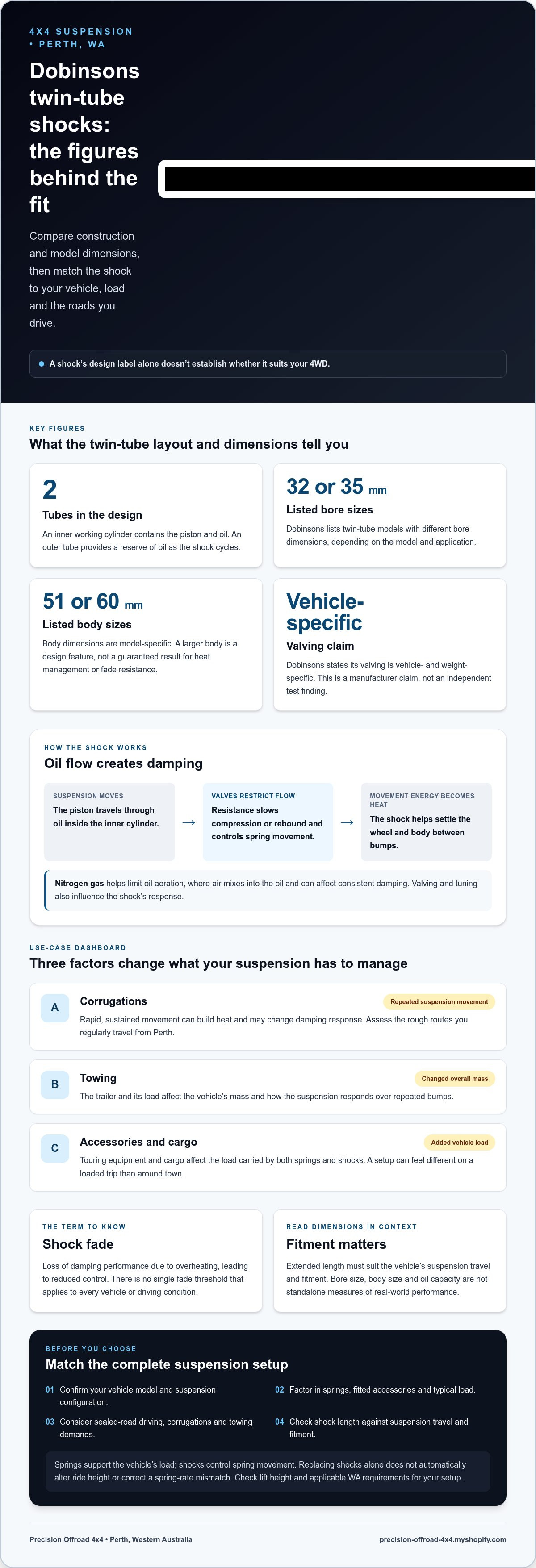
In a twin-tube layout, a piston moves through oil inside the inner working cylinder. As the suspension moves, oil passes through valves that restrict its flow. That resistance creates damping, converting some movement energy into heat and slowing compression or rebound. The outer tube holds a reserve of oil, allowing fluid to move between the tubes as the shock cycles.
Nitrogen gas helps limit oil aeration, where air mixes into the oil and can affect consistent damping. The gas, oil and internal valving each play a role, but they don’t determine the response on their own. Valve design and tuning influence how firmly the shock resists movement at different speeds. That’s why a shock’s suitability depends on its application, not just the twin-tube label.
What the Dobinsons twin-tube range is designed to address
Dobinsons describes its twin-tube shocks as designed, developed and tested in Australia. The manufacturer also states that its valving is vehicle- and weight-specific. These are manufacturer claims, not independent test findings. They also highlight a practical selection factor: damping needs to suit your vehicle’s configuration and the weight it carries.
For example, a 4WD used mainly on Perth’s sealed roads has different suspension demands from one set up for regular regional travel over rough surfaces with touring accessories aboard. Springs, fitted equipment and typical load all affect how the suspension behaves. When considering Dobinsons twin tube shocks, assess the complete setup and intended use, then match the shock to your vehicle’s fitment and operating conditions. That gives you a useful basis for comparing options in the sections ahead.
How Dobinsons twin tube shocks manage heat, travel and shock fade
Shock fade is a loss of damping performance in a shock absorber due to overheating, leading to reduced control. As the shock cycles, damping converts movement energy into heat. On a short, uneven section, there may be time between movements for heat to dissipate. Sustained corrugations keep the suspension working repeatedly, so heat can build and damping response may change. There’s no single fade threshold that applies to every vehicle or driving condition.
For Perth 4WD owners, demands can shift between sealed-road commuting and longer trips on rough Western Australian tracks. Towing adds another factor: the trailer and its load affect the vehicle’s overall mass and how its suspension responds over repeated bumps. Touring accessories and cargo also add to the load carried by the springs and shocks. A setup that feels controlled around town may respond differently on a loaded trip over corrugations.
Why corrugations and towing place different demands on shocks
Corrugations create rapid, repeated suspension movement. Towing changes the load the suspension must manage, while rough surfaces make it cycle more often. Both can increase the workload and heat generated during a trip. Your speed, vehicle load, suspension condition and terrain all affect those demands. Assess the routes you regularly travel from Perth rather than relying on a general claim of suitability.
Reading design features without assuming performance guarantees
Bore size and oil capacity are design considerations, not standalone measures of how a shock will perform in your vehicle. Dobinsons lists twin-tube models with different dimensions, including 32 or 35 mm bores and 51 or 60 mm bodies, depending on the model. Extended length is also application-specific: it must suit the vehicle’s suspension travel and fitment.
A larger body or increased oil capacity is a product feature, not a guaranteed outcome for heat management or fade resistance. Dobinsons describes its shocks as tested for their intended applications, but that is not the same as an independently verified comparison across products, vehicles and operating conditions. For a general explanation of design differences, Monroe’s twin-tube vs. monotube shock absorber comparison provides useful background. It doesn’t replace matching the shock to your specific 4WD.
Check the exact shock application against your vehicle model and suspension configuration, then consider the load you carry and the roads you regularly drive in WA. A shock’s dimensions and features only make sense in that context. If you’re weighing up Dobinsons twin tube shocks for your setup, explore Dobinsons suspension options with those requirements in mind. This keeps the focus on fitment and intended use rather than assuming a feature guarantees a particular result.
Dobinsons twin tube shocks vs IMS monotube shocks: how to compare
Neither design is automatically the right choice for every 4WD. Compare how each shock is built, what Dobinsons says it is designed to address, and how that matches your vehicle’s fitment, load and regular driving conditions. For a Perth vehicle used mainly around town with occasional trips on rough Western Australian tracks, the priorities may differ from those of a touring 4WD regularly towing over corrugations. Use your actual driving mix to guide the comparison.
Dobinsons describes IMS monotube shocks as suited to hot, harsh and demanding conditions, with a focus on heat dissipation and fade resistance. Treat that as the manufacturer’s stated advantage, not a guaranteed result for every vehicle. Use the table to frame your comparison, then resolve the fitment details for your particular 4WD.
| Design | Typical use considerations | Fitment questions to resolve |
|---|---|---|
| Twin-tube | May suit everyday Perth road use and occasional off-road driving, depending on vehicle application and load. | Is the shock valved for your vehicle and weight, and does it suit your springs and suspension configuration? |
| IMS monotube | Worth comparing if your regular WA trips involve sustained corrugations, towing or demanding conditions where heat and fade resistance are priorities. | Does the selected IMS application match your model, suspension travel, load and intended use? |
When twin-tube shocks may suit your driving mix
If your 4WD is used mainly on sealed Perth roads, with occasional off-road trips, start by checking the correct twin-tube application for your vehicle. Dobinsons states that its valving is vehicle- and weight-specific, so assess the match against your suspension configuration and the load you carry. This manufacturer-stated design approach can guide selection, but the application still needs to suit your complete setup.
When to compare twin-tube with Dobinsons IMS
Regular travel on Western Australian corrugations, towing or sustained hard use are reasons to compare IMS with twin-tube options. Dobinsons presents IMS as having an advantage in heat dissipation and fade resistance in demanding conditions. Your actual result will still depend on vehicle fitment, load, road conditions and the rest of the suspension. Don’t treat a product-page claim as a promise of performance in every 4WD.
Before choosing, note your vehicle model, current suspension configuration, accessories and typical trip load. Then consider how much of your driving involves Perth roads, rough tracks, corrugations and towing. This gives you a practical basis for comparing designs against the routes you actually travel, rather than selecting by badge alone.
How to choose twin-tube shocks for your 4x4, load and terrain
Choose shocks in context, not as an isolated replacement part. Work through your vehicle, current suspension, regular load and typical terrain before settling on a model. This sequence helps you compare Dobinsons twin tube shocks against your actual requirements and avoid treating a product description as a fitment recommendation.
Match vehicle fitment, springs and load
- Identify your vehicle. Record the make, model, year and relevant variant. Shock fitment can differ across vehicles, so don’t assume that a part suited to a similar-looking 4WD will fit yours.
- Document the suspension configuration. Note whether the vehicle has standard or replacement springs, a lift and any other suspension changes. The shock needs to work with the spring and suspension travel, not just bolt into place.
- Account for what you carry. Include accessories, regular cargo, passengers and towing use in your assessment. The load-carrying capacity is the amount of weight a vehicle can safely support, considering its suspension, chassis and braking system. A shock choice can’t increase that capacity by itself.
- Describe your driving. Separate everyday sealed-road use from regular rough tracks, corrugations and towing. The more sustained the demanding conditions, the more carefully you should compare shock designs and their intended applications.
Springs support the vehicle’s load, while shocks control spring movement. A matched suspension kit considers how those components work together. Fitting a shock without accounting for spring rate, vehicle load and available travel can leave the setup poorly suited to how you use your 4WD.
Check geometry, handling and compliance after suspension changes
A lift can change suspension geometry, so suspension geometry correction may be relevant to restore suitable steering and alignment settings. A professional wheel alignment is mandatory after any suspension or tyre change. Check handling and tyre clearance as part of assessing the completed setup, rather than assuming a shock replacement alone resolves every issue.
Before changing ride height, check the applicable Australian Design Rules and current Western Australian modification requirements for your vehicle and proposed setup. Requirements can depend on the details of the modification, so don’t rely on a general rule or advice written for another state. Confirm the relevant requirements before work begins, and consider compliance alongside fitment and intended use.
Precision Offroad 4x4 is a Perth-based authorised Dobinsons retailer. Its product selection takes account of vehicle fitment, suspension configuration, load and how you plan to drive. Explore Dobinsons suspension options with those factors in mind, then carry the same information into your final setup decision.
Choosing Dobinsons twin tube shocks with a Perth 4x4 specialist
Choosing a shock is a fitment decision, not just a choice between twin-tube and monotube designs. Precision Offroad 4x4 is a Perth-based specialist and authorised Dobinsons retailer. Product selection starts with your vehicle and the suspension already fitted, then considers what you carry and where you drive. That context helps narrow the options to shocks intended for your specific application, rather than relying on a general claim about a design.
What a considered shock selection should account for
Bring together four details before comparing products: your vehicle’s exact model and variant, its spring and suspension configuration, the load it regularly carries, and its typical terrain. Include accessories and towing in the load picture. A vehicle used mainly for commuting with occasional off-road trips has a different duty cycle from a tourer that regularly carries gear over corrugated roads.
The shock also needs to work with the rest of the suspension. Springs support the vehicle; shocks control their movement. Selection should account for the complete configuration and intended use, rather than assuming that a shock suited to another model or load will suit yours. Precision Offroad 4x4 uses these vehicle and use details to guide selection across its Dobinsons suspension range.
Local support for your Dobinsons suspension choice
As a Perth-owned and operated 4x4 specialist, Precision Offroad 4x4 brings local product-selection knowledge to the process. Its authorised Dobinsons retailer status provides a direct product-sourcing reference, while fitment still needs to match your vehicle and suspension setup. Before choosing, have your vehicle details, fitted springs, accessories, regular payload and driving conditions ready. Clear information makes it easier to assess the relevant application and avoid selecting on a product label alone.
Modification work needs its own compliance consideration. Requirements depend on the vehicle and the change being made, so assess the proposed work against current Western Australian requirements before proceeding. Precision Offroad 4x4 holds Licensed Vehicle Modifier certification, which is relevant to applicable modification work. Certification should not be read as blanket approval for every suspension change; the specific work and requirements matter.
If you’re ready to compare options against your vehicle and use, Shop Dobinsons suspension at Precision Offroad 4x4. Start with the correct vehicle application, then choose a setup that accounts for your springs, load and regular terrain. That gives you a sound basis for selecting Dobinsons twin tube shocks as part of a suspension setup matched to your 4x4.
Plan your next suspension step with confidence
Before you choose, write down how your 4x4 is set up now and what you want it to handle next. Your vehicle may change as you add touring gear, towing equipment or larger tyres, so your shock choice should suit how you’ll use the vehicle, not just its current configuration. Keep the intended use clear and revisit the setup if your load or driving conditions change.
For Dobinsons twin tube shocks, match the product application to your vehicle and the rest of its suspension. A considered selection helps you make a practical decision without relying on a badge or a performance claim alone.
Shop Dobinsons suspension at Precision Offroad 4x4 and take the next step towards a setup suited to your trips. Start with correct fitment and a clear purpose, then build a 4x4 setup for the driving you have planned.
Frequently Asked Questions
Are Dobinsons twin tube shocks suitable for everyday driving?
Yes, Dobinsons twin tube shocks can suit everyday driving, but suitability depends on the vehicle-specific application, suspension setup, carried load and road conditions. Dobinsons describes its shocks as valved for specific vehicles and weights. For example, consider whether your 4x4 is mostly unladen around Perth or regularly carries touring gear. Assess the springs, accessories and typical routes together. Don’t choose by shock design alone or assume a particular ride result.
Do twin-tube shocks fade on corrugated roads?
They can experience shock fade, which is reduced damping performance associated with overheating. Repeated suspension movement on corrugations can place sustained demands on shocks, though there’s no single threshold that applies to every vehicle or route. Dobinsons positions IMS shocks as offering greater fade resistance in demanding conditions. Treat this as the manufacturer’s stated design focus, not a guaranteed result. Compare it with the twin-tube option’s application, vehicle fitment and typical load.
What is the difference between Dobinsons twin tube and IMS shocks?
A twin-tube shock uses an inner working cylinder and an outer reservoir, while a monotube shock has a single main cylinder. Dobinsons positions IMS monotubes for demanding conditions involving heat, corrugations and towing. That description can help frame your comparison, but it doesn’t establish that IMS is always the better choice. Match either design to your 4WD’s fitment, suspension configuration, load and regular use before deciding.
Do Dobinsons twin tube shocks come with springs?
Not necessarily. A shock absorber controls spring movement, while the spring supports vehicle load and contributes to ride height. What’s supplied depends on the specific product and whether you’re selecting an individual component or a suspension kit. Before choosing, check the complete configuration against your vehicle and its existing springs. This helps avoid treating a shock purchase as though it automatically includes the parts needed for a full suspension change.
Can I fit twin-tube shocks to a lifted 4x4?
Yes, if the shock is designed for your vehicle and lift configuration. Fitment depends on the model, lift height, springs and shock dimensions, including whether they suit the suspension’s intended travel. A suspension change can also affect geometry and alignment. Before selecting parts, verify the application for your exact setup and check the Australian and Western Australian modification requirements that apply to your vehicle and proposed changes.
Do I need a wheel alignment after changing my shocks?
Yes. A professional wheel alignment is mandatory after any suspension or tyre change. The alignment check helps confirm that steering and tyre angles are appropriate after suspension work, particularly if the wider setup has changed. Don’t rely on how the vehicle feels from the driver’s seat as a substitute for an alignment. Use vehicle-specific alignment information, since suitable settings vary by vehicle and suspension configuration.
How do I know which Dobinsons shocks fit my 4x4?
Start with your exact make, model and vehicle configuration, then account for the springs, lift, accessories, regular load and intended use. Dobinsons describes its shocks as tailored to vehicle models and applications, so a broad name such as “LandCruiser” or “Ranger” isn’t enough to identify fitment. Use verified application information for your specific 4x4, including any suspension changes already fitted, before choosing a shock.