

After a suspension lift, aftermarket upper control arms can help bring alignment closer to factory specifications. In this Dobinsons upper control arms review, we explain how the adjustment sleeve and lock nut allow camber adjustment and slight caster adjustment, and cover the listed 10 kg product weight.
If you’re weighing up whether upgraded arms suit your 4x4, fitment and alignment matter as much as construction. The right setup depends on your vehicle and suspension, so it pays to understand what the arms can adjust and what they can’t.
We’ll look at construction, vehicle compatibility, maintenance and the role of a wheel alignment after installation. You’ll get a practical basis for deciding whether Dobinsons upper control arms suit your lifted 4x4 and how to approach fitment in Perth.
Key Takeaways
- Learn how an adjustment sleeve and lock nut support camber adjustment and slight caster adjustment after a lift.
- Use the listed dimensions and 10 kg weight to assess the arms for your vehicle and installation plan.
- Compare the billet and tubular construction details to understand how the different designs are built.
- Check vehicle compatibility before selecting arms, then arrange a wheel alignment after installation.
- Understand which parts are described as maintenance-free and what to inspect as part of ongoing suspension care.
Dobinsons billet UCA adjustment
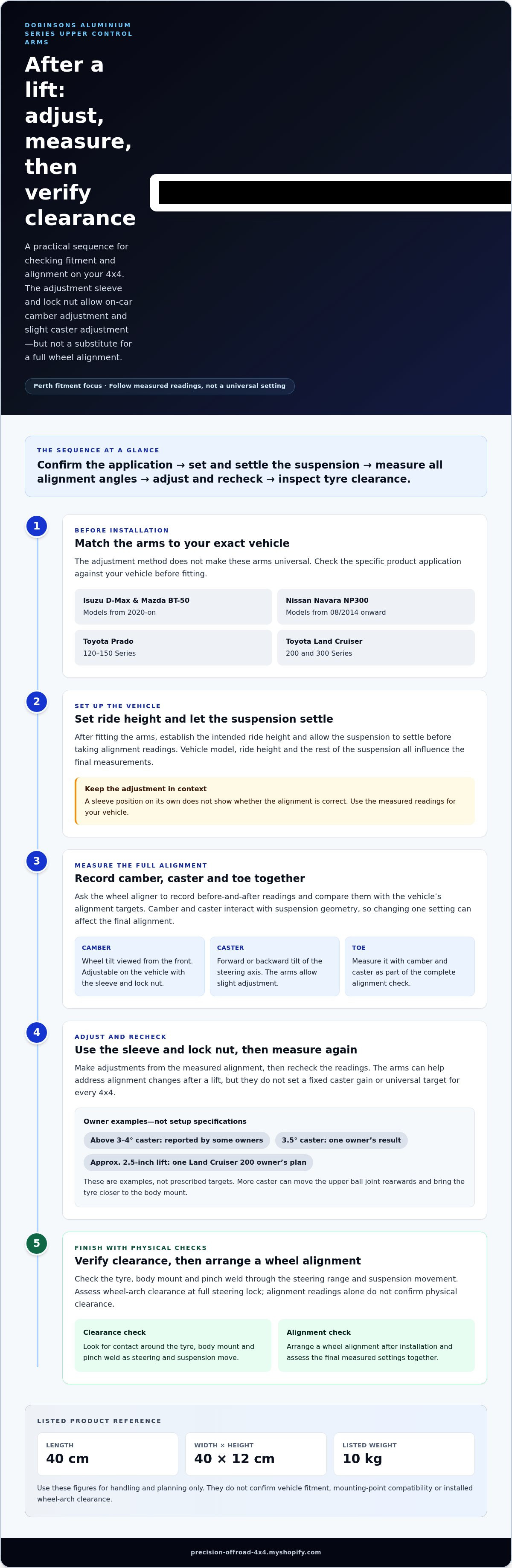
Dobinsons Aluminium Series upper control arms use an adjustment sleeve and lock nut for on-car camber adjustment and slight caster adjustment. These settings can help address alignment changes after a suspension lift, but they don’t replace a full wheel alignment.
Camber adjustment
Camber is the inward or outward tilt of a wheel when viewed from the front. The Dobinsons adjustment sleeve and lock nut allow camber adjustment on the vehicle. What matters is the measured alignment, not how far the sleeve appears to move. Ask the wheel aligner to record the before-and-after readings and compare them with the vehicle’s alignment targets.
Camber and caster interact with the suspension geometry, so changing one setting can affect the final alignment. The sleeve allows an adjustment, but it doesn’t establish a universal setting for every 4x4. Vehicle model, ride height and the rest of the suspension influence the readings. After fitting the arms, have camber, caster and toe measured together rather than treating camber as a stand-alone correction.
Caster adjustment
Caster is the forward or backward tilt of the steering axis. Dobinsons Aluminium Series arms allow slight caster adjustments through the sleeve and lock nut. That limited adjustment can help refine the alignment, but it shouldn’t be confused with a guaranteed caster gain or a fixed setting for every vehicle. A reported Land Cruiser 200 owner planned to use the arms to correct alignment with a lift of approximately 2.5 inches.
Some owners report using caster settings above 3-4 degrees to reduce highway wandering and move tyres away from body mounts and pinch welds. Treat that as an example, not a prescribed target. More caster can also move the upper ball joint rearwards and bring the tyre closer to the body mount, so tyre clearance needs assessment through the steering range.
After installation, follow a practical sequence: confirm the arms suit your exact vehicle, set ride height and let the suspension settle, then measure camber, caster and toe. Adjust and recheck the readings, and arrange a wheel alignment after suspension changes. Final settings should account for tyre position and clearance, not just the alignment display.
Dobinsons Aluminium Series arms are listed for Isuzu D-Max and Mazda BT-50 models from 2020-on, Nissan Navara NP300 models from 08/2014 onward, Toyota Prado 120-150 series, and Land Cruiser 200 and 300 Series models. The adjustment method doesn’t make these arms universal. Match the application before fitting, then assess wheel-arch clearance at full steering lock.
A lift changes the relationship between suspension components, which can make factory alignment settings harder to achieve. After fitting arms, check for contact around the tyre, body mount and pinch weld during steering and suspension movement. A reported 3.5° caster setting is one owner’s result, not a specification for every Dobinsons setup. Use measured alignment and physical clearance to judge the finished adjustment.
Product dimensions and weight
The listed dimensions are 40 cm long, 40 cm wide and 12 cm high, with a listed weight of 10 kg. Use these figures as a handling and planning reference, not as a substitute for checking vehicle fitment or installation requirements.
Length, width and height describe the listed product envelope. They don’t show the arm’s mounting points, shape around the chassis or clearance beside other suspension parts. A 40 cm measurement, for example, can’t tell you whether the arm clears a coil spring through its full movement. Fitment still depends on the vehicle and suspension configuration.
The 10 kg figure is useful when planning how to handle the parts before installation. Keep the arms supported while moving them, and avoid placing them where they could fall or strike other components. Don’t assume the listed weight describes each arm individually or the complete package.
Before fitting, compare the product listing with the specific Dobinsons arm application you plan to install. Inspect the delivered parts for visible transport damage and compare the pair before removing existing components. Plan enough room to handle and store the parts safely before starting work.
The listed 40 cm by 40 cm by 12 cm dimensions also don’t provide a measurement of installed wheel-arch clearance. That clearance changes with vehicle geometry, ride height, wheel and tyre combination, and steering position. Check the physical space around the arm and tyre after installation, rather than using the listed dimensions as a clearance guarantee.
Keep the measurements in context with the rest of the suspension setup. A replacement arm may fit the vehicle application yet still need alignment and clearance checks once installed. The measurements help with preparation; they don’t confirm compatibility by themselves. Confirm the product application, then plan the work area and handling around the listed 10 kg weight.
For your workshop notes, record the listed dimensions and weight alongside the arm’s vehicle application. This gives you a clear reference when comparing components or planning storage. Listing details describe the product; the installed position still needs to be assessed on the vehicle. Keep handling information separate from fitment decisions.
If you’re planning other vehicle upgrades alongside your suspension work, review relevant 4x4 upgrade products as part of the overall build plan. Keep component dimensions, installation space and vehicle compatibility in view when organising the work.
Product price
Compare Dobinsons upper control arms by exact application and included components, not by a product name alone. The Aluminium Series SKU is UCA19-224K, while the tubular arm code is UCA59-006K. Those identifiers help distinguish different products when you’re comparing listings for your 4x4.
Start with your vehicle’s make, model and year. The tubular UCA59-006K is listed for Toyota Land Cruiser 100 Series models from 1998 to November 2017. The Aluminium Series UCA19-224K covers different applications, including Toyota Prado 120-150 Series and Land Cruiser 200 and 300 Series models. Matching the code to your vehicle is the first step.
Next, compare what each application requires for its ball joints. The Aluminium Series arms for Isuzu D-Max and Mazda BT-50 models from 2020 onward must reuse the original ball joints. That differs from an assumption that every arm arrives with a complete replacement joint assembly. Include this distinction in your comparison, because it changes which components you need to retain and prepare.
Use this checklist when comparing a listing:
- Match the product code to the vehicle application and model year.
- Identify whether the listing refers to tubular or Aluminium Series arms.
- Check the ball-joint arrangement, including reuse requirements for 2020-on D-Max and BT-50 applications.
- Compare the listed package contents with the components your installation requires.
These checks separate unlike products before you make a decision. For example, a Land Cruiser 100 Series tubular arm and a Prado 150 Series Aluminium Series arm aren’t interchangeable simply because both are Dobinsons upper control arms. Their applications and construction differ. Treat each product code as a fitment identifier, not just a catalogue label.
Also consider whether you’re comparing the arms alone or a broader suspension setup. A Land Cruiser 200 owner planned to pair the arms with a lift of approximately 2.5 inches. That example shows why product comparisons need to account for the vehicle’s suspension configuration, rather than isolating the arm from its intended setup.
Finally, write down the exact vehicle, model year, product code and ball-joint arrangement before comparing listings. For instance, record “2020-on Mazda BT-50, UCA19-224K, reuse original ball joints” where that application applies. This makes the comparison specific and helps prevent confusion between different Dobinsons arm designs.
Tubular upper control arm construction
Dobinsons tubular upper control arms use chrome-moly tubing, with listed tube diameters of 35, 36 and 38 mm. The tubing has 5 mm-thick walls. Those are construction specifications, not a universal fitment guide or a promise about vehicle performance.
The three listed diameters indicate that the tubular design uses more than one tube size. Don’t assume which diameter applies to a particular arm from the range alone. Match the product code and vehicle application first. The tubular arm code UCA59-006K is listed for Toyota Land Cruiser 100 Series models from 1998 to November 2017.
A 5 mm wall thickness describes the tube wall, while diameter describes its width. Neither measurement alone tells you the arm’s full shape, mounting position or clearance on your vehicle. During a pre-fit inspection, compare the two arms and check for visible damage. Then assess how the installed arm sits relative to nearby components.
Chrome-moly is the specified tubing material for this tubular design. Don’t confuse it with the Dobinsons Aluminium Series arms, which are made from 6082 T6 aluminium and are drop-forged and CNC-machined. Those are separate construction descriptions. A material comparison should begin with the exact arm type and vehicle application, not a general assumption that one design suits every 4x4.
For fitment, use the UCA59-006K identifier to keep product information tied to the Land Cruiser 100 Series application. Before installation, confirm the vehicle matches that listed application and inspect the mounting points and surrounding suspension parts. After fitting, check clearance through steering and suspension movement. A tube diameter or wall measurement cannot confirm installed clearance by itself.
Tube dimensions don’t establish an arm’s adjustment range or the alignment result. Those depend on the arm design and vehicle setup. Keep construction and alignment checks separate: verify the correct part, inspect the tubing and mounting areas, then assess the installed suspension as a complete assembly. A single specification does not prove fitment.
These specifications alone don’t determine whether installation affects warranty, insurance or roadworthiness in Australia. Assess the modification against vehicle-specific requirements and the relevant warranty and insurance terms. Tube material and dimensions are not compliance approval.
For a practical inspection, record the UCA59-006K code, the listed 35, 36 or 38 mm tube diameter, and the 5 mm wall thickness alongside the vehicle details. Use those points to identify the tubular design, then keep fitment, clearance and alignment as separate checks. That gives you a clearer basis for assessing the arm without assuming the same construction applies to every Dobinsons UCA.
UCA maintenance and longevity
Maintenance depends on the arm design. Dobinsons Aluminium Series upper control arms are described as having maintenance-free rubber bushes and ball joints. That does not mean every Dobinsons arm has the same components or care requirements. Identify whether your vehicle has Aluminium Series or tubular arms before following maintenance procedures.
Begin an inspection by checking the bushes and ball-joint area for visible damage, movement, torn rubber or escaping grease. Then inspect the arm and mounting points for impact marks or changes in position. These checks can help reveal issues, but they don’t replace assessment by a qualified suspension professional.
Don’t assume grease is required on every UCA. The maintenance information for Dobinsons Aluminium Series arms describes their rubber bushes and ball joints as maintenance-free. A forum owner’s report about using NLGI #2 grease concerned SPC upper control arms, not a Dobinsons maintenance instruction. Only grease a fitting when the arm’s own design and instructions call for it.
After driving on rough tracks, check the arms for obvious damage or contact with nearby components. For example, after an off-road trip in a Land Cruiser, inspect around the arm, ball joint and bushes. Listen for new noises and note any change in steering feel. These observations are prompts for inspection, not proof of a particular fault.
Keep maintenance records for the vehicle and fitted arm type. Record inspection findings, work completed and changes noticed while driving. If wheel alignment changes unexpectedly or a bush or joint shows damage, have the suspension assessed. Don’t try to correct a mechanical fault by adjusting alignment alone.
One owner’s experience can’t establish how long an arm will last. A Dobinsons UCA owner described the set as their third pair, but that account doesn’t explain why earlier pairs were replaced or establish a service life. Treat it as an individual report, not a lifespan estimate. Vehicle use, terrain and the condition of surrounding suspension components all matter when assessing wear.
For a consistent routine, identify the UCA type, inspect the bushes and joints, check arm condition, then record any changes. Follow the product-specific maintenance instructions for the exact Dobinsons arm fitted. Avoid applying grease or tightening components based on advice for another brand; the SPC example shows why maintenance guidance must match the part.
Precision Offroad 4x4: Wheel Upgrades
Precision Offroad 4x4 can help you consider wheel upgrades alongside suspension changes, so wheel and tyre choices suit your build. If you’re selecting upper control arms after a lift, look at the whole setup: vehicle application, suspension components, wheel fitment and tyre clearance.
Its range includes Dobinsons Suspension Kits and premium tyre options like Maxxis Tyres. These options are relevant when you’re planning a broader 4x4 upgrade, not just replacing one component. Keep your intended use and vehicle compatibility in view, and consider how each choice affects the finished setup.
For a Perth-focused upgrade plan, contact Precision Offroad 4x4 or visit precision-offroad-4x4.myshopify.com.
Plan your next suspension step
Before choosing arms, make a vehicle-specific note of the model, year, suspension setup, wheel and tyre combination, and any clearance concerns. This gives you a practical starting point for discussing fitment and the work required, instead of relying on a general recommendation.
A useful Dobinsons upper control arms review should lead to a setup that suits how you use your 4x4, not just a parts list. Consider how the control arms relate to the rest of the suspension and what checks your vehicle needs after installation. If you’re planning wheel changes or a broader suspension upgrade, consider those components together so the finished setup works as a system.
Precision Offroad 4x4 offers Wheel Upgrades, Dobinsons Suspension Kits and Fulcrum Suspension Kits. Contact the team with your vehicle details and upgrade priorities to discuss a practical direction for your build.
Contact Precision Offroad 4x4 to plan your next step. A well-matched setup gives you a clear path forward.
Frequently Asked Questions
Why Aftermarket UCAs?
Consider aftermarket arms when your planned suspension changes call for components beyond the factory setup. They’re not automatically necessary for every 4x4 or every lift. First assess the complete front-end condition, including springs, shock absorbers and steering components. Replacing an arm won’t repair worn parts elsewhere, so identify the source of the problem before choosing an upgrade.
What are the pros and cons of Dobinsons upper control arms?
The main advantage is that arm options are available for different vehicle applications and suspension builds. The trade-off is that an arm upgrade is only one part of the front suspension system. If springs, shock absorbers or steering components are worn or poorly matched, changing the arms alone won’t resolve those issues. Base your decision on the full vehicle setup, not one component in isolation.
What caster and alignment improvements do Dobinsons upper control arms provide?
There’s no single improvement figure that applies to every vehicle. To assess the result, compare alignment readings before and after installation, then note how the vehicle tracks on a familiar road. Record whether the steering wheel stays centred and whether the vehicle pulls during steady driving. These observations add context to the alignment figures, but no single reading tells the whole story.
How durable are Dobinsons upper control arms in touring and off-road use?
There isn’t one service-life figure that applies across touring and off-road conditions. A vehicle’s load, terrain and driving style all affect the demands placed on its suspension. Treat owner mileage claims cautiously unless the review also describes the vehicle’s use and setup. A touring 4x4 carrying equipment and a vehicle used on rough tracks don’t provide directly comparable durability examples.
How much do Dobinsons upper control arms cost in Australia, including installation?
The total depends on the arm application and the work included in the installation. When planning the job, separate the arms from labour and related suspension work, then account for the wheel alignment needed afterwards. A vehicle-specific comparison is more useful than comparing unrelated listings. Ask for a clear scope of the proposed parts and tasks so you can assess the full job.
What do Australian owners and mechanics say in Dobinsons upper control arm reviews?
Reviews are most useful when they clearly describe the vehicle, installation and use. Look for details such as whether the arms were fitted with a new suspension setup, how the vehicle was driven afterwards, and whether the owner reported changes over time. A rating alone offers little context. Reviews that explain the conditions behind an opinion are easier to compare with your own build.
What are common problems or complaints about Dobinsons upper control arms?
Clearance is a key concern. More caster can move the upper ball joint rearwards and bring the tyre closer to the body mount. Check for contact around the tyre, body mount and pinch weld through steering and suspension movement. The arms allow only slight caster adjustment, and a wheel alignment is still needed after installation.