

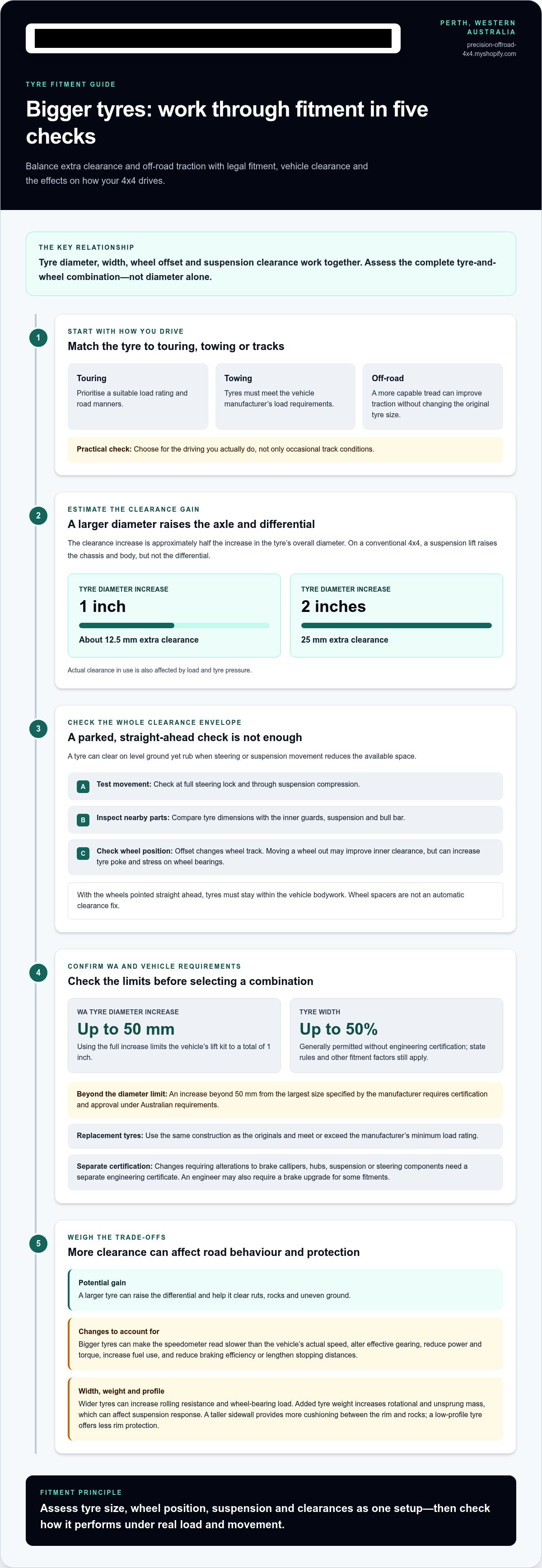
Fitting bigger tyres to a 4x4 can add ground clearance, but wider tyres can increase rolling resistance and place extra load on wheel bearings. In Western Australia, tyre diameter can be increased by up to 50 mm. Using the full increase limits the vehicle’s lift kit to 1 inch, so tyre and suspension changes need to be considered together.
It’s easy to focus on the extra clearance and off-road grip. The trade-offs matter too: tyre width, profile and overall diameter affect how your 4x4 handles, clears obstacles and fits within Australian requirements.
This guide explains why drivers change tyres, what larger diameters can offer and where wider tyres can create drawbacks. You’ll also learn how tyre profile affects rim protection off-road, and which fitment and compliance factors matter when choosing a setup for Perth roads and tracks.
Key Takeaways
- In WA, tyre diameter increases are limited to 50 mm; changes beyond applicable limits can require engineering certification.
- Compare the tyre’s full diameter with your wheel-arch and bull bar clearances to reduce the risk of rubbing.
- Choose a tyre profile with enough sidewall for the terrain, as low-profile tyres offer less rim protection over rocks.
- Weigh the traction and clearance benefits against the added rolling resistance, weight and handling effects of wider or larger tyres.
JH: What are some of the functional reasons for changing tyres?
Drivers change tyres to suit touring, towing or off-road conditions, often seeking different tread or extra clearance. In WA, tyre diameter can increase by up to 50 mm, so your intended fitment must also meet legal requirements.
Choosing tyres for different driving
Choosing tyre size means balancing your usual driving conditions with fitment, load and vehicle requirements. For touring, prioritise a suitable load rating and road manners. If you tow, tyres must also meet the vehicle manufacturer’s load requirements. For off-road use, a more capable tread pattern can improve traction without changing the original tyre size. Match the tyres to how you actually use the vehicle, not just occasional track conditions.
Australian tyre-size rules and certification
In WA, tyre diameter can increase by up to 50 mm. Increasing diameter beyond 50 mm from the largest size specified by the manufacturer requires certification and approval under Australian requirements. Using the full 50 mm allowance limits the vehicle’s lift kit to a total of 1 inch. Rules can vary between states, and total vehicle height also affects what is permitted.
Replacement tyres must use the same construction as the originals and meet or exceed the manufacturer’s minimum load rating. With the wheels pointed straight ahead, tyres must stay within the vehicle bodywork. A wheel-and-tyre change that requires alterations to brake callipers, hubs, suspension or steering components needs a separate engineering certificate. An engineer may also require a brake upgrade for some fitments.
Effects on vehicle performance
Tyre diameter affects speedometer accuracy, gearing, fuel use, braking and handling. Bigger tyres make the speedometer read slower than the vehicle’s actual speed. They also alter effective gearing, which can reduce power and torque. Greater rolling resistance and rotating mass can increase fuel consumption, while a larger diameter can reduce braking efficiency and lengthen stopping distances.
These effects matter on Perth roads and during loaded touring. Assess the complete tyre-and-wheel combination alongside suspension, clearances and load requirements, rather than choosing by diameter alone. For light off-roading, changing the tread pattern while keeping the original size can improve traction without introducing the same diameter-related changes.
JH: What are the pros of larger-diameter tyres?
The main practical gain is extra clearance beneath the vehicle. Fitting bigger tyres to a 4x4 can raise the differential and help clear ruts, rocks and uneven ground. The benefit depends on the tyre’s diameter and which components sit lowest.
Ground clearance from tyre upsizing
A larger tyre raises the axle and differential by approximately half the increase in its overall diameter. A tyre that is 1 inch larger adds about 12.5 mm of clearance; a 2-inch increase adds 25 mm. That extra height can help prevent the differential contacting a ridge on a Perth-area track.
A suspension lift raises the chassis and body, but not the differential on a conventional 4x4. The differential remains the lowest point unless the vehicle has independent suspension or portal axles. Larger-diameter tyres raise that low point because the axle sits higher relative to the ground. Load and tyre pressure also affect the clearance available in real use.
Tyre and vehicle component clearance
Bigger tyres take up more space inside the wheel arch. Check clearance at full steering lock and through suspension compression, not just with the vehicle parked straight. A tyre may clear on level ground but rub an inner guard or bull bar while turning or articulating over uneven terrain.
Wheel offset changes wheel track and where the tyre sits beside the body and suspension. Moving a wheel outward may improve inner clearance, but can increase tyre poke and stress on wheel bearings. When fitting bigger tyres to a 4x4, assess offset and diameter together, within applicable wheel-track limits.
Compare the measured tyre dimensions with the arches, suspension and bull bar before choosing a combination. A suitable wheel upgrade must allow clearance through steering and suspension movement, not just create a larger stance.
Rim diameter and off-road tyre profile
Rim diameter and tyre profile determine how much sidewall sits between the rim and the track. A larger rim usually leaves less sidewall when the overall tyre diameter stays similar. That trade-off matters on rocky tracks around Perth, where a tyre can strike sharp edges.
For off-road driving, a taller sidewall provides more cushioning between the rim and rocks. A low-profile tyre offers less protection, increasing the risk of rim damage from a hard impact. Wider tyres can also push more sand, dirt or mud aside, raising rolling resistance. Their extra weight increases rotational and unsprung mass, which can affect suspension response.
Tyre width and diameter are separate measurements. In Australia, 4WD tyre width can generally increase by up to 50% without engineering certification, but state rules and other fitment factors affect what’s permitted. In WA, the stated maximum diameter increase is 50 mm. Wheels and tyres must remain within the bodywork with the wheels straight ahead.
Bigger tyres can rub inner guards or a bull bar when steering or suspension movement reduces clearance. A lift kit may create more room around the wheel arch, but it won’t automatically resolve every clearance issue. Wheel spacers aren’t an automatic fix either: changing offset changes wheel track and can affect legal tyre position. Replacement wheels must retain the original stud or bolt pattern.
Will bigger tyres require a lift kit, wheel spacers or different rims? Not always. The answer depends on tyre diameter and width, wheel-arch clearance, wheel offset and the vehicle’s existing fitment. Assess these factors together before choosing parts.
Larger-diameter tyres
A larger tyre can raise the differential and add clearance, but diameter changes more than ground clearance. In WA, the stated tyre-diameter increase limit is 50 mm. Using that full allowance also affects how much suspension lift fits within the vehicle’s total-height limits. Plan tyre and suspension changes as one combination, not separate upgrades.
Speedometer readings change as rolling diameter increases. A 50 mm increase can make a 4WD’s speedometer approximately 10% inaccurate, with the vehicle travelling faster than the display suggests. Larger tyres also alter effective gearing, which can reduce available power and torque. The practical effect is more noticeable when towing or climbing, where the engine works against the taller gearing.
Braking is another consideration. A larger tyre can reduce braking efficiency, while greater rolling resistance and rotating weight can increase fuel consumption. Added tyre mass also raises unsprung mass, which can affect how quickly the suspension responds over corrugations. Tread pattern matters too: for light off-roading, a more capable pattern at the original size can improve traction without changing rolling diameter.
Before choosing a larger fitment, compare its diameter with the manufacturer’s specified size, then assess speedometer accuracy, gearing, braking and clearance. Include suspension lift in the total-height calculation. In a state with a 50 mm total vehicle-height increase limit, a 50 mm suspension lift leaves no room for taller tyres within that example limit. Modifications beyond local requirements may also affect an insurance claim.
The practical takeaway is to upsize only when the added clearance solves a real terrain problem. For lighter off-road use, keeping the original diameter and choosing a suitable tread pattern can avoid several diameter-related trade-offs.
Explore tyre options for your 4x4 to compare patterns for your intended driving.
Precision Offroad 4x4: Wheel Upgrades
Precision Offroad 4x4 offers Wheel Upgrades and Maxxis Tyres for drivers comparing tyre size, wheel fitment and off-road tread. If your current setup needs more clearance, consider the complete wheel-and-tyre combination alongside wheel-arch clearance, wheel track and the applicable WA limits.
If you're also changing the suspension, Dobinsons Suspension Kits are options to consider as part of the overall setup. Match each choice to your vehicle, intended use and load requirements rather than choosing tyre diameter alone. Bigger tyres can affect speedometer readings, gearing and braking, so include compliance and mechanical effects in your decision.
Contact Precision Offroad 4x4 to discuss wheel upgrades and tyre options for your 4x4.
Plan your 4x4 setup around the way you drive
Your approach to fitting bigger tyres to a 4x4 should start with the job you need the vehicle to do. Decide whether extra clearance is worth the changes to ride, steering feel and everyday usability. Then treat the tyres, wheels and suspension as one setup, with compatibility and safe handling as priorities. A measured choice will serve you better than selecting a size for appearance alone.
Precision Offroad 4x4 offers Wheel Upgrades, Dobinsons Suspension Kits and Fulcrum Suspension Kits to help you plan related components together. If you’re ready to discuss a suitable direction for your vehicle, contact Precision Offroad 4x4. Take the next step with a clear use case and a setup designed around your real driving.
Frequently Asked Questions
JH: What are the cons of wider tyres?
Wider tyres can be more prone to tramlining, where the steering follows grooves or uneven road surfaces. You may notice this on worn bitumen or roads with pronounced wheel ruts. The effect depends on tyre construction, pressure, alignment and the vehicle. After changing tyre width, pay attention to steering behaviour on familiar roads, not just traction on a track.
JH: What are the legalities?
If a modification requires engineering certification, keep the paperwork with the vehicle records and make sure the approved configuration matches the fitted wheels and tyres. A modification plate identifies a certified suspension or GVM modification. Consider your insurer too: a vehicle modified beyond local regulations may have an insurance claim rejected. Legal requirements can differ between Australian states, so WA rules apply to your Perth-registered vehicle.
How much difference does it really make?
Tyre pressure can make a practical difference off-road without changing tyre size. Lowering pressure increases the tyre’s contact patch with the ground, which can help traction on loose surfaces. Suitable pressure depends on the tyre, vehicle load and terrain. Reinflate before returning to sealed roads, and account for the conditions and load you’ll encounter next.
JH: How big is too big?
A tyre is too big if the complete setup cannot move through the vehicle’s steering and suspension range without making contact. Assess it with the vehicle loaded as you actually drive it, then check at full steering lock and during suspension compression. Also consider whether the larger spare fits its carrier or storage space. These checks reveal practical fitment limits beyond appearance.
Should you upsize your 4x4 tyres?
Upsizing is worth considering if your regular routes include obstacles that the current setup struggles to clear. Before deciding, compare that benefit with how the vehicle behaves under its usual touring or towing load. Identify the specific obstacle or track condition you want to address. Without a clear use case, changing size may add complexity without solving a regular problem.
Tyre and wheel size: How big and low can you go?
Read the tyre sidewall marking as a set: it identifies the tyre’s section width, aspect ratio and rim diameter. Aspect ratio describes sidewall height relative to width, so tyres with the same rim diameter can have different profiles and overall sizes. Choose a wheel diameter that suits the intended tyre profile, then assess the assembled combination against the vehicle’s fitment requirements.