

A stiffer suspension setup isn’t automatically the fix. To fix LandCruiser body roll, first look at the vehicle’s load, ride height, springs and shock absorbers. The right adjustment depends on what’s causing the body to lean and how you use your 4x4.
If your LandCruiser feels unsettled through corners or leans heavily when changing direction, it’s natural to suspect the suspension. But extra weight mounted high, tired components or springs that don’t suit your load can all affect how the vehicle behaves. Replacing parts before identifying the cause may leave the handling problem unresolved.
This guide explains common causes of body roll and how to assess them, from load placement and spring selection to shock absorber damping and suspension geometry. You’ll also learn why safe, practical testing matters and what to consider before changing a lifted LandCruiser’s suspension in Perth, WA.
Key Takeaways
- Start by checking how your gear is loaded; weight carried high can affect cornering stability.
- Match spring rate to your LandCruiser’s regular load. Springs support the vehicle, while shock absorbers control their movement.
- Assess damping, ride height and suspension geometry together before changing components, then test the vehicle safely with its normal load.
- For suspension and wheel options suited to your setup, compare the Dobinsons suspension kits and Wheel Upgrades available from Precision Offroad 4x4.
Fix landcruiser body roll
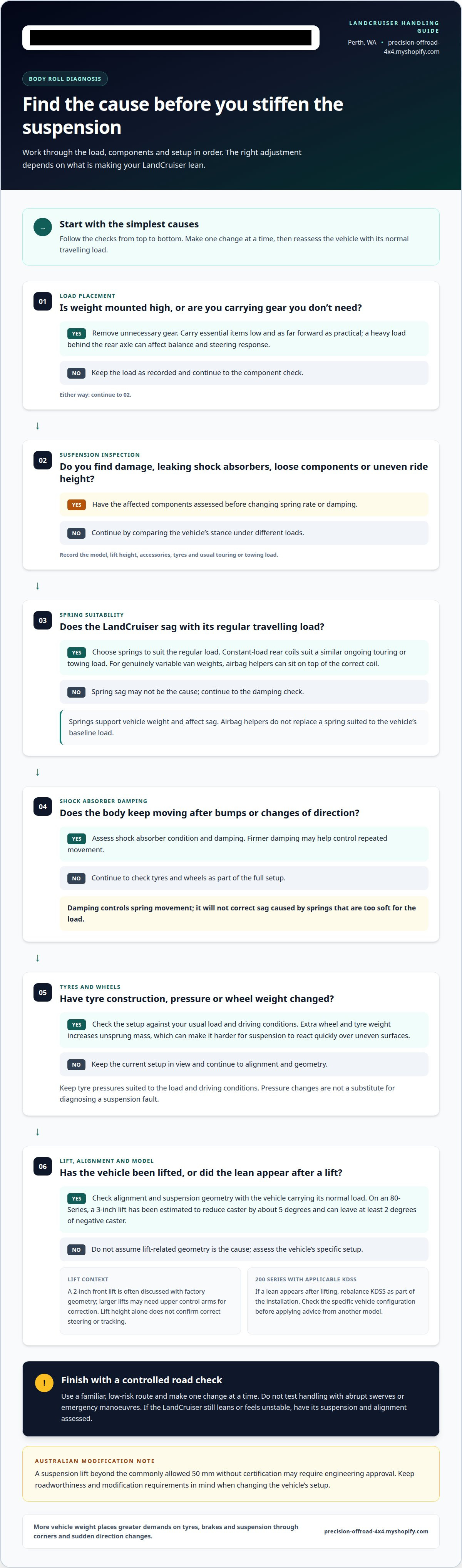
To reduce body roll, first identify what is affecting your LandCruiser’s balance. Excess weight, high-mounted accessories, unsuitable springs, worn dampers and altered suspension geometry can all contribute. A heavier vehicle also places greater demands on its tyres, brakes and suspension through corners and during sudden direction changes.
Start by reviewing the load. A rooftop tent, roof rack and recovery gear raise the vehicle’s centre of gravity, increasing the leverage that makes the body lean. Remove gear you don’t need, then carry essential items low and as far forward as practical. A heavy load behind the rear axle can also affect balance and steering response.
Use this sequence to narrow down the cause:
- Record the setup. Note the LandCruiser’s model, lift height, accessories, tyres and usual touring or towing load.
- Inspect the suspension. Look for damaged springs, leaking shock absorbers, loose components and uneven ride height.
- Assess the load. Compare how the vehicle sits and handles when empty with its normal travelling load.
- Test methodically. Use a familiar, low-risk route and make one change at a time. Don’t test handling with abrupt swerves or emergency manoeuvres.
Spring rate and shock absorber damping do different jobs. Springs support the vehicle’s weight and affect whether it sags. Shock absorbers control spring movement after bumps and as the body moves. Firmer damping may help control repeated movement, but it won’t correct sag caused by springs that are too soft for the load.
Choose springs for the LandCruiser’s regular load, not occasional extra gear alone. Constant-load rear coils suit a vehicle that regularly carries a similar touring or towing load. For genuinely variable van weights, airbag helpers can be fitted on top of the correct coil. An airbag helper doesn’t replace a spring suited to the vehicle’s baseline load.
Tyres and wheels also affect the result. Tyre construction, pressure and wheel weight can change steering response and suspension behaviour. Added wheel and tyre weight increases unsprung mass, which can make it harder for the suspension to react quickly over uneven surfaces. Keep tyre pressures suited to the load and driving conditions. Don’t use pressure changes as a substitute for diagnosing a suspension fault.
After a lift, check alignment and suspension geometry with the vehicle carrying its normal load. On an 80-Series LandCruiser, a 3-inch lift has been estimated to reduce caster by about 5 degrees and can leave at least 2 degrees of negative caster. These figures illustrate why lift height alone doesn’t establish whether the vehicle will steer or track correctly. A 2-inch front lift is often discussed with factory geometry, while larger lifts may need upper control arms for correction.
LandCruiser 200 Series models use KDSS on applicable variants. If a lean appears after lifting one, KDSS should be rebalanced as part of the installation. The 200 and 300 Series also use independent front suspension with a five-link coil live axle rear. Check the specific vehicle’s configuration before applying advice from another model.
In Australia, a suspension lift beyond the commonly allowed 50 mm without certification may require engineering approval. A lifted 80-Series can also be more vulnerable to rollover during an emergency evasive manoeuvre. Keep any road test controlled, and address handling changes before returning to normal driving.
On an 80-Series LandCruiser, a 3-inch lift has been estimated to reduce caster by an amount that should be checked through a proper alignment assessment. A forum participant advised checking alignment with the vehicle carrying its normal load before deciding whether caster correction is needed. A forum participant also estimated that modified suspension could compress 23% more slowly than factory suspension in a described off-road example. That estimate is specific to that example; it does not establish that slower compression will suit every vehicle or load.
Take rollover risk seriously when evaluating changes to handling. A forum participant warned that a lifted 80-Series Land Cruiser may be capable of rolling over during an emergency evasive manoeuvre. A forum participant also described a test in which a lifted 80-Series Land Cruiser could be flipped in a parking lot within 30 seconds. Treat that account as a caution, not as a test to repeat. On a LandCruiser 200 Series, the article recommends rebalancing KDSS during installation to address a lean that appears after lifting. If the vehicle still leans or feels unstable after setup changes, have its suspension and alignment assessed rather than trying abrupt manoeuvres to judge the result.
Precision Offroad 4x4: Wheel Upgrades
Precision Offroad 4x4 offers Wheel Upgrades alongside Dobinsons and Fulcrum Suspension Kits for LandCruiser owners reviewing their vehicle’s setup. If your body roll persists after checking load placement, spring suitability and damping, compare components as a matched system rather than changing wheels or suspension in isolation.
Wheel and tyre choices affect unsprung mass, steering response and how the suspension reacts over uneven surfaces. Maxxis Tyres may suit your LandCruiser if your current tyres don’t match your regular driving conditions. The right combination depends on your model, wheel fitment, tyre requirements and usual load. Keep Australian roadworthiness and modification requirements in mind when changing the vehicle’s setup.
Contact Precision Offroad 4x4 to discuss Wheel Upgrades, suspension kits or Maxxis Tyres for your LandCruiser.
Plan the next suspension adjustment
Treat your LandCruiser’s handling as ongoing feedback, not a one-off verdict after an upgrade. Keep a simple record of changes to the load, tyre setup and road behaviour. If the vehicle’s response shifts after you add touring gear or change how you use it, reassess the setup before making another adjustment. This measured approach can help you fix LandCruiser body roll without chasing changes that don’t address the cause.
Make adjustments one at a time, then pay attention to how the vehicle behaves in ordinary driving. A clear record makes it easier to spot patterns and decide what to address next. With a considered process, you can build confidence in your LandCruiser’s handling over time.