

Bolting a two-inch lift onto your rig won't stop your suspension from cooking itself on corrugated washouts. When sourcing heavy duty 4x4 shock absorbers Australia tracks demand, you have to engineer around actual axle mass and heat dissipation rather than arbitrary ride height.
You already know the gut-wrenching feeling of severe shock fade twenty kilometres into a remote desert run, or the uneasy sway of an overloaded touring setup wallowing through high-speed sweepers. Relentless outback heat and abrasive bulldust quickly destroy standard seals, while heavy towing payloads push mismatched dampers well past their physical limits.
This technical guide will help you select the exact damper configuration engineered to control your gross vehicle mass, match your spring rates, and survive brutal off-road punishment without mechanical failure.
We break down the practical differences between twin-tube, monotube, and remote reservoir systems, explain how internal valving controls unsprung mass, and cover the essential requirements for full ADR compliance on Australian roads.
Key Takeaways
- Selecting the right heavy duty 4x4 shock absorbers Australia requires means matching fluid volume and cooling surface area to thermal load, preventing shock fade on extended corrugations.
- Twin-tube, monotube, and remote reservoir dampers offer distinct trade-offs between stone-strike resistance, oil capacity, and high-speed piston control.
- Upgrading your springs for increased load-carrying capacity requires recalibrated rebound valving to stop dangerous rear-axle bucking under heavy touring payloads.
- Lifting an independent front suspension alters wheel alignment, requiring suspension geometry correction and upper control arms (UCAs) to restore safe caster angles.
- Achieving legal road compliance in Western Australia requires meeting Department of Transport guidelines and securing a certified modification plate for complex GVM upgrades.
Why Factory 4x4 Dampers Fail Under Australian Touring Demands
Every factory damper fitted to an off-the-showroom-floor four-wheel drive is a compromise. Manufacturers tune original equipment (OE) units for unladen passenger comfort on sealed metro roads, not for carrying full overland payloads across the Gibb River Road or the Great Central Road. When you load a vehicle to its gross vehicle mass (GVM) and hit remote tracks, these factory units quickly reach physical limits.
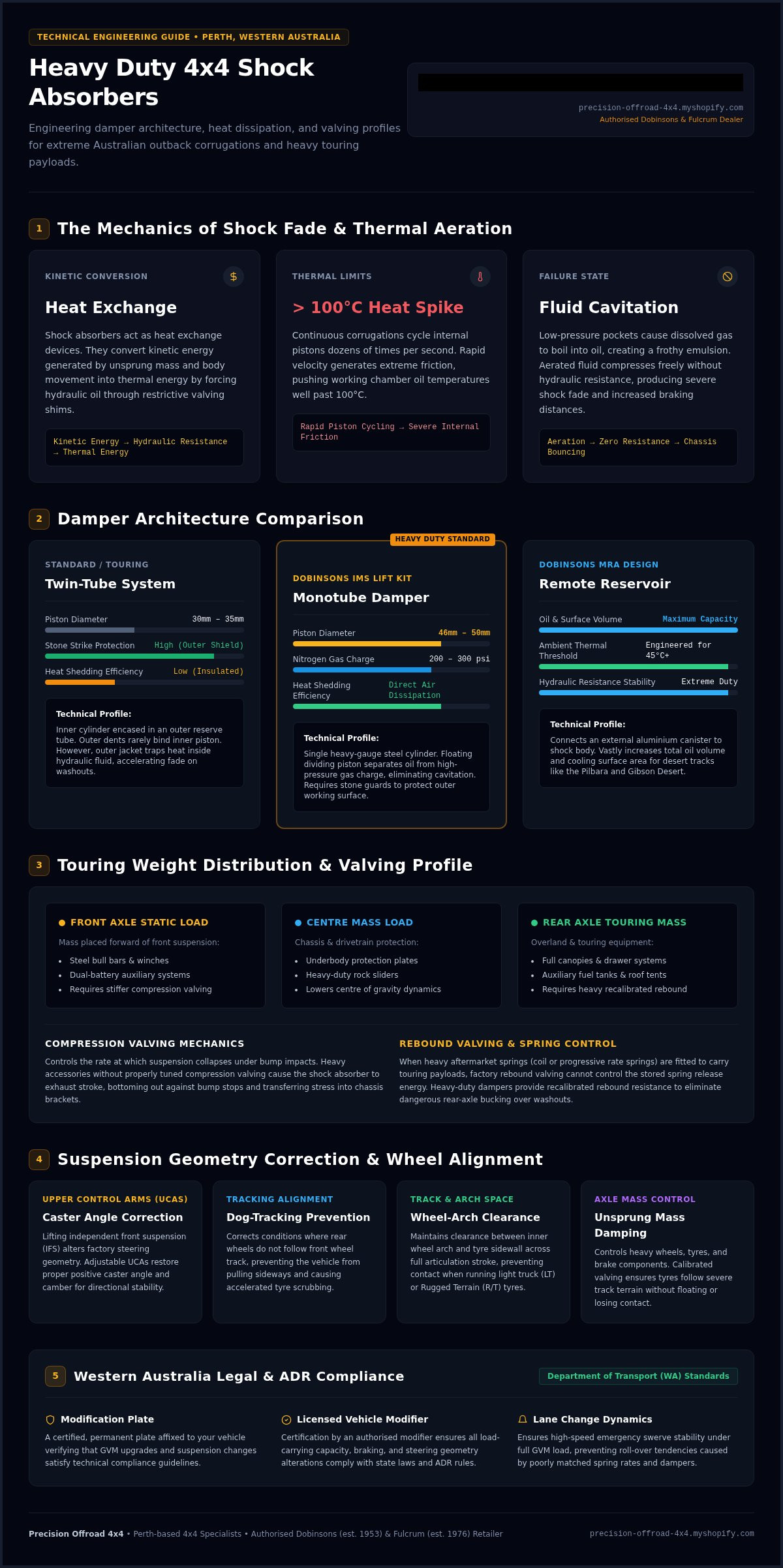
Understanding fundamental shock absorber principles helps explain why this happens. A shock absorber is essentially a heat exchange device. It controls the kinetic energy generated by unsprung mass and body movement, forcing hydraulic oil through restrictive valving shims and turning that movement into thermal energy. Under relentless Australian conditions, that heat accumulates faster than a standard damper body can shed it.
The Mechanics of Shock Fade and Hydraulic Aeration
Corrugations force the internal piston to cycle dozens of times per second. This rapid velocity builds extreme friction inside the working chamber, pushing oil temperatures past 100 degrees Celsius. In standard low-volume dampers, intense thermal cycles trigger cavitation, where low-pressure pockets cause dissolved gas to boil out into the fluid. The oil turns into a frothy emulsion. Because aerated oil compresses easily without offering hydraulic resistance, your damping resistance vanishes completely. This condition, known as shock fade, lets the chassis bounce unchecked, extending braking distances dramatically and reducing emergency steering control.
Impact of Constant Heavy Accessories on Suspension Life
Outfitting a touring rig adds immense static mass over both axles. Consider the cumulative weight of typical off-road accessories:
- Steel bull bars, winches, and dual-battery systems overloading the front axle
- Underbody protection plates and rock sliders adding centre mass
- Full-length canopies, drawers, auxiliary fuel tanks, and roof tents loading the rear
When you compress a factory shock absorber against that much weight, the compression valving runs out of stroke. The suspension bottoms out on bump stops, transmitting massive mechanical impacts directly into the chassis mounts. Installing heavier aftermarket coil or leaf springs solves the ride height issue, but factory dampers lack the rebound valving necessary to slow that stored spring energy. This mismatch leads to violent bucking over washouts, which eventually fractures mounting brackets. Sourcing high-grade heavy duty 4x4 shock absorbers Australia conditions require ensures your valving matches your load, keeping the tyres firmly planted on the dirt.
Selecting Damper Architecture: Twin-Tube, Monotube, and Remote Reservoir
Matching damper architecture to your specific touring style prevents early hydraulic failure. Heavy duty 4x4 shock absorbers Australia retailers stock fall into three main design categories: twin-tube, monotube, and remote reservoir. Each design handles oil capacity, heat shedding, and mechanical protection differently.
Internal Monotube Design vs Traditional Twin-Tube Systems
Twin-tube shocks feature an inner working cylinder encased within an outer reserve tube. Dents to the outer body from flying track gravel rarely bind the inner piston, making them durable against stone strikes. However, that outer jacket acts as an insulating blanket, trapping heat inside the hydraulic fluid and speeding up fade.
Monotube dampers, such as the Dobinsons IMS lift kit, eliminate the outer jacket entirely. A single, heavy-gauge steel cylinder contains the oil and gas charge, dissipating heat directly through the outer wall into the ambient airflow. Inside, a floating dividing piston physically isolates high-pressure nitrogen (typically 200 to 300 psi) from the oil, eliminating fluid cavitation. Piston diameters jump from 30mm or 35mm up to 46mm or 50mm, delivering finer hydraulic control and superior structural rigidity. Because the cylinder wall is also the working surface, monotubes require durable stone guards to protect the body from flying debris.
When Do Remote Reservoirs Become Necessary for Australian Tracks?
When you tackle hundreds of kilometres across the Gibson Desert or the Pilbara in 45-degree ambient heat, internal fluid expansion tests damper seals to their limits. Remote reservoir systems, such as Dobinsons MRA configurations, connect an external aluminium canister to the primary damper body via high-pressure hydraulic hose. This layout doubles oil volume and expands the cooling surface area. More oil means the fluid takes far longer to saturate with heat, preserving consistent damping forces across relentless corrugations.
Damper Design Comparison for Australian 4x4 Applications
Selecting the right damper format comes down to real-world usage demands:
- Twin-Tube: Suits light touring, daily commuting, and low-speed technical crawling. High stone-strike protection with lower thermal headroom.
- Internal Monotube (IMS): Built for general remote touring, towing caravans, and weekend off-roading. Delivers fast heat rejection and instant valving response without complex external plumbing.
- Remote Reservoir: Designed for continuous high-speed dirt running, heavy gross vehicle mass touring, and extreme washboard tracks. Features maximum fluid volume and external compression adjustment.
Balancing these mechanical designs against your touring plans ensures your rig handles washouts predictably. Reviewing core 4x4 suspension reliability principles helps you decide whether a sealed monotube or an adjustable remote canister system fits your operational requirements. If you are building an outback touring setup, explore matched Dobinsons suspension kits to pair the correct damper architecture with your vehicle's specific axle loads.
Matching Valving Profiles to Load-Carrying Capacity and GVM Upgrades
A shock absorber does not support your vehicle's physical weight. That job belongs entirely to your springs. The damper's sole task is controlling the speed at which those springs compress and rebound. When upgrading your rig for remote touring, matching internal valving to spring rates and payload demands is essential. Installing stiffer springs without upgrading your dampers turns your 4x4 into an uncontrolled pogo stick.
The Interplay Between Progressive Rate Springs and Damping Rates
Progressive rate springs increase their resistance as they compress deeper into their travel stroke. When you strike a washout at speed, these springs store massive potential energy. Standard dampers lack the rebound resistance needed to manage that energy release. The chassis rebounds violently, lifting the rear axle and destabilising the entire vehicle.
Valving profiles dictate how fluid flows across velocity ranges:
- Digressive valving: Delivers high resistance at low piston speeds to control body roll and brake dive, opening up at high piston speeds to absorb sharp rocks.
- Linear valving: Provides resistance directly proportional to shaft speed, offering predictable feedback across varied terrain.
Mismatched rebound valving under heavy load leads to rear-axle steer and dangerous dog-tracking during sudden braking manoeuvres.
Managing Unsprung Mass with Heavy Wheel and Tyre Packages
Upgrading to heavy light truck (LT) construction tyres adds substantial unsprung mass to each corner. The suspension must now control this extra dead weight as it moves rapidly over corrugated washboards. Light factory valving allows heavy wheel assemblies to resonate uncontrollably, inducing severe wheel hop and tearing up the tyre tread. Integrating technical wheel upgrades with correctly calibrated heavy duty 4x4 shock absorbers Australia tracks require ensures you maintain high-speed tyre contact without rattling the chassis to pieces.
Damping Compliance in Certified GVM Upgrade Programs
A legal gross vehicle mass increase requires rigorous engineering validation. To achieve ADR compliance, an upgraded platform must pass dynamic vehicle testing, including the high-speed Lane Change test under full gross mass. This test evaluates whether the vehicle can swerve around an obstacle and recover without rolling over or losing directional stability.
Precision-engineered suspension kit solutions from Dobinsons and Fulcrum Suspensions use custom shim stacks tailored for certified gross vehicle mass ratings. These calibrated compression and rebound curves prevent chassis wallow, keeping the steering predictable when loaded to maximum capacity.
Suspension Geometry Correction and Component Integration
Your 4x4 isn't actually finished once the new springs and shocks are bolted in. Bolting longer stroke heavy duty 4x4 shock absorbers Australia retailers supply onto a modern rig changes factory suspension geometry across the entire operational sweep. Without targeted hardware adjustments, those fresh components cause severe driveline binding, vague steering response, and rapid bush destruction.
Correcting Front-End Alignment Angles After a Suspension Lift
Lifting an independent front suspension (IFS) pushes the steering knuckles downward, reducing your positive caster angle. The vehicle starts to wander across freeway lanes and loses directional self-centring. Factory eccentric alignment bolts rarely provide enough adjustment to dial angles back into specification beyond a 50mm lift.
Installing aftermarket upper control arms (UCAs) corrects these angular faults. Quality UCAs provide built-in caster correction, restore neutral ball-joint operating angles, and eliminate contact with the coil spring under full droop. A professional wheel alignment is mandatory after any suspension or tyre change to lock in these steering geometry corrections.
Driveline Angles, Extended Brake Lines, and Sway Bar Adjustments
Extending axle droop places immense tension on factory ancillary components. When your axle drops into deep ruts, factory rubber brake hoses stretch taut, risking hydraulic line rupture. Extended braided brake lines eliminate this hazard by accommodating long-travel damper articulation.
Drivelines also need realignment:
- Centre bearing drop kits: Lower the prop-shaft carrier bearing to eliminate low-speed takeoff vibrations in dual-cab utes.
- Sway bar relocation brackets: Shift the anti-roll bar forward to maintain adequate clearance, preventing the link from fouling the shock absorber body under full compression.
Preventing Driveline Binding on Outback Touring Tracks
Excessive wheel droop stresses front constant velocity (CV) joints. When driven hard in soft sand or deep ruts, extreme angles tear flexible rubber boots and crack outer joint housings. Precision internal bump stops inside high-end dampers control maximum shaft extension, protecting internal piston seals while preserving adequate wheel-arch clearance to stop tyre scrub on the bodywork. Pairing this setup with essential outback accessories protects the chassis and steering linkages from unexpected rock strikes.
Do not compromise your touring safety with mismatched suspension geometry. Browse Fulcrum suspension kits to secure matched upper control arms and geometry correction brackets engineered for your specific rig.
Sourcing, Setting Up, and Certifying Heavy Duty Suspension in Perth
Precision Offroad 4x4 delivers tailored suspension solutions engineered specifically for harsh Western Australian tracks. We are Perth-based specialists who spend our weekends on the same WA tracks you do. We understand that you want a rig that performs as well as it looks without risking a defect notice or poor handling. Sourcing heavy duty 4x4 shock absorbers Australia broad demands a setup that accounts for both extreme regional terrain and strict local transport department regulations.
Navigating Western Australian Transport Regulations and Mod Plates
Modifications in Western Australia are governed by the Road Traffic (Vehicles) Regulations 2014, using the National Code of Practice (VSB 14) as a technical baseline. The WA Department of Transport (DoT) treats suspension height increases of up to 50mm as simple modifications, requiring inspection at an Authorised Inspection Station (AIS). However, combining suspension lifts with larger tyres beyond 50mm total lift, or executing a gross vehicle mass upgrade, triggers complex modification status under Vehicle Technical Bulletins VTB-180A and VTB-181A.
Interstate compliance does not automatically carry over to Western Australia. To remain fully street-legal and protect your insurance coverage, complex upgrades require engineering assessment by an approved automotive consultant. Precision Offroad 4x4 provides Licensed Vehicle Modifier certification capability, affixing an official modification plate directly to your vehicle once testing is signed off.
Tailoring Damping Rates for Local Western Australian Terrains
A damper valving profile set for rocky Victorian high country will not perform across Western Australia. Soft coastal sand around Lancelin requires supple, rapid low-speed compression to prevent nose-diving into soft drop-offs. Conversely, carrying a loaded canopy across corrugated Pilbara haul roads generates relentless high-velocity cycles that punish damper seals. Local iron ore dust and coastal salt spray grind away exposed shafts, requiring heavy-duty wipers and stone deflectors.
Regular maintenance intervals protect your investment:
- Inspect damper bodies for hydraulic oil misting after every major desert trip
- Check polyurethane and rubber eyelet bushings for flogging or thermal distortion
- Verify mounting bolt torque settings after the first 1,000 kilometres of track work
Consulting Perth 4x4 Suspension Specialists
Selecting the right setup starts with an accurate axle-by-axle weight assessment. Weighing your vehicle in full touring trim reveals the true spring rates needed before choosing damper valving curves. Precision Offroad 4x4 is an authorised retailer for Dobinsons and Fulcrum suspension systems, ensuring every component carries genuine manufacturer warranty protection. Our team pairs matched hardware, executes precise wheel alignments, and signs off on certified engineering, giving you complete mechanical confidence across remote WA tracks.
Build a Dependable Setup for Punishing Outback Tracks
Surviving the harshest outback tracks requires engineering your suspension around real heat dissipation, gross axle mass, and proper operational travel arcs. Selecting the correct heavy duty 4x4 shock absorbers Australia conditions demand ensures your dampers control violent washboards without suffering from hydraulic aeration or damaging chassis mounts. Pairing calibrated valving with suspension geometry correction keeps your steering stable and your driveline free from vibration.
Precision Offroad 4x4 is an authorised Dobinsons and Fulcrum retailer with Licensed Vehicle Modifier certification capability. From our specialised Perth workshop, we build and test setups on demanding WA tracks to guarantee legal ADR compliance and official modification plate sign-off. Speak with our Perth suspension technicians to configure an ADR-compliant heavy duty damper setup tailored to your vehicle's exact touring payload. You can head out on your next remote trek knowing your suspension is built to bring you home safely.
Frequently Asked Questions
How do I know if my 4x4 shock absorbers need replacement?
Visible oil pooling around the main seal, excessive body bouncing over minor speed humps, and cupped tyre wear indicate internal damper failure. If your rig takes several oscillations to settle after crossing an undulation, the hydraulic valving is shot. Damaged eyelet bushes or metallic clunking sounds under compression also mean your dampers can no longer control axle movement safely.
What is the functional difference between monotube and twin-tube shocks?
Monotube dampers use a single steel tube containing a large-diameter piston and high-pressure nitrogen gas separated by a floating divider. This design rejects heat rapidly through the outer wall and stops oil cavitation. Twin-tube shocks encase an inner working cylinder inside a protective outer jacket, offering better resistance to rock dents but trapping internal fluid heat more readily.
Do I need a wheel alignment after replacing 4x4 shock absorbers?
A professional wheel alignment is mandatory after any suspension or tyre change. Swapping out dampers, especially strut-style front assemblies, alters your ride height and operational geometry. This shift directly affects your toe, camber, and caster angles. Failing to realign the front end produces rapid inner or outer shoulder tyre wear and causes the steering wheel to pull off-centre.
What causes shock fade when driving on remote Australian tracks?
Shock fade occurs when rapid piston movement over corrugated roads superheats the internal hydraulic fluid past its thermal limit. As the oil boils, dissolved gases create low-pressure cavities, aerating the fluid into foam. Upgrading to heavy duty 4x4 shock absorbers Australia tracks demand prevents this breakdown by providing larger oil volumes and high-pressure gas charges that stop cavitation.
Can heavy duty shock absorbers increase my vehicle payload capacity?
No, shock absorbers do not increase your gross vehicle mass or legal payload rating. Dampers only regulate the speed and rebound of your spring pack, while springs and chassis components carry the actual weight. Increasing your legal load-carrying capacity requires a fully engineered GVM upgrade kit featuring matched springs, heavy-duty dampers, and an official state compliance inspection.
Do I need a modification plate for heavy duty suspension in Western Australia?
A standard suspension lift up to 50mm is classified as a simple modification in WA and only requires an inspection at an Authorised Inspection Station. However, lifts exceeding 50mm or suspension packages installed as part of a formal GVM upgrade require complex certification. Precision Offroad 4x4 handles Licensed Vehicle Modifier certification to secure your official modification plate.
Why do lifted vehicles require aftermarket upper control arms?
Raising an independent front suspension pushes the steering knuckle downward, significantly reducing positive caster angle and altering camber arcs. This geometry change induces highway wandering and vague steering feedback. Aftermarket upper control arms restore factory caster settings, correct ball-joint operating angles, and create crucial clearance between the arm and the coil spring under full droop.