

A single ball joint failure on a remote WA track isn't just a mechanical issue; it's a recovery nightmare that can cost you thousands and leave you stranded for days. Most drivers spend weeks researching the right lift, yet they often overlook the small pivot points holding the front end together. It's a common oversight that leads to steering wander, "death wobble," and the premature destruction of expensive Maxxis tyres.
We understand the frustration of trying to decode marketing jargon when comparing Dobinsons vs Fulcrum suspension kits for your 2026 build. You want a rig that handles corrugated roads without rattling apart and the confidence to tackle solo remote travel. This guide cuts through the noise to explain why heavy-duty ball joints are the mandatory backbone of a reliable Australian 4WD. We will show you how to choose the right upgrade for your specific setup, whether you're chasing durability or pure performance. You'll discover the practical differences between greaseable and sealed units and how to ensure your front-end components outlast the harshest conditions in the bush.
Key Takeaways
- Understand why factory ball joints are the weak link in a 4WD front end and why forged chromoly steel is required for corrugated Australian tracks.
- Identify the engineering differences between Dobinsons vs Fulcrum suspension kits to choose the heavy-duty components that best support your specific lift and load.
- Decide between greaseable and sealed ball joints by evaluating how Perth’s coastal salt and inland limestone dust impact your maintenance routine.
- Learn to diagnose early warning signs of front-end wear, such as steering wander and uneven tyre wear, before they lead to failure in remote areas.
- Discover how high-quality ball joints maintain steering geometry and protect your investment in upgraded wheel and tyre packages.
The Real Cost of Factory Ball Joints on Australian Tracks
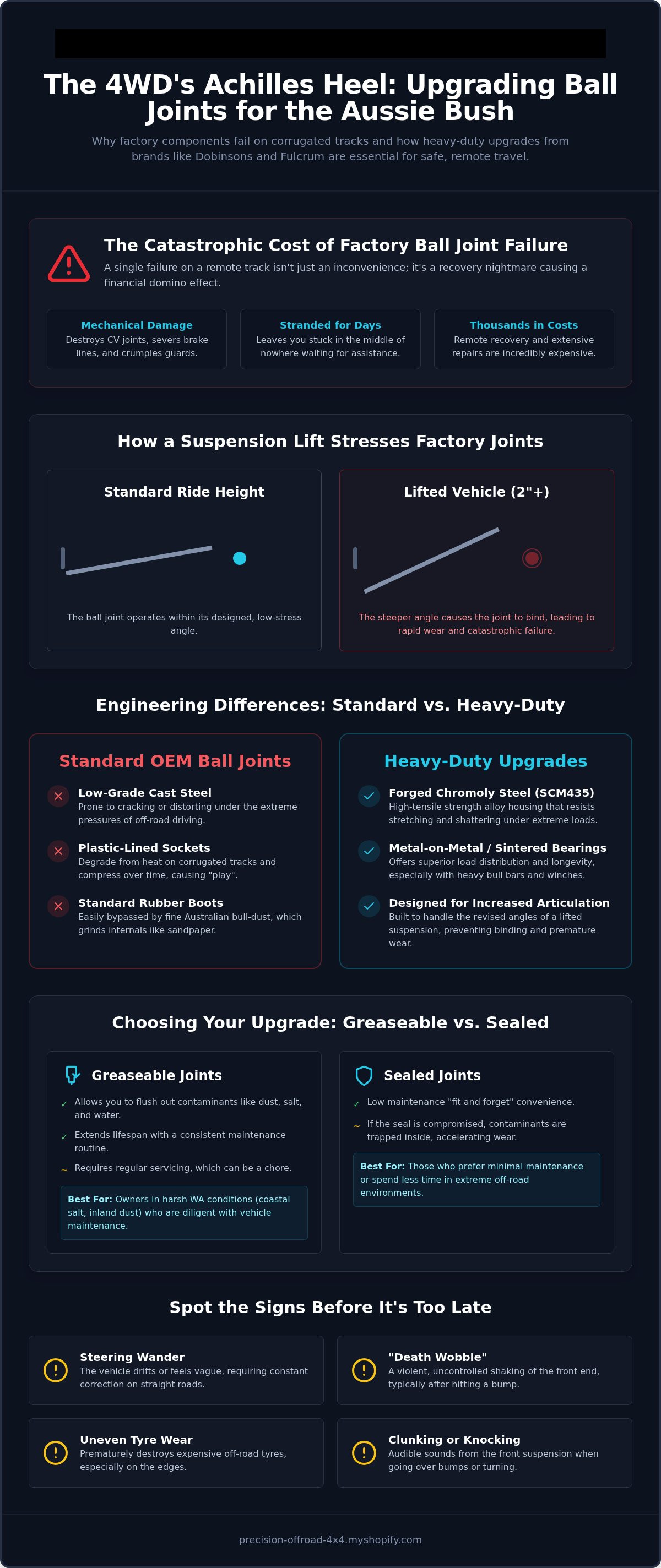
The ball joint is the Achilles heel of the modern 4WD front end. While other components might rattle or squeak, a ball joint failure is often catastrophic. Most OEM parts are engineered for bitumen and assembly-line cost savings rather than the harsh realities of the Australian bush. To understand the mechanical theory behind these components, you can research What is a Ball Joint? and its role as a critical pivot point in your steering system.
A snapped joint creates a financial domino effect. When the joint lets go, the control arm drops. This often severs brake lines, destroys CV joints, and crumples guards. 2026 vehicle designs place more stress on factory components than ever. Modern utes carry higher GVMs and more complex electronics, making a front-end failure both dangerous and incredibly expensive to rectify in remote areas. When deciding between Dobinsons vs Fulcrum suspension kits, you must account for how the increased height and weight impact your steering geometry.
Why OEM Joints Struggle with Australian Corrugations
Heat is the primary enemy of a standard ball joint. Most factory units use plastic-lined sockets that degrade when subjected to high-frequency vibrations. During long hauls on corrugated tracks, this heat buildup causes internal lubrication to fail. Fine Aussie bull-dust then bypasses standard rubber boots and grinds the internals like sandpaper. We see consistent failure rates on popular models like the Hilux and Ranger when they are used for serious touring without component upgrades.
The Impact of Suspension Lifts on Ball Joint Longevity
Most 4x4 suspension upgrades change the static working angle of the joint. When you lift a vehicle, the control arms sit at steeper angles. This leads to a binding effect where the ball stud hits the edge of the housing during down-travel. Standard joints cannot handle this increased travel. They wear out rapidly or snap under the pressure of the new geometry.
This is a vital factor when comparing Dobinsons vs Fulcrum suspension kits, as both brands provide heavy-duty options built for these revised angles. For any lift over 50mm (2 inches), heavy-duty joints are a mandatory safety requirement to ensure your front end survives the track. Without them, you are simply waiting for a failure to happen in the middle of nowhere.
Engineering Differences: What Defines a True Heavy Duty Ball Joint?
"Heavy duty" is a term often thrown around in the 4WD industry, but the difference between a standard joint and a high-performance upgrade lies in the engineering. While OEM parts prioritize cost, specialized components from brands like Dobinsons and Fulcrum focus on structural integrity. When you compare Dobinsons vs Fulcrum suspension kits, you aren't just buying springs and shocks; you're investing in a system designed to handle high-load stresses that factory components weren't built to withstand.
Chromoly Housing vs. Standard Steel
The housing is the first line of defence against mechanical failure. Standard ball joints typically use cast iron or low-grade steel, which can crack or "pop" under the extreme pressure of off-road driving. True heavy-duty units utilize forged SCM435 chromoly steel. Chromoly is a high-tensile strength steel alloy containing chromium and molybdenum as its primary strengthening agents.
Forging this material compresses the grain structure of the metal, making it significantly tougher than cast alternatives. This prevents the housing from stretching or distorting when you're crawling over rocks or hitting unexpected washouts. Forged housings are the gold standard for Australian touring because they maintain their shape and grip on the ball stud under loads that would shatter factory parts.
Increased Articulation and Oversized Internal Bearings
Internal architecture determines how long a joint will last before developing play. Cheap joints use nylon or plastic liners that compress over time, especially when supporting a heavy bull bar and winch. Professional-grade upgrades use metal-on-metal bearings or high-density sintered steel bushings. These materials offer superior load distribution for heavy touring rigs.
Oversized ball studs increase the surface area within the socket. This design choice reduces localized pressure and friction wear, which is critical for vehicles with increased wheel travel. To keep these parts moving smoothly, specialized high-pressure lubricants are used to prevent galling. Selecting between Dobinsons vs Fulcrum suspension kits often comes down to these engineering details, as both manufacturers offer specific ball joint upgrades for their lifted configurations. Most heavy-duty designs also feature improved articulation, allowing the joint to tilt further without binding against the housing.
Longevity also depends on protection from the elements. Quality joints feature zinc plating or e-coating to resist corrosion from Perth's coastal salt and mud. If you're ready to build a more resilient front end, you can view our range of suspension components to find the right fit for your vehicle. By choosing the right internals, you ensure your steering remains precise and your tyres wear evenly across thousands of kilometres.
Choosing Between Greaseable and Sealed Ball Joints for the WA Outback
The choice between greaseable and sealed joints often sparks debate at Perth campfires. While some drivers claim grease nipples are mandatory for the bush, the reality is more nuanced. Your decision should hinge on your maintenance habits and where you actually drive. When evaluating Dobinsons vs Fulcrum suspension kits, you will find that both manufacturers provide high-quality options in both categories, but they serve different operational profiles.
Boot design is your critical first line of defence. Whether the joint is greaseable or sealed, the quality of the rubber or polyurethane boot determines its lifespan. A boot that cracks under WA's intense UV exposure or tears on a stray branch will allow limestone sand and salt to enter. Once contaminants bypass the seal, they destroy the internal bearing regardless of the grease type. High-end heavy-duty joints use multi-lip seals to ensure the internal cavity remains protected in the harshest environments.
Greaseable Joints: The Maintenance-Heavy Performance Choice
Greaseable joints allow you to purge old, contaminated lubricant. This is a massive advantage if you frequently tackle river crossings or the muddy tracks of the South West. By pumping in fresh grease, you push out water and grit before they can cause permanent damage. This capability makes them a favourite for full-time explorers who carry a grease gun as part of their standard kit.
However, these require a strict maintenance cycle. If you only crawl under the rig once a year, a greaseable joint will likely fail sooner than a sealed one as the grease dries out. There is also the risk of over-servicing. Using a high-pressure grease gun can easily blow out the boot seal, creating an entry point for the very contaminants you are trying to exclude. Precision is required during every service to maintain the integrity of the component.
Sealed Heavy Duty Units: Set and Forget Reliability
Modern sealed units are not the "standard" parts they once were. High-tech heavy-duty seals now rival traditional designs for longevity. These are often the better choice for weekend warriors who want reliability without the need for frequent manual intervention. They are particularly effective against the fine inland dust of the Pilbara, which can sometimes be forced into a greaseable joint if the nipple is not cleaned properly before servicing.
Sealed designs rely on high-quality internal synthetic lubricants engineered to last the life of the component. Because the system is closed, there is no risk of accidental seal damage during a service. When comparing Dobinsons vs Fulcrum suspension kits, look at the seal specifications for your specific vehicle model. If you prefer a "set and forget" solution that still offers heavy-duty performance, a premium sealed joint provides a reliable alternative that stands up to Australian conditions without the maintenance burden.
Diagnosing Wear and Maintaining Your 4x4 Front End in Perth
Perth drivers face a unique set of challenges that accelerate mechanical wear. The abrasive limestone sand found in local coastal tracks and the heavy salt spray from beach driving create a grinding paste that eats through rubber boots. Spotting a failure before it leaves you stranded on the Forrest Highway or deep in the dunes is essential for any touring rig. While choosing between Dobinsons vs Fulcrum suspension kits is a great first step for durability, even the highest quality gear requires a regular inspection schedule in Western Australian conditions.
Wheel alignment is your most effective diagnostic tool. If your steering wheel is off-centre or the car pulls to one side, it is rarely just an alignment issue; it's often a sign that a ball joint has developed play. This movement changes the camber and toe settings of your vehicle, leading to a rapid decline in handling and safety.
Common Symptoms of Ball Joint Failure on 4WDs
Identifying the early warning signs can save you thousands in secondary repairs. Listen for distinct clunking or popping noises when driving over speed bumps, small potholes, or when turning the wheels at low speeds. At highway speeds, worn joints often manifest as a vague or wandering steering feel, which becomes significantly worse on corrugated tracks where the front end feels disconnected from your inputs.
Keep a close eye on your rubber. Uneven tyre wear on upgraded 4x4 wheels is a major red flag. If the inner or outer edges of your tread are scrubbing off faster than the rest of the tyre, the ball joints are likely failing to hold the wheel at the correct angle under load.
The 4x4 Inspection Checklist for Off-Roaders
You don't need a workshop hoist to perform a basic safety check. Using a sturdy floor jack, lift the front of the vehicle until the tyre is off the ground. Grab the tyre at the 12 and 6 o'clock positions and rock it vertically. Any noticeable "thump" or movement indicates vertical play in the ball joint. Repeat this at the 3 and 9 o'clock positions to check for horizontal play, which can also signal tie-rod issues.
- Visual Boot Inspection: Look for tears, cracks, or leaking grease. In Perth, sand often gets trapped in these cracks and acts as an abrasive.
- The Crowbar Test: For lower ball joints, place a crowbar between the lower control arm and the steering knuckle. Gently pry upwards. If the joint moves independently of the arm, it is spent.
- Cleanliness: After a beach run, pressure wash the steering knuckles to remove salt and sand that can degrade the seals.
Regular maintenance ensures that your investment in premium Dobinsons vs Fulcrum suspension kits continues to provide the performance you expect. If you've noticed any of these symptoms, it's time to shop heavy-duty ball joints and steering components to restore your rig's reliability before your next trip.
Upgrading Your Rig with Precision Offroad 4x4
Selecting the right hardware is the final step in building a reliable touring rig. At Precision Offroad 4x4, we prioritise functional expertise over flashy marketing. We trust Dobinsons and Fulcrum for heavy-duty front-end components because their engineering is proven on the most demanding Australian tracks. Whether you are comparing Dobinsons vs Fulcrum suspension kits for a new build or refreshing an older vehicle, these brands provide the structural integrity required for peace of mind in remote areas.
High-quality ball joints don't work in isolation. They are part of a wider ecosystem that includes essential 4x4 accessories like bull bars, winches, and secondary battery systems. Every kilogram added to the front of your vehicle increases the load on your pivot points. We help Perth locals choose components that match their specific GVM needs, ensuring the front end doesn't sag or lose its alignment under the weight of a full touring setup.
While many owners consider a DIY installation, ball joint replacement is a technical task that requires specific tools. Standard hammer-and-chisel methods often result in damaged control arms or scarred housings. A professional shop press is your best friend here. It ensures the new joint is seated perfectly square within the arm, preventing premature wear and maintaining the tight tolerances required for a precise wheel alignment. Our workshop is equipped to handle these high-pressure fitments, saving you the frustration of a botched driveway job.
Specialist Selection: Dobinsons and Fulcrum Solutions
We often recommend the Dobinsons range for Toyota and Nissan platforms, particularly for 200 and 300 Series Landcruisers or Y62 Patrols. Their heavy-duty joints are designed to handle the massive torque and weight of these larger wagons. Conversely, Fulcrum’s engineering is a favourite for lifted dual-cab Utes in WA. Their components are specifically tuned for the independent front suspension (IFS) setups found in the Hilux, Ranger, and D-Max. We ensure every part is compatible with your existing suspension geometry and lift height to prevent binding at full articulation.
Expert Advice and Local Support in Perth, WA
Buying local in Western Australia offers more than just convenience. It provides a direct line to technical help and straightforward warranty support if something goes wrong. You can visit our Perth storefront for a hands-on look at the heavy-duty gear we've discussed. We don't just sell parts; we provide solutions based on years of experience in local WA track conditions. If you're planning a trip up north or through the South West, your next step should be booking a front-end health check. We'll identify any play in your steering and help you choose the right Dobinsons vs Fulcrum suspension kits or individual components to keep your rig moving.
Build a Resilient Rig for the WA Outback
Investing in heavy-duty ball joints is about more than mechanical longevity; it's about the safety of your rig in remote Western Australian environments. We've seen how factory components struggle with revised geometry and harsh track conditions. Choosing the right hardware when comparing Dobinsons vs Fulcrum suspension kits ensures your steering stays precise and your expensive tyres remain protected from uneven wear. Whether you prefer the maintenance-heavy performance of greaseable units or the reliability of high-tech sealed designs, the right upgrade prevents catastrophic failure on the track.
Precision Offroad 4x4 is an official Dobinsons and Fulcrum retailer. As a specialist Perth 4x4 workshop, we provide the expert technical support required for WA tracks. We understand the specific stresses of local limestone and sand and can help you select the ideal components for your GVM requirements. Browse our range of heavy-duty ball joints at Precision Offroad 4x4 to secure your front end today. Get your vehicle sorted now so you can head into the bush with total confidence.
Frequently Asked Questions
How long do heavy-duty ball joints typically last compared to OEM?
Heavy-duty ball joints often last two to three times longer than OEM units when used in off-road environments. While factory parts are designed for bitumen and light loads, forged chromoly components are built to handle the constant vibration of corrugated tracks. In Perth, the primary factor is sand ingress. A quality heavy-duty joint should provide several years of reliable service if you maintain the seals and follow a regular inspection schedule.
Can I install heavy-duty ball joints myself, or do I need a shop press?
You generally need a shop press or a specialised heavy-duty ball joint press to ensure a safe and correct installation. Most 4WD ball joints are press-fit into the control arms with very tight tolerances. Attempting to use a hammer or heat can easily damage the arm or the new joint housing. For a reliable result in Perth, professional installation ensures the joint is seated square, preventing premature failure or steering issues.
Will upgrading my ball joints affect my vehicle’s warranty in Australia?
Under Australian Consumer Law, a manufacturer cannot void your entire vehicle warranty simply because you've fitted aftermarket parts. However, they can refuse a specific warranty claim if they prove the aftermarket component directly caused a failure. Upgrading to heavy-duty parts typically improves vehicle reliability, but it's wise to discuss modifications with your dealer. We focus on high-quality kits that meet or exceed factory specifications to ensure your peace of mind.
How often should I grease my greaseable 4WD ball joints?
You should grease your joints every 5,000 to 10,000 kilometres or after every significant off-road trip involving water crossings. In Perth, beach driving requires more frequent maintenance to flush out salt and abrasive sand. Regular greasing purges internal contaminants and replenishes the lubricant. Be careful not to over-grease, as excessive pressure can blow out the rubber boot seal, which creates an entry point for dirt and moisture to ruin the joint.
Do I need to do a wheel alignment after replacing ball joints?
A professional wheel alignment is mandatory after replacing ball joints to ensure your steering geometry is correct. New joints have different tolerances than worn parts, which directly changes your camber and toe settings. Failing to align the front end will lead to rapid tyre scrubbing and poor handling on the highway. This is a critical step when comparing Dobinsons vs Fulcrum suspension kits to ensure your rig remains stable and safe at speed.
Are heavy-duty ball joints necessary for a 2-inch lift?
While not always mandatory, heavy-duty ball joints are highly recommended for any 50mm (2-inch) lift. Lifting a vehicle changes the static angle of the control arms, placing additional stress on the factory pivot points. Standard joints often bind or wear out rapidly at these revised angles. Upgrading ensures your front end can handle the increased travel and the extra weight of accessories like bull bars and winches common on WA touring rigs.
What is the best brand of heavy-duty ball joints for a Toyota Hilux?
We recommend Dobinsons or Fulcrum for the Toyota Hilux platform because their components are engineered for the specific stresses of modern independent front suspension. When evaluating Dobinsons vs Fulcrum suspension kits, check the ball joint specifications for your model. Both brands provide the forged housings and superior multi-lip seals required to survive the abrasive limestone sand and corrugated tracks found throughout Western Australia, offering far better durability than standard factory replacements.
Can a failed ball joint cause my wheel to fall off while driving?
A catastrophic ball joint failure can cause the steering knuckle to detach from the control arm, which may lead to the wheel folding out or collapsing. This usually occurs under high stress, such as during a sharp turn or while navigating a rough track. Such a failure often destroys CV joints, brake lines, and guards. Regular inspections at a specialist Perth workshop help identify internal play before a dangerous failure leaves you stranded.