

Coil springs aren’t automatically better than leaf springs for towing. Heavy-duty coil springs for towing can suit a 4WD when their load rating matches the vehicle’s permanent accessories and towing load; leaf springs may suit vehicles designed to carry substantial rear loads. The right choice depends on your vehicle, how it’s loaded and how it needs to ride.
When comparing heavy duty coil springs for towing, look beyond lift height. Spring rate affects ride height and how the vehicle responds to load. Springs that are too stiff for your everyday setup can make unladen driving less comfortable. Consider towing weight as well as the weight you carry all the time.
This guide explains how coil and leaf springs differ, how to assess load ratings and lift height, and what to consider when towing and touring around Perth. You’ll also learn why springs and shock absorbers need to work as a matched set, and how suspension changes can affect vehicle geometry and compliance.
Key Takeaways
- Choose between coils and leaves based on your vehicle’s suspension design, typical load and towing requirements.
- Match spring rate to the accessories and gear you carry regularly, not just the occasional trailer load.
- Assess lift height alongside ride quality, shock absorber performance and suspension geometry.
- Compare suspension kit options with your towing and touring setup in mind, including the wheels and tyres you run.
Are leaf springs or coil springs better for towing?
Neither coil springs nor leaf springs are automatically better for towing. The right choice depends on your vehicle’s suspension design, how it carries weight and the ride you need. Coils support the vehicle through a spring at each wheel. Leaf springs use layered steel leaves, which also help locate the axle in many rear suspension systems.
Leaf springs are common on vehicles designed to carry substantial rear loads. A leaf pack flexes as the axle moves, and its construction affects how it responds under load. Parabolic leaf packs typically contain two leaves shaped to vary in thickness along their length. This differs from a conventional multi-leaf pack, but neither design suits every vehicle.
Coil-sprung vehicles can tow when their suspension is designed for that use. The coil’s rate and travel affect how the vehicle responds as weight is added. The right choice must suit the vehicle’s existing suspension layout, rather than being selected by spring type alone.
Airbag helper springs and replacement coils serve different purposes. Helper springs add support to the primary suspension when extra weight is present; they don’t replace its main springs. Replacement coils form part of the primary suspension. A vehicle that tows occasionally may need a different setup from one carrying a heavy load every day.
A “heavy-duty” label alone doesn’t determine whether engineering approval or certification is required. Consider the exact spring, how it is fitted and whether the change affects the vehicle’s configuration or ride height.
To compare options, identify the vehicle’s rear suspension type and the manufacturer’s intended application for each spring. Then consider your usual driving, cargo and towing pattern. This helps narrow the choice to a setup compatible with your vehicle, instead of assuming coils or leaf springs always tow better.
Coil springs with different lift heights and load ratings
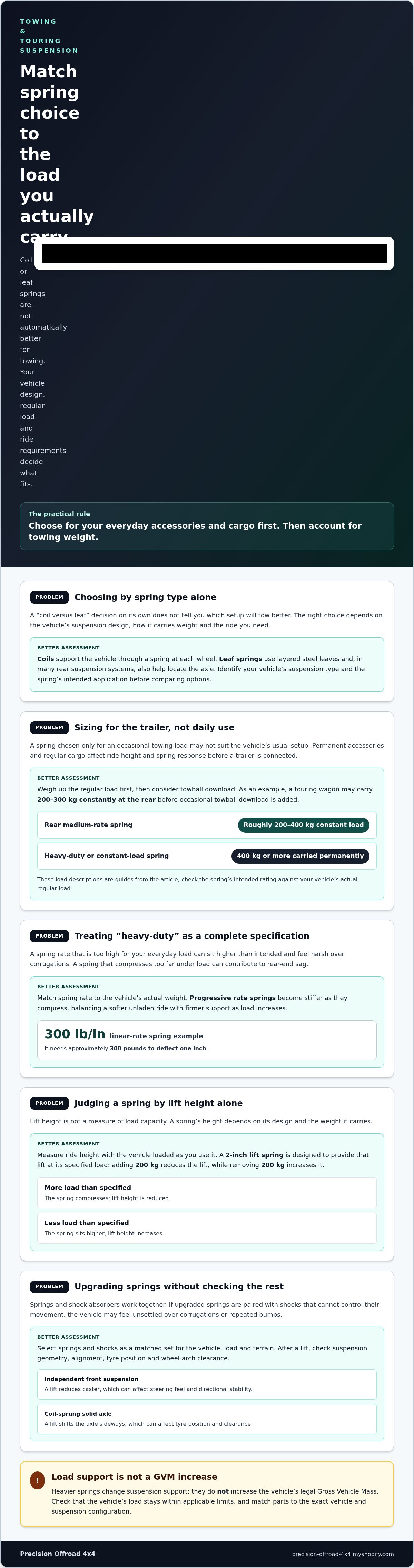
Choose springs for the vehicle’s regular load, then account for towing weight. Lift height depends on the spring design and the weight it carries.
Load support and ride comfort
Load-carrying ability and comfort depend on matching spring rate to the vehicle’s actual weight. A touring wagon may carry 200 to 300 kg constantly at the rear, before occasional towball download is added. A spring rated for more load than the vehicle usually carries can sit higher than intended and feel harsh over corrugations. Compare your normal touring load with the spring’s intended rating.
Spring rates and rear-end sag
Heavy-duty springs provide firmer support for a higher constant load. Progressive rate springs become stiffer as they compress, helping balance unladen comfort with support under load. Variable-rate springs also change resistance through their travel, but the specific design determines how they respond. For example, a 300 lb/in linear-rate spring needs approximately 300 pounds to deflect one inch.
Rear-end sag often appears when cargo and towball download compress springs beyond the load they suit. A rear medium-rate spring is suggested for roughly 200 to 400 kg of constant load; a heavy-duty or constant-load spring suits 400 kg or more permanently carried. Occasional towing is different: choose for daily carrying, then manage the extra trailer load separately.
Lift height is measured at the spring’s intended vehicle weight, not in isolation. A 2-inch lift spring is designed to provide that lift at its specified load; adding 200 kg reduces the lift, while removing 200 kg increases it. Compare ride height with the vehicle loaded as you use it, and avoid using lift alone as a measure of load capacity. Compare suspension options for your load as part of that assessment.
Coil-spring suspension benefits and drawbacks
Coil springs support a vehicle’s weight and control ride height as the wheels move over uneven ground. Their compact design suits many independent front suspension systems, where each wheel moves separately. However, a lift or heavier spring changes how the rest of the suspension behaves.
Coils can provide controlled wheel movement and a comfortable ride when matched to the vehicle and its load. They still need compatible springs, shocks and mounting points. A spring that’s too firm for the vehicle’s regular use can reduce comfort, while a spring that compresses too far can affect clearance and handling under load.
Springs and dampers work together, so treat them as a matched set. The spring supports the vehicle; the shock absorber controls spring movement. If upgraded springs are paired with shocks that can’t control that movement, the vehicle may feel unsettled over corrugations or repeated bumps. Choose a performance-tuned package to suit the vehicle, load and terrain, not just the lift height.
Check suspension geometry after a lift. On independent front suspension, lifting reduces caster, which can affect steering feel and directional stability. On a coil-sprung solid axle, a lift shifts the axle sideways. These changes can affect tyre position and clearance, so inspect alignment and wheel-arch clearance after modifying the setup.
Vehicle-specific suspension products account for differences in chassis, axle design and factory components. A spring intended for one 4WD may not suit another, even if their body styles look similar. Match the parts to the exact vehicle and its suspension configuration, then assess the complete setup, including shocks and any geometry correction.
Heavier springs don’t increase a vehicle’s legal Gross Vehicle Mass. They change suspension support, not the vehicle’s approved mass rating. Before choosing a package, list the vehicle’s accessories and intended use, then check that its load stays within applicable limits. A suspension change is not a change to legal load capacity.
Heavy-duty coil springs for towing and touring
Base spring selection on your vehicle’s load pattern and how often you tow. The key distinction is between occasional trailer use and weight carried during regular driving.
Towing capacity considerations
No. Heavier springs don’t increase the vehicle’s rated towing capacity. Springs affect how the suspension supports the vehicle; towing limits depend on the vehicle’s ratings and the loaded combination. Before a trip, consider the trailer, towball download, passengers and gear together. A more level stance after fitting springs doesn’t mean the vehicle can tow beyond its rating.
Spring and fitting costs
Spring and fitting requirements depend on the vehicle’s suspension layout and the work involved. For a useful assessment, identify the exact vehicle, its existing suspension, fitted accessories and typical touring load. Note whether the setup needs springs alone or related suspension components. These details help define the parts and fitting scope without relying on the “heavy-duty” label alone.
For a touring setup, assess front and rear ride height with the vehicle carrying its usual gear. On level ground, measure from each hub centre to the guard and record the figures before changing parts. Repeat the measurements with the trailer attached and loaded for travel. Comparing the results shows how the vehicle sits in everyday use and while towing, rather than relying on its unloaded stance.
Then consider your driving conditions. A vehicle used mainly on sealed roads has different demands from one regularly travelling on corrugations with a trailer. Springs and shocks need to work together throughout the suspension’s available travel. If you replace springs, assess shock condition and compatibility at the same time. This helps ensure the setup suits the vehicle’s load and intended touring use.
Bring your measurements and load details when discussing suspension options for towing and touring.
Precision Offroad 4x4: Wheel Upgrades
Precision Offroad 4x4 can help you consider wheel upgrades alongside suspension choices for a towing and touring setup. Wheel and tyre fitment needs to work with your vehicle’s suspension, load and intended use. Assess the complete combination, including clearance and the way added wheel and tyre weight may affect suspension response.
For a suspension refresh, compare Dobinsons Suspension Kits with your vehicle and regular load. Maxxis Tyres are also available to pair with your wheel setup. Considering suspension and wheel choices together helps you avoid selecting parts in isolation.
If you’re planning a towing-focused setup in Perth, contact Precision Offroad 4x4 to discuss your requirements.
Plan your next suspension step
Choosing heavy duty coil springs for towing is part of planning a complete vehicle setup. Before making changes, write down how you use your 4WD: daily driving, touring, towing, or a mix of all three. Note the accessories and cargo that stay fitted, plus what changes when the trailer is connected. This gives you a clear starting point for comparing options.
Consider how the vehicle should behave on your usual roads and tracks. A setup designed around a regular touring load may feel different when the vehicle is unloaded, so account for both conditions. Keep within applicable load and towing limits, and consider how wheel and tyre choices work with the suspension.
For a practical next step, discuss your vehicle and intended use with Precision Offroad 4x4. Its range includes Wheel Upgrades, Dobinsons Suspension Kits and Fulcrum Suspension Kits. Contact Precision Offroad 4x4 to talk through your setup.
A clear plan helps you choose with purpose and build a 4WD that suits the way you travel.
Frequently Asked Questions
Can I use heavy-duty springs on an empty 4WD?
Yes, but springs intended for a heavy constant load can make an empty 4WD sit higher and ride more firmly. For example, a vehicle carrying little cargo may transmit more road corrugation into the cabin with springs designed for substantial permanent weight. Consider your everyday load first, then decide whether occasional towing needs separate support rather than a permanently stiffer setup.
Do heavier springs lift the vehicle more?
Not necessarily. Spring height depends on the spring’s design and the weight it supports, so a heavier spring may raise a lightly loaded vehicle more than expected. On level ground, measure from the wheel hub centre to the guard, then compare the figures with the vehicle carrying its usual load. This gives you a practical reference for assessing ride height.
How do I know if my springs have sagged?
Look for a lasting change in ride height, an uneven stance or reduced clearance compared with the vehicle’s normal setup. Park on level ground, keep the load consistent, and measure from each wheel hub centre to its guard. A side-to-side difference or a rear measurement that remains lower after unloading can indicate sag or another suspension issue.
What are heavy-duty coil springs for towing and how do they work?
Heavy duty coil springs for towing are replacement springs selected to support a vehicle carrying a higher regular load. Each coil compresses under the vehicle’s weight and returns as the suspension moves, helping maintain ride height. Spring rate determines how much force is needed for compression, so choose based on the vehicle’s fitted accessories and normal cargo.
How do I choose the right towing coil springs for my vehicle and trailer load?
Start with the exact vehicle model and suspension type, then list accessories and cargo that stay fitted on everyday trips. Include the trailer’s towball download as a separate towing load, and compare both setups with the vehicle’s applicable ratings. This helps distinguish springs for constant touring weight from support needed only while towing.
How do heavy-duty coil springs affect ride comfort, handling and vehicle height when unladen?
With no cargo aboard, springs rated for a heavy load may hold the vehicle higher and feel firmer over bumps. A suitable spring rate helps the suspension respond to the vehicle’s actual weight; an overly stiff match can reduce comfort. After fitting, assess steering feel, stance and tyre clearance, including how the vehicle behaves on uneven roads.