

Chasing maximum ride height is the fastest way to ruin how your RG series ute drives. If you are shopping for a Holden Colorado lift kit, you likely already know the frustration of factory leaf springs bottoming out against the bump stops under the weight of a canopy, steel bar work, or a heavy camper trailer. Pushing for height without calculating your working mass ruins road comfort, strains CV joints, and attracts defect notices from roadside inspectors.
You don't have to sacrifice unladen ride quality to carry real payload. This guide gives you the mechanical facts to select the ideal suspension setup, matching progressive rate springs, shock absorber valving, and suspension geometry correction to your driving routine. We break down proven systems from Dobinsons and Fulcrum, clarify when you need aftermarket upper control arms, and explain WA Department of Transport rules so your rig stays safe and legal across remote tracks.
Key Takeaways
- Assess your constant payload before selecting rear leaf packs to prevent your RG Colorado bottoming out under heavy touring loads.
- Choosing the correct Holden Colorado lift kit requires balancing increased clearance against CV angles to avoid driveline vibration.
- Correct front suspension geometry with aftermarket upper control arms to restore proper caster angle and maintain highway stability.
- Keep your build compliant with Western Australian regulations by factoring in the 50mm combined limit for suspension and tyre increases.
- Opt for matched shock absorber valving and spring rates from established brands like Dobinsons and Fulcrum to protect unladen ride comfort.
Holden Colorado Factory Suspension Limits and Why You Need an Upgrade
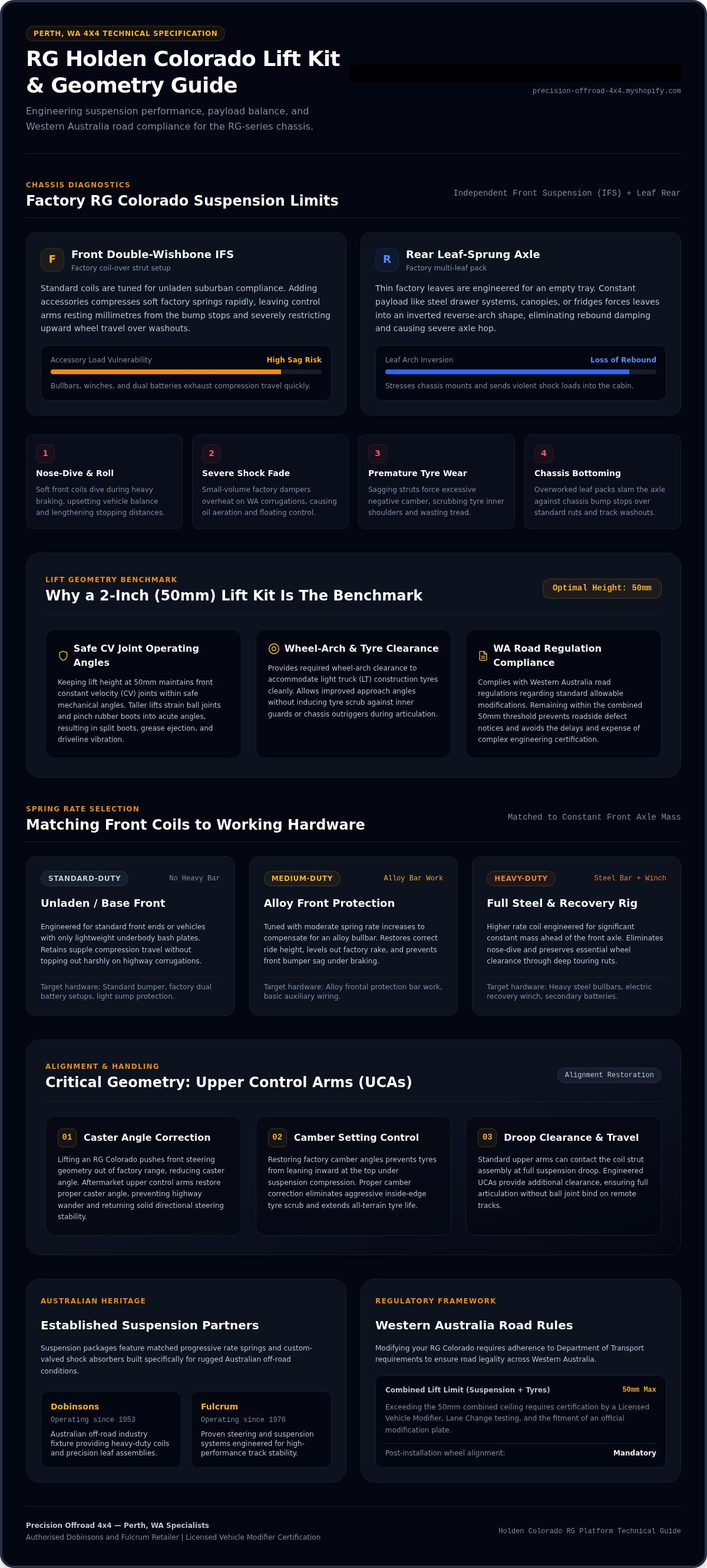
General Motors tuned the standard RG-series Holden Colorado chassis for a passenger-car ride while unladen, paired with moderate light-commercial hauling. While this factory compromise works for daily suburban commuting, it falls short once you fit heavy touring accessories. Bolting on steel bullbars, winches, dual batteries, and rear canopy setups consumes the factory compression travel rapidly. Installing a dedicated Holden Colorado lift kit restores critical wheel-arch clearance, levels out the aggressive factory rake, and improves approach angles for challenging tracks.
The RG Colorado Independent Front Suspension and Leaf Rear Setup
The RG platform pairs a double-wishbone independent front suspension (IFS) with a conventional leaf-sprung rear axle. Standard front coil-over struts provide very little bump clearance. Adding front-end bar work compresses these soft factory coils, leaving the control arms resting within millimetres of the bump stops. This severely restricts upward wheel travel over washouts. At the rear, the factory leaf pack features thin leaves designed primarily for unladen compliance. When you drop constant payload into the tray, such as steel drawer units or a loaded fridge, these leaves invert into a reverse-arch shape. This posture stresses the chassis mounts and eliminates the rebound damping needed to control axle hop.
Recognising Suspension Sag, Body Roll, and Shock Fade
Suspension failure on an RG Colorado usually starts with subtle handling changes before causing mechanical damage. For drivers purchasing a used ute, booking a comprehensive inspection with an experienced mechanic through platforms like My Auto Shop can help spot underlying chassis fatigue early. You can also pinpoint failing or overloaded components yourself by watching for these clear indicators:
- Excessive nose-dive and body roll: Soft front springs cause the front bumper to drop aggressively under heavy braking, unsettling the vehicle balance and increasing stopping distances.
- Severe shock fade on corrugations: Factory twin-tube dampers contain a small oil volume that overheats quickly under continuous high-speed cycling, causing aeration, loss of hydraulic resistance, and a loose, floating sensation.
- Premature tyre wear: Sagging front struts force negative camber onto the front wheels, scrubbing the inner shoulders of your tyres and ruining road contact.
- Harsh chassis bottoming: Worn leaf packs allow the rear axle to slam into the chassis bump stops across basic ruts, sending violent shock loads into the cab.
Upgrading to a tuned suspension kit with matched spring rates and larger-bore shock absorbers eliminates these stability issues, keeping your vehicle controlled across punishing Western Australian tracks.
Choosing Your Holden Colorado Lift Kit Height and Spring Rates
Suspension tuning comes down to geometry and weight distribution. Cranking height without calculating your working load accelerates drivetrain wear and creates an unstable ride. Selecting the right Holden Colorado lift kit means tailoring spring rates to your constant axle mass, ensuring your shock absorbers control movement rather than fighting over-stiff steel.
Why a 2-Inch Suspension Kit Is the Benchmark for Australian Rigs
A 2-inch (50mm) lift remains the practical sweet spot for the RG platform. It increases underbody clearance over rutted tracks while keeping front constant velocity (CV) joint operating angles within safe mechanical boundaries. Taller heights strain ball joints and push rubber boots into sharp angles, causing premature splits and grease loss. A 50mm suspension increase also provides ample wheel-arch clearance to fit light truck (LT) construction tyres cleanly. Under Western Australia road regulations, keeping your combined lift within standard limits prevents the delays and expense of complex engineering certification.
Matching Front Coils to Bull Bars and Accessories
Factory front coils cannot support heavy front-end modifications. When choosing front coils, account for the actual hardware bolted ahead of the front axle. A standard-duty coil suits an unladen front with basic underbody plates. Adding an alloy bar requires a medium-rate coil to maintain correct ride height. If you run a heavy steel bullbar and an electric recovery winch, you need heavy-duty front coils to prevent excessive sag. Review our guide on essential 4x4 accessories for Australian tracks to tally your front-end mass accurately.
Selecting Rear Leaf Springs for Constant Payload
Rear suspension choice must reflect what sits in your tray every single day, not what you might pack for a once-a-year holiday. If your RG Colorado runs empty during the work week, fitting a 500kg constant-load leaf pack produces a brutal, skatey ride that reduces rear-wheel traction over corrugated roads. Opting for progressive rate springs delivers a supple unladen drive while steadily stiffening as weight drops onto the tow ball or tray. If you run a permanent canopy, trade drawers, or dual spares, select leaf packs rated specifically to that measured dead weight. You can browse matched systems directly at Precision Offroad 4x4 to align your Colorado's springs with your everyday setup.
Critical Geometry Correction Components for Lifted Colorados
Lifting an RG Colorado does far more than raise the body off the ground. Altering the ride height changes the resting angles of your suspension arms, driveshafts, and steering links. Bolting in taller springs without complete suspension geometry correction leaves the vehicle prone to vague steering, highway wandering, and rapid driveline wear. Completing your Holden Colorado lift kit with matched alignment hardware ensures your rig drives with factory precision on blacktop and survives remote touring.
Upper Control Arms (UCAs) and Restoring Caster Angle
Raising the front suspension rotates the steering knuckle, drastically reducing your positive caster angle and pushing camber out of specification. Standard factory adjustment cams cannot compensate for lifts of 40mm to 50mm. Installing aftermarket upper control arms (UCAs) solves this alignment bottleneck. Quality arms provide built-in caster correction, returning high-speed directional tracking and preventing the vehicle from darting across road ruts. They also reposition the ball joint, eliminating contact between the arm and the coil spring when the suspension droops over rough washouts.
Managing CV Joint Angles and Diff Drop Kits
Steep half-shaft operating angles accelerate mechanical wear across the front driveline. When you lift the front struts, the constant velocity (CV) joints operate at continuous sharp angles, pinching the rubber boots. This continuous friction causes split boots, loss of grease, and eventual joint binding under power. Installing a front differential drop kit lowers the front diff casing by roughly 25mm to 30mm. This flattens out the CV shafts, preserving boot integrity and maintaining maximum joint strength when you crawl through deep ruts in four-wheel drive.
Centre Bearing Spacers and Preventing Dog-Tracking
Modifying the rear leaf packs alters the alignment of the two-piece tail shaft running between the transmission and the rear axle. Without correction, this altered pinion angle causes noticeable driveline shudder under initial acceleration, particularly when towing heavy trade trailers. You can eliminate this shudder and protect rear components with these simple additions:
- Centre bearing spacers: Dropping the centre carrier bearing bracket realigns the front and rear prop-shaft sections, smoothing out harsh rotational vibrations.
- Leaf spring alignment: Replacing worn shackle bushes and ensuring leaf centre pins seat cleanly in the axle pad prevents the rear axle from shifting out of square.
- Pinion angle shims: Wedges placed between the spring pack and axle perch tilt the rear differential nose back into parallel alignment with the transfer case.
Addressing these rear hardware details keeps the chassis tracking straight, stopping erratic dog-tracking and maintaining vehicle balance across heavy work shifts. If you are sourcing replacement bushes, u-bolts, or driveline brackets for your build, platforms like Car Parts Marketplace connect you with independent sellers offering a wide range of automotive components.
Top Holden Colorado Suspension Kits: Dobinsons and Fulcrum
Precision Offroad 4x4 supplies tailored suspension packages from Australia's leading engineering brands rather than pushing universal, uncalibrated bundles. The RG series demands matched damper valving and spring rates suited to our demanding local conditions. Whether you tackle corrugated Pilbara tracks or pull loaded trade trailers along the Tonkin Highway, choosing a proven Holden Colorado lift kit ensures lasting reliability. Explore the full setup options in our Holden Colorado suspension and accessories range to find an exact match for your vehicle payload.
Dobinsons Suspension Kits for Touring and Heavy Workloads
Dobinsons has manufactured high-grade suspension hardware in Australia since 1953. Their RG Colorado systems offer exceptional customisation across spring rates and damping architectures. Dobinsons suspension kits feature heavy-duty twin-tube units or advanced internal monotube shocks (IMS) designed to resist fade over extended washboard tracks. Their cold-wound coil springs maintain structural tension under heavy steel accessories, while their multi-leaf rear packs preserve legal load-carrying capacity without bottoming out under touring loads.
Fulcrum Suspension Kits for Ride Control and Articulation
Fulcrum Suspensions has refined vehicle handling and chassis dynamics across Australia since 1976. A Fulcrum suspension lift kit for the RG platform typically integrates Formula 4x4 or Bilstein dampers with SuperPro alignment components. This setup gives you refined road handling when unladen, quickly stiffening through cornering cycles to stop high-speed body sway. You can learn more about damper technologies in our 4x4 suspension guide to evaluate monotube versus twin-tube setups.
Matching Wheels and Tyres to Your Lifted Setup
Upgrading your ride height creates the required wheel-arch clearance to move away from light-duty passenger tyres. Matching a 50mm lift with properly rated tyres completes your vehicle build for off-road durability:
- Tyre construction: Swapping to light truck (LT) casing adds puncture resistance across rocky trails and stabilises the sidewall under heavy tow-ball loads.
- Tread patterns: Fitting Maxxis RAZR AT811 all-terrain tyres provides biting traction in slick mud and sharp gravel while retaining quiet highway manners.
- Track width: Check our detailed guide to 4x4 wheel upgrades to select wheel offsets that widen your wheel track safely without causing guard rubbing.
If you want help selecting the ideal package for your rig, shop the full range at Precision Offroad 4x4 and secure a matched suspension and wheel combination.
Installation, Wheel Alignment, and Western Australia Road Regulations
Bolting on heavy-duty suspension demands mechanical discipline. Compressing heavy coils, torqueing suspension pins to specification, and seating leaf packs squarely on axle perches requires proper workshop equipment. Your 4x4 isn't actually finished once the new springs and shocks are bolted in. Protecting your investment and staying road-legal requires strict adherence to alignment checks and regional vehicle standards.
Navigating WA Department of Transport Regulations and Modification Plates
In Western Australia, the Department of Transport (DoT) allows a maximum combined lift of 50mm without engineering certification. This 50mm ceiling includes both suspension lift height and increases in tyre rolling diameter combined. If you fit a 50mm Holden Colorado lift kit, you have zero legal margin for larger tyres without formal testing. Exceeding this 50mm combined threshold classifies the build as a complex modification. That pathway requires dynamic testing by an approved automotive engineer and an affixed modification plate to remain road-legal. Keeping your setup compliant prevents roadside defect notices and protects your insurance coverage.
Mandatory Wheel Alignments and Suspension Settling
A professional wheel alignment is mandatory after any suspension or tyre change. Fresh coil springs and multi-leaf packs settle slightly as the steel cycles and the suspension bushes bed into place. Plan a complete mechanical check after your first 500 kilometres of driving:
- Re-torque critical hardware: Check all rear U-bolts, shackle pins, strut top nuts, and control arm bolts to factory torque ratings.
- Re-check alignment settings: Measure front caster angle, camber, and toe to prevent uneven shoulder wear across your tyres.
- Inspect component clearances: Confirm sufficient wheel-arch clearance at full steering lock to prevent tyres scrubbing against body mounts or chassis rails.
Explore Proven Colorado Suspension Upgrades with Precision Offroad 4x4
Precision Offroad 4x4 is a Perth-based specialist and an authorised retailer for Dobinsons and Fulcrum suspension. We spend our weekends on the same WA tracks you do, so we know what it takes to survive remote washouts and heavy hauling. We match spring rates, shock valving, and alignment hardware directly to your setup. Explore our Holden Colorado suspension collection to equip your RG ute with an engineered, durable suspension upgrade today.
Equip Your RG Colorado for Every WA Trail
Setting up your RG ute comes down to practical mechanical engineering rather than chasing raw ride height. Accurately matching your coil and leaf spring rates to your constant payload stops rear sag, prevents chassis bottoming, and preserves everyday ride comfort. Integrating critical geometry correction components, including upper control arms and driveline spacers, ensures your vehicle tracks straight on open highways while remaining fully compliant with Western Australian road regulations.
As an authorised Dobinsons and Fulcrum retailer, our Perth-based independent 4x4 team supplies systems tested against harsh corrugated tracks and heavy hauling conditions. When you combine tuned shock absorber valving with the correct spring capacity, your Holden Colorado lift kit delivers uncompromising control, trail clearance, and durability. Ready to get the most out of your rig? Upgrade your Holden Colorado with our premium suspension kits and head out on your next outback journey with complete confidence.
Frequently Asked Questions
Can I fit a 2-inch lift kit to my Holden Colorado without changing upper control arms?
Yes, you can physically fit a standard 2-inch kit with the factory upper arms, but your wheel alignment will be compromised. Raising the front struts reduces positive caster angle and restricts camber adjustment. This causes wandering on Perth highways and accelerates tyre shoulder scrub. Fitting aftermarket upper control arms restores correct steering geometry and provides necessary clearance around the front coil springs at full suspension droop.
Will lifting my Holden Colorado cause driveline vibrations or tail shaft shudder?
Lifting the rear leaf packs alters the operating angles of the two-piece tail shaft, which often causes a distinct shudder during initial takeoff. This vibration occurs because the centre carrier bearing is no longer aligned with the transmission and rear differential pinion. Installing a centre bearing spacer kit drops the carrier bearing down, realigning the driveline and eliminating low-speed take-off shudder when accelerating under load.
What is the largest tyre size I can legally run on a Holden Colorado with a 2-inch lift?
In Western Australia, tyre rolling diameter increases are capped within the overall 50mm combined vehicle lift rule without engineering certification. If your Holden Colorado lift kit raises the vehicle by 50mm, you cannot legally increase tyre diameter past factory specifications without testing. Fitting a common 265/70R17 tyre adds roughly 25mm of total tyre height (12.5mm of lift), which requires a lower suspension lift to remain under the 50mm combined threshold.
How do I choose between heavy-duty and comfort leaf springs for my rear suspension?
Base your leaf spring selection strictly on your constant, everyday payload rather than temporary holiday gear. Comfort packs suit unladen utes or those carrying light luggage under 150kg. If you run a permanent canopy, trade drawers, or a heavy dual-battery system, choose heavy-duty packs rated to that constant weight. Over-stiff leaf packs ridden without sufficient weight ruin axle articulation and cause harsh, skittery unladen handling.
Is a diff drop kit necessary when fitting a 50mm suspension kit to an RG Colorado?
While not strictly mandatory for a moderate 40mm lift, fitting a differential drop kit with a 50mm lift is strongly recommended for off-road use. A diff drop lowers the front differential by roughly 25mm, correcting the steep angle of the constant velocity shafts. This modification prevents the rubber CV boots from rubbing together, avoiding premature boot tears and protecting the inner joints from binding during deep wheel articulation.
Do I need a modification plate for a 2-inch lift kit in Western Australia?
You do not need a modification plate in Western Australia provided the total combined lift from your suspension and tyres does not exceed 50mm. However, installing a 50mm suspension kit alongside larger tyres pushes the overall height beyond state limits. Once you exceed that combined 50mm cap, you must have the vehicle inspected and certified with a formal modification plate through an approved automotive engineer.
How does lifting my Holden Colorado affect its towing stability and legal payload?
A standard Holden Colorado lift kit raises your tow ball height and vehicle centre of gravity, but it does not increase your legal payload or Gross Vehicle Mass (GVM). Correctly rated rear springs prevent rear-end squat, keeping the front steer tyres planted for safer braking while towing. To legally carry more weight beyond the factory Colorado payload rating, you must install an engineered and certified GVM upgrade.