

A larger set of Maxxis tyres can transform your vehicle's off-road capability, but bolting on oversized rubber involves much more than just aesthetics. If you're wondering how to fit bigger tyres on 4x4 Australia rigs without attracting a yellow sticker, you need to treat it as a complete engineering upgrade rather than a simple swap. Most owners want that aggressive stance and extra ground clearance, yet they're rightfully concerned about tyres scrubbing on the wheel arches or falling foul of the strict VSB 14 regulations that govern our roads in 2026.
We understand the frustration of trying to navigate conflicting state laws, especially when Western Australia maintains a strict 50mm total lift limit while other states allow more. This guide provides a clear roadmap for upsizing your tyres while remaining 100% street legal and insured. You'll discover the technical requirements for clearance using Dobinsons or Fulcrum suspension kits, the mechanical impact on your driveline, and the specific diameter increases allowed under current Australian standards. We'll show you how to achieve a high-performance setup that stays reliable on the tracks and compliant on the tarmac.
Key Takeaways
- Navigate the complexities of VSB14 and state-specific lift limits to keep your vehicle roadworthy and insured.
- Explore how to fit bigger tyres on 4x4 Australia builds by pairing oversized rubber with the correct Dobinsons or Fulcrum suspension lift.
- Correct wheel offset issues to eliminate tyre scrub and protect your steering components during technical off-road driving.
- Account for changes in braking leverage and speedometer readings to preserve factory safety standards.
- Select the right Maxxis tread pattern to balance aggressive off-road performance with daily drivability and driveline durability.
Understanding Australian Tyre Laws and VSB14 Regulations
Fitting oversized rubber is more than a cosmetic choice; it's a legal one. In Australia, vehicle modifications are governed by the National Code of Practice, specifically Vehicle Standards Bulletin 14 (VSB14). This document sets the technical baseline for off-road tyres and suspension changes. If your vehicle doesn't meet these standards, you risk a defect notice or a voided insurance policy. Insurance companies often deny claims if a vehicle is deemed unroadworthy due to illegal tyre sizes, leaving you liable for damages.
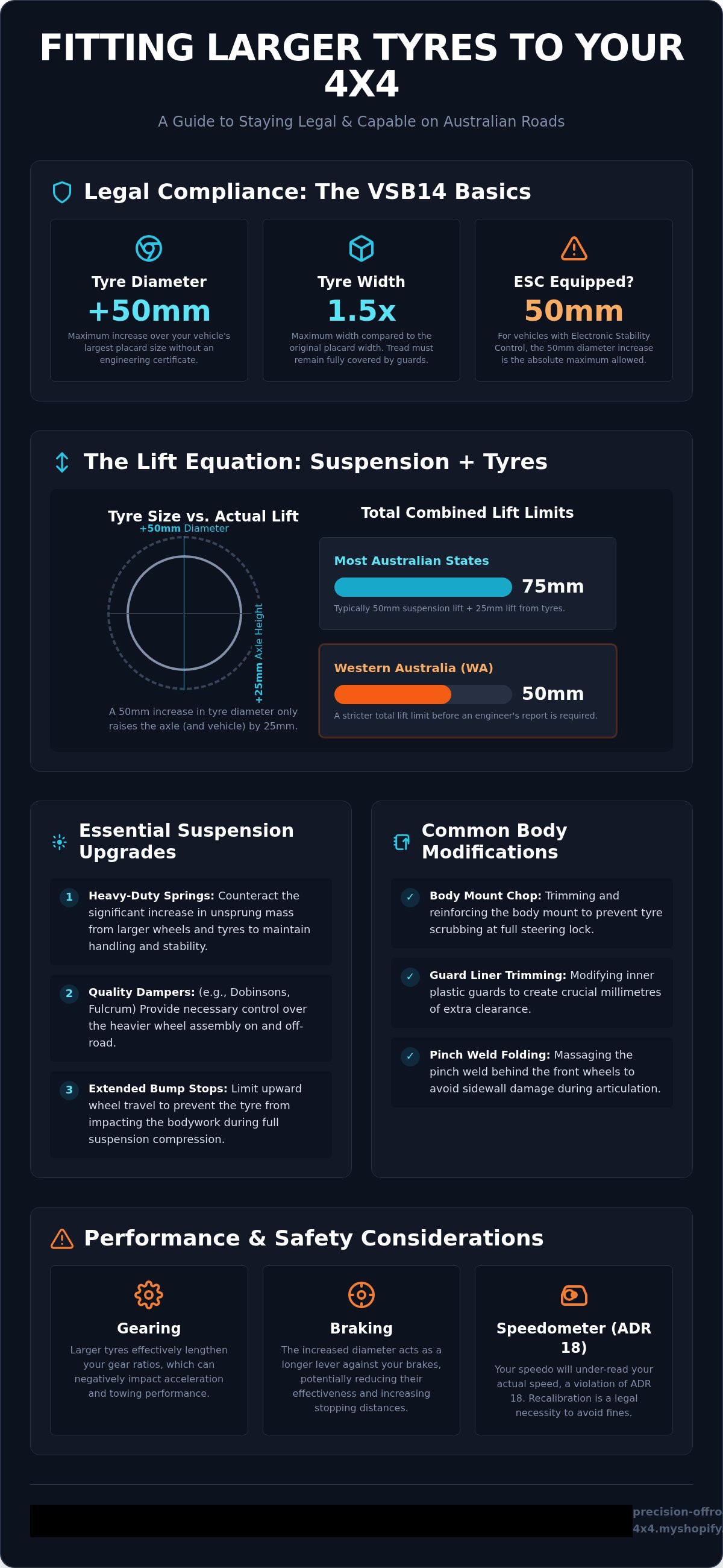
The 50mm rule is the most critical regulation for owners researching how to fit bigger tyres on 4x4 Australia rigs. You can increase your tyre's overall diameter by up to 50mm over the largest size listed on your vehicle's tyre placard without needing an engineer's certificate. You must also ensure the tyre width doesn't exceed 1.5 times the original placard width. All tread must remain entirely covered by the guard flares. If the tyres poke out, you're a target for a yellow sticker.
The "50mm Total Lift" Limit Explained
It's vital to distinguish between tyre diameter and actual lift height. A 50mm (2-inch) increase in tyre diameter only raises your vehicle by 25mm (1 inch). This is because the axle sits in the centre of the wheel, so only half the diameter increase translates to ground clearance. Most states allow a combined lift of 75mm, which usually consists of a 50mm suspension lift and a 25mm lift from larger tyres. For vehicles equipped with Electronic Stability Control (ESC), the maximum allowable tyre diameter increase is limited to 50mm to ensure the system's sensors remain calibrated and functional.
State-Specific Nuances for WA Drivers
Western Australia has a more restrictive 50mm total lift limit. This includes the combined effect of suspension, tyres, and any body lift before certification is required. If you've already installed a 50mm Dobinsons suspension kit, fitting larger tyres technically pushes you over the legal limit in WA without an engineer's report. Speedometer accuracy is another non-negotiable requirement under Australian Design Rule 18 (ADR 18). Your speedo must never under-read; if you're travelling at 100km/h, the speedo must show at least 100km/h. Making these modifications to fit bigger tyres on your 4x4 often requires a speedo correction tool to maintain compliance and avoid speeding fines.
Mechanical Requirements: Suspension Lifts and Clearance
Fitting larger tyres is a dynamic challenge. While a vehicle might look fine on the driveway, the real test occurs at full suspension compression. This "bump zone" is where oversized rubber often makes contact with inner guards or suspension components. To manage this, a professionally installed 4x4 suspension system is essential. It provides the necessary height and controls the movement of the wheel assembly to prevent panel damage during off-road articulation.
Heavy-duty springs are a non-negotiable part of the equation. Larger tyres and aftermarket wheels significantly increase unsprung mass. Standard factory springs often struggle to support this extra weight, leading to a wallowy ride and decreased handling precision. Upgrading to heavier spring rates ensures the vehicle maintains its ride height and stability, even when loaded with recovery gear or bar work. This is a fundamental step in how to fit bigger tyres on 4x4 Australia rigs without compromising safety.
Dobinsons and Fulcrum: The Right Lift for the Job
Dobinsons suspension kits are specifically engineered to provide the clearance needed for 33-inch Maxxis tyres on most Australian dual-cab utes. However, height alone isn't the solution. We often adjust or extend bump stops to limit upward travel before the tyre impacts the bodywork. High-quality dampers from Fulcrum or Dobinsons are also critical; they provide the damping force required to control the increased momentum of heavier wheel setups on corrugated tracks.
Trimming and Modifications: Beyond the Bolt-ons
Sometimes, even a 50mm lift isn't enough to clear aggressive tread patterns. Popular models like the Toyota HiLux or Ford Ranger often require "Body Mount Chops" to prevent scrubbing at full steering lock. This involves carefully trimming the steel body mount and welding a reinforcement plate to maintain structural integrity. Other common modifications include:
- Trimming inner plastic guard liners and relocating mounting points to gain extra millimetres.
- Folding or "massaging" the pinch weld behind the front wheels to prevent tyre sidewall damage.
- Heat-treating plastic flares to slightly reshape them for better clearance.
Understanding how to fit bigger tyres on 4x4 Australia builds requires a holistic approach to the wheel arch. If you're planning an upgrade, consider our range of suspension and wheel packages to ensure a functional, rub-free setup.
Wheel Offset and Scrub Radius: Avoiding the Scrub
Selecting the right wheels is just as important as the rubber itself. While Section 2 focused on vertical clearance, wheel offset determines the horizontal position of the tyre within the wheel arch. Offset is the distance from the hub mounting surface to the centreline of the wheel. A positive offset pushes the wheel inward toward the chassis, while a negative offset pushes it outward, widening the vehicle's track. Zero offset means the mounting surface is perfectly aligned with the wheel's centre.
Incorrect offset causes the tyre to swing in a wider arc during steering, a phenomenon known as scrub radius. If the offset is too low or negative, the tyre doesn't just pivot; it "scrubs" across the ground. This increases steering effort and places immense stress on your steering rack and tie rod ends. When researching how to fit bigger tyres on 4x4 Australia builds, aim for an offset that provides clearance from the UCA (Upper Control Arm) without pushing the tyre so far out that it hits the rear of the guard or the bumper during turns.
Calculating the Ideal Offset for Your Ute
Most modern Australian dual-cab utes leave the factory with high positive offsets, typically between +30 and +55. Moving to a +20 or +12 offset is common when fitting 33-inch tyres, as it provides enough inner clearance for wider tread. However, going to zero or negative offsets significantly increases the leverage applied to your wheel bearings, potentially leading to premature failure. To check if your tyres will protrude past the flares, hang a plumb line from the outside edge of the guard and measure the horizontal distance to the tyre sidewall. Remember, VSB14 requires the entire tyre tread to be covered by the bodywork or flares.
The Importance of Hub-Centric vs Lug-Centric Wheels
Hub-centric wheels are designed so the centre bore of the wheel fits snugly over the hub's pilot. This ensures the vehicle's weight is supported by the hub rather than the wheel studs. Many cheap aftermarket wheels are lug-centric, meaning they rely entirely on the tapered nuts to centre the wheel. For heavy 4x4 applications, lug-centric designs are prone to vibration and can even shear studs on corrugated outback tracks. Always choose hub-centric, high load-rated wheels to maintain mechanical integrity. This is a critical factor in how to fit bigger tyres on 4x4 Australia safely, especially if you plan on heavy touring or technical rock crawling.
Performance Trade-offs: Gearing, Braking, and Speedo
Larger tyres aren't just about clearance; they alter the mechanical leverage of your entire driveline. When you increase tyre diameter, you effectively lengthen your vehicle's final drive ratio. This means your engine turns fewer revolutions for every kilometre travelled. While this sounds efficient, it often pulls the engine out of its optimal power band. You'll likely experience "transmission hunting", where an automatic gearbox shifts constantly to find torque, especially when climbing hills or towing. Fuel economy typically suffers as the engine works harder to overcome the increased rolling resistance and mass of aggressive tread patterns.
Understanding how to fit bigger tyres on 4x4 Australia builds means accounting for the 5% to 10% drop in effective torque at the wheels. This performance loss is most noticeable in small-capacity turbo-diesel engines that rely on staying within a specific RPM range to maintain boost. If the gearing is too long, the vehicle feels sluggish off the line and struggles to maintain cruising speeds on the highway. Re-gearing the differentials is an option for extreme builds, but for most 33-inch setups, an electronic throttle controller or a custom ECU tune can help manage the change in power delivery.
Correcting the Speedo and Odometer
Fitting oversized rubber causes your speedometer to under-read. If your dash shows 100km/h, you might actually be doing 106km/h, which is a major legal liability and a safety risk. Under Australian Design Rule 18, a speedometer must never indicate a speed less than the true speed. We recommend using an electronic calibration module to intercept the signal and correct the readout. Always use a GPS-based speed app to verify your "true" speed immediately after fitment to avoid unexpected speeding fines.
Braking and Driveline Stress
The increased diameter of Maxxis tyres places significantly more leverage on your braking system. It takes more force to stop a 33-inch or 35-inch tyre than a factory 31-inch unit. If you've added heavy steel wheels and a full touring load, your factory rotors may struggle with heat dissipation. Upgrading to high-performance brake pads or slotted rotors is a smart move for anyone jumping up multiple tyre sizes. Additionally, larger tyres increase the workload on your transmission. Monitoring transmission fluid temperatures is vital, as heat is the primary cause of automatic gearbox failure in modified 4x4s.
If you're ready to upgrade properly, shop our selection of Maxxis tyres and wheel packages to find the right balance for your rig.
The Solution: Professional Selection at Precision Offroad 4x4
Generic online tyre calculators provide a rough estimate of diameter changes, but they fail to account for real-world variables like spring sag, vehicle load, and specific wheel arch geometry. Relying on a basic tool often leads to expensive mistakes, such as purchasing a set of tyres that scrub heavily under load or during technical manoeuvres. At Precision Offroad 4x4, our approach to how to fit bigger tyres on 4x4 Australia builds involves a comprehensive assessment of the entire vehicle. We focus on creating a balanced system where the suspension, wheels, and rubber work in unison to provide durability without compromising safety.
A professional consultation ensures that your chosen tyre size aligns with your specific use case. If you spend 90% of your time on the bitumen but want a capable rig for the weekend, your requirements differ significantly from a dedicated touring vehicle heading across the Simpson Desert. We help you choose the right essential 4x4 accessories and mechanical upgrades to support your tyre choice, ensuring your vehicle remains a reliable tool for both work and play.
Maxxis Tyres: Engineered for the Australian Scrub
Maxxis is our preferred brand because their tyre range is specifically engineered to withstand the high-heat and high-impact conditions of WA tracks. The Maxxis RAZR AT811 is a standout all-terrain option, offering a reinforced sidewall and a tread pattern that balances on-road quietness with aggressive off-road grip. For drivers tackling deep mud or sharp limestone, the MT772 Mud Terrain provides superior self-cleaning properties and puncture resistance. We prioritise tyres with high load ratings and ply counts, which are critical for maintaining integrity when you're running low pressures on the Canning Stock Route or through the Kimberley.
Visit Our Perth Workshop
Our Perth-based workshop provides a hands-on environment where we can accurately measure your vehicle's clearance and GVM needs. We specialise in the expert fitment of Dobinsons and Fulcrum suspension kits, ensuring that every component is installed to handle the increased unsprung mass of oversized Maxxis tyres. We don't just bolt on parts; we verify every clearance point and steering angle to ensure your rig is 100% functional. This level of precision is the only way to guarantee your vehicle remains legal and performant in demanding Australian environments. Book a consultation with the Perth 4x4 experts today to start your build with confidence.
Build Your Rig with Technical Confidence
Upsizing your tyres is a significant mechanical modification that impacts everything from braking efficiency to legal compliance. Staying within the 50mm diameter increase limit and matching your rubber with a high-quality Dobinsons or Fulcrum suspension kit ensures your vehicle remains safe and roadworthy. By addressing wheel offset and speedometer calibration early, you avoid the common pitfalls of tyre scrub and legal defect notices. Understanding how to fit bigger tyres on 4x4 Australia builds is about balancing aggressive off-road performance with long-term driveline reliability.
As an authorised Dobinsons dealer and specialist Perth workshop, we provide the expert technical advice needed to engineer a functional setup. Don't leave your vehicle's safety to guesswork or generic online calculators. Our team understands the specific requirements of Western Australian tracks and Department of Transport regulations. Get a Professional Tyre and Suspension Quote from Precision Offroad 4x4 and ensure your next upgrade is built to last. We're here to help you get out on the tracks with a vehicle that's as capable as it is compliant.
Frequently Asked Questions
Will 33-inch tyres fit on my 4x4 without a lift kit?
Most modern 4x4s require at least a 50mm suspension lift to clear 33-inch tyres during off-road articulation. While they might fit at a standstill, you will likely experience significant scrubbing on the inner guards and body mounts when the suspension compresses or at full steering lock. Using a Dobinsons or Fulcrum lift kit provides the necessary clearance to prevent panel damage and ensures the tyre doesn't impact the chassis during technical driving.
Are 35-inch tyres legal in Western Australia for daily driving?
In Western Australia, 35-inch tyres are typically illegal for street use without an engineer's certificate. The WA Department of Transport limits the total lift from suspension and tyres to 50mm. Since a 35-inch tyre is often 75mm larger than factory rubber, it exceeds the limit on its own. Understanding how to fit bigger tyres on 4x4 Australia builds in Perth requires staying within these strict regulatory boundaries to avoid defect notices and fines.
How does fitting bigger tyres affect my car insurance coverage?
Fitting tyres that exceed legal limits or VSB14 standards can completely void your insurance coverage. If your vehicle is involved in an accident and is found to be unroadworthy due to oversized tyres, your insurer may deny the claim. You must always disclose tyre upgrades to your insurance provider. We recommend ensuring your setup remains within the 50mm diameter increase limit to maintain roadworthiness and protect your financial interests in the event of a claim.
Do I need to re-gear my diffs if I go up two tyre sizes?
Re-gearing is not strictly mandatory for 33-inch tyres, but it is highly recommended if you move to 35s or larger. Increasing tyre size by two stages significantly alters your final drive ratio, making the vehicle feel sluggish and increasing transmission heat. Re-gearing restores the engine's power band and improves fuel economy. This is a critical step in how to fit bigger tyres on 4x4 Australia rigs while maintaining long-term driveline reliability and performance.
What is the maximum legal tyre size increase for a Toyota Hilux in Australia?
The maximum legal increase for a Toyota Hilux is 50mm over the largest tyre diameter listed on the vehicle's tyre placard. For most modern Hilux models, this allows an upgrade to roughly a 32-inch or small 33-inch tyre. Any increase beyond 50mm requires engineering certification in most states. You must also ensure the tyre width does not exceed 1.5 times the original width and that the tread remains fully covered by guard flares or aftermarket flares.
Will bigger tyres void my new vehicle manufacturer warranty?
Fitting larger tyres won't void your entire vehicle warranty, but it will likely void coverage for related components. Manufacturers can deny claims for wheel bearings, CV joints, steering racks, and suspension bushes if they determine the oversized rubber caused the failure. Because larger tyres increase stress on these parts, it's important to use high-quality suspension components from brands like Dobinsons or Fulcrum to help manage the additional loads and protect your factory driveline components.
How much will my fuel consumption increase with larger off-road tyres?
You can expect a fuel consumption increase of approximately 10% to 20% when fitting larger off-road tyres. This increase is caused by the extra weight (unsprung mass) and the higher rolling resistance of aggressive tread patterns like the Maxxis RAZR MT. Additionally, the change in effective gearing often forces the engine out of its most efficient RPM range. Using an all-terrain pattern rather than a dedicated mud-terrain can help mitigate some of this fuel penalty.
What is the best wheel offset for fitting 285/70R17 tyres?
For a 285/70R17 tyre, which is roughly 33 inches, an offset between +12 and +25 is usually ideal for most modern dual-cab utes. This range provides enough inner clearance to prevent the tyre from hitting the upper control arms while keeping the tread tucked under the factory guard flares. Going to a zero or negative offset may cause the tyre to scrub on the rear of the wheel arch or the front bumper during steering manoeuvres.