

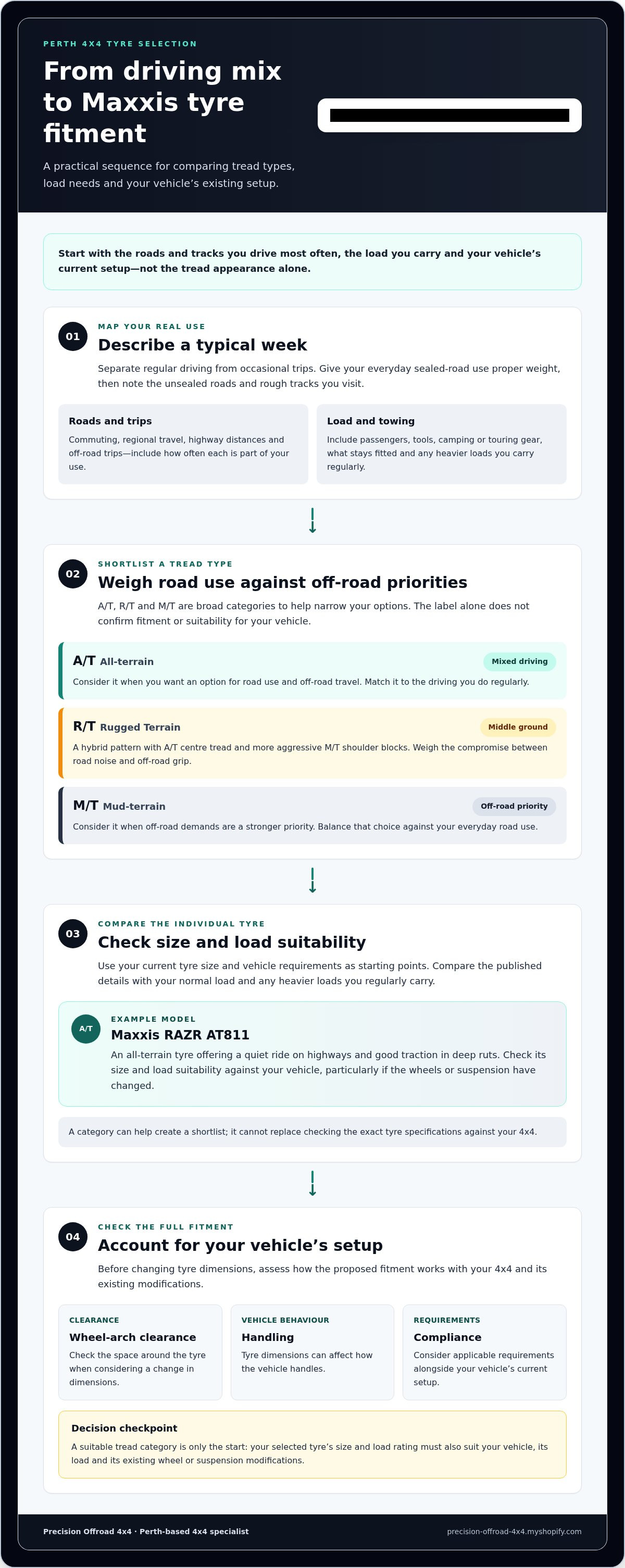
When comparing Maxxis tyres in Perth, start with how you use your 4x4, not just how aggressive the tread looks. Your tyres need to suit the roads and tracks you drive, the load you carry and the vehicle’s existing setup.
If you’re weighing up an all-terrain or mud-terrain pattern for Perth streets and WA tracks, consider the full fitment as well as the tread. Size and load markings can be hard to interpret, and a change in tyre dimensions may affect wheel-arch clearance, handling and compliance. This guide explains how to compare Maxxis options and check the details before choosing.
You’ll compare tread types, see where the Maxxis RAZR AT811 fits as an all-terrain option, and learn which fitment checks matter when changing tyre size. We’ll cover load ratings, clearance and how wheels or suspension modifications can influence the result. Precision Offroad 4x4 is a Perth-based 4x4 specialist, so the guidance focuses on local driving needs and a practical path from tyre selection to your next step.
Key Takeaways
- Match your tyre choice to your regular driving, vehicle setup and the loads you carry, not just occasional off-road trips.
- Compare A/T, R/T and M/T tread designs by their balance of road comfort and off-road priorities.
- Use your current tyre size and load requirements as starting points, and assess LT construction against how your 4x4 is used.
- Before changing tyre size, consider wheel-arch clearance, wheel track, handling and any effects on compliance or warranty.
- For Maxxis tyres Perth drivers can compare, follow a fitment sequence that accounts for vehicle details, terrain and existing wheel or suspension modifications.
Choosing Maxxis Tyres in Perth: Start With How You Use Your 4x4
Start with your vehicle, the loads it regularly carries and the roads and tracks you drive most often. A tyre that suits weekday commuting may not be the right match for frequent towing or rough-track touring. Equally, an aggressive tread chosen for an occasional trip may compromise everyday comfort without meeting your vehicle’s actual needs.
Match vehicle fitment and load requirements to the driving conditions you face most often. An A/T, R/T or M/T label can help narrow the field, but it doesn’t confirm that a tyre’s size and load rating suit your 4x4 or that the fitment complies with applicable requirements. Your vehicle details and existing modifications matter too.
What should Perth drivers consider before choosing Maxxis tyres?
Think about a typical week. How much of your driving is on sealed roads around Perth, and how often do you head onto unsealed roads or off-road tracks? Separate regular use from occasional trips. If most of your kilometres are on sealed roads, give that everyday use proper weight rather than choosing solely for a less frequent outing.
Next, consider how the vehicle is usually loaded. Passengers, tools, camping gear and touring equipment all contribute to the load the tyres must support. Towing also affects how you use the vehicle and the demands on its tyres. Keep a clear picture of your normal load, along with any heavier loads you carry regularly. Compare tyre options with your vehicle’s requirements rather than assuming one construction or tread type suits every 4x4.
How to describe your driving mix clearly
When comparing Maxxis tyres in Perth, describe real journeys rather than relying on a broad label such as “touring”. A useful summary might include regular sealed-road commuting, occasional towing, extended highway travel and some rough-track trips. Another driver may commute less but carry touring equipment and spend more time on unsealed roads. Those patterns can lead to different priorities.
- Commuting: Note how often you drive on sealed roads and whether road comfort is a regular priority.
- Towing and touring: Include what you tow, how the vehicle is loaded and whether trips involve long highway distances.
- Regional travel: Describe the mix of sealed and unsealed roads rather than assuming every route has the same surface.
- Off-road trips: Explain how often you drive on rough tracks and whether those trips are occasional or a regular part of your use.
If touring gear is part of your usual setup, include it in the load picture. Accessories can add weight and affect how you use the vehicle, so note what stays fitted and what you carry only for particular trips. This gives you a more useful starting point for comparing tread options, size and load suitability. There isn’t one tread type for every Perth-area driver. The right option depends on your vehicle and the work you ask it to do.
Maxxis Tyre Types Explained: A/T, R/T and M/T
A/T, R/T and M/T identify broad tread categories. Use them to narrow your options by the balance you want between sealed-road driving and off-road use. They’re a starting point, not a complete recommendation. The category alone won’t establish whether a particular tyre suits your vehicle, size, load requirements or modifications.
Compare the tread approach and intended use first, then check the specifications of the individual tyre. Don’t assume that two tyres in the same category have identical characteristics. A category label can’t replace a vehicle-specific fitment check.
| Category | Tread approach | Consider it when | Priority to weigh |
|---|---|---|---|
| A/T | All-terrain pattern for mixed driving | You want an option for road use and off-road travel | How well the intended use matches your regular driving |
| R/T | Hybrid pattern with A/T centre tread and more aggressive M/T shoulder blocks | You’re weighing a middle ground between A/T and M/T characteristics | The compromise between road noise and off-road grip |
| M/T | A more aggressive tread approach | Off-road demands are a stronger selection priority | How that priority fits with everyday road use |
Use the table to create a shortlist, then compare the exact model details and fitment information. Don’t select on appearance alone. Your intended use may point towards a category, but your vehicle’s documented requirements and current setup determine whether a specific option is suitable.
Where the Maxxis RAZR AT811 fits
The Maxxis RAZR AT811 is an all-terrain tyre offering a quiet ride on highways and good traction in deep ruts. Weigh those characteristics if you’re considering an A/T option. You’ll still need to check the tyre’s size and load suitability against your vehicle, especially if its wheels or suspension have changed.
When Maxxis mud-terrain tyres may suit your use
Mud-terrain tyres may suit you if off-road driving is a frequent part of your use and a priority in your selection. Weigh that against everyday road use before deciding. A driver whose 4x4 spends most of its time on sealed roads may have different priorities from someone who regularly takes it onto demanding tracks. Neither tread category is automatically right for every vehicle.
Once you’ve identified the category that best fits your priorities, treat it as a shortlist rather than a final choice. Compare the specific tyre’s published details with your 4x4’s requirements and setup. To review the available options, explore Maxxis tyre options alongside those fitment considerations.
Compare Maxxis Tyres for Your 4x4: Fitment, Load and Setup
Before comparing alternatives, record your current setup. Write down the full tyre size from the sidewall and the make, model, year and variant of your 4x4. Compare those details with the tyre and load information on the vehicle placard and in its documentation. If the vehicle has aftermarket wheels or suspension changes, record those too. The existing tyre size is a useful reference, but it doesn’t prove that a different size will suit the vehicle.
A tyre-size change needs a vehicle-specific fitment assessment because tyre dimensions, wheel position and suspension movement all affect available clearance. A size that fits one model or setup may not suit another.
- Record the current size: Copy the full sidewall marking, including its letters and numbers, rather than estimating from the tyre’s appearance.
- Check load information: Note your vehicle’s documented requirements and the load marking on the tyre options you’re comparing.
- Describe your usual load: Include passengers, cargo, tools and touring equipment that are regularly carried, as well as towing if it’s part of your use.
- List setup changes: Record wheel and suspension changes that could affect tyre position, steering movement or clearance.
light truck (LT) construction tyres are built with extra plies for higher load capacity and puncture resistance, making them suitable for heavy-duty rigs. That construction doesn’t make LT tyres necessary for every 4x4. Compare the tyre’s marked load information with your vehicle requirements and actual use. A higher load capacity alone doesn’t establish suitability. Size and fitment still matter.
How tyre size affects a modified 4x4
wheel-arch clearance is the space between the tyre sidewall and the vehicle’s inner wheel arch. If there isn’t enough space, the tyre may scrub against nearby parts as the steering turns or the suspension moves. Check clearance through the steering range and consider suspension movement, rather than judging only how the tyre sits while parked. wheel track is the distance between the left and right wheels on the same axle. Wheel position can affect how the tyre sits relative to the body and suspension.
When wheels or suspension changes affect tyre selection
A suspension lift changes ride height and the relationship between the tyre, wheel arch and suspension components. A wheel change can alter tyre position too. Consider the wheel, tyre and suspension as one setup. Don’t assume a lift automatically creates adequate clearance for a larger tyre. If your vehicle has been modified, include those changes in the fitment assessment and check the requirements that apply to the specific vehicle.
Wheel choice can shape tyre fitment, so the 4x4 wheel upgrade guide is relevant when reviewing wheel-specific factors. If a lift is part of your setup, the 4x4 suspension performance guide can help you consider suspension and geometry together. Keep the vehicle details, tyre markings and modification notes in one place as you compare options. This gives you a more accurate basis for assessing Maxxis tyres against your 4x4’s actual setup.
Before Changing Tyres in Perth: Check Safety and WA Compliance
Before choosing a replacement, make a written record of the vehicle, existing tyres, expected load and proposed change. This gives you a clear basis for checking fitment and avoids treating a tyre label or online vehicle filter as final approval. A change that appears straightforward on an unmodified 4x4 may need closer assessment if wheels, suspension or other parts have already changed.
Use this sequence before settling on a tyre:
- Confirm the vehicle details: Record the make, model, year and variant. Refer to the tyre placard and vehicle documentation for the recorded tyre and load requirements.
- Read the fitted tyre markings: Copy the complete size and load information from the sidewall. Note any difference between the fitted tyres and the vehicle documentation.
- Set out the load and use: Include passengers, cargo, towing and touring equipment. Distinguish regular use from occasional heavier trips so the comparison reflects how the 4x4 is actually driven.
- Record modifications: List wheel and suspension changes, including changes that affect the tyre’s position. Keep relevant modification records with your vehicle details.
- Check current WA guidance: Use authoritative Western Australian Department of Transport information for the proposed tyre or vehicle change before proceeding.
A practical fitment and condition check
Inspect the current tyres and surrounding components for visible damage or signs of contact. Compare the sidewall markings with the vehicle’s documented requirements, then consider how the proposed tyre would sit through steering and suspension movement. wheel-arch clearance is the space between the tyre sidewall and the inner wheel arch. wheel track, wheel position and suspension changes can influence the available space, so include them in the same fitment review.
A qualified assessment is appropriate if the proposed size differs from the documented setup, the vehicle has modifications, or you can’t establish adequate clearance and load suitability from the information available. A static visual check alone may not show how the tyre sits through the full steering and suspension range. If you’re uncertain, pause before selecting the tyre.
WA rules, modifications and warranty considerations
Tyre changes and vehicle modifications can affect safety, compliance and warranty considerations. The outcome depends on the vehicle and the particular change, so don’t apply a general rule to every 4x4. Check current WA Department of Transport guidance for the change you’re considering. Requirements can be specific to the vehicle and modification, and guidance for another state may not answer what applies in Western Australia.
Review the vehicle manufacturer’s warranty terms alongside relevant tyre or component information. Keep a record of the vehicle’s original details, the proposed parts and the checks you’ve made. Don’t assume a modification plate or other certification is required in every case, or that it can be ignored. Verify the requirements for your particular change before proceeding. This keeps your selection grounded in the vehicle’s documented needs and current WA guidance.
Find Maxxis Tyres in Perth for Your Vehicle and Driving Needs
A useful shortlist starts with five details: your vehicle, current tyre size, load requirements, driving conditions and existing modifications. Keep them together as you compare options. This helps you distinguish tyres that match your actual setup from those that only appear suitable by category or size.
Before browsing, gather the information below. Use the vehicle’s tyre placard and documentation alongside the sidewall markings. They provide different details about the existing fitment and the vehicle’s requirements.
What information helps narrow down Maxxis tyre options?
- Vehicle: Note the make, model, year and variant. Differences between variants can affect the original wheel and tyre fitment.
- Current tyre size: Copy the full size marking from the sidewall. If the vehicle documentation records more than one size, note that too.
- Regular load: Describe what is usually carried, including passengers, work gear and touring equipment. Include towing if it’s part of your regular use.
- Driving conditions: Summarise your usual sealed-road driving, highway touring, regional travel and off-road use. Be clear about which conditions are frequent and which are occasional.
- Modifications: Record wheel and suspension changes, plus any other changes that could affect tyre position or clearance.
These details form a practical selection brief. For example, a vehicle used mainly for commuting but occasionally loaded for touring has different regular demands from one carrying equipment and travelling on rough tracks most weeks. Don’t choose a category based on one trip alone. Identify the tyre’s everyday role, then compare suitable options against the vehicle’s specifications and setup.
Explore Maxxis tyres with a Perth 4x4 specialist
Precision Offroad 4x4 is a Perth-based specialist retailer of Maxxis tyres, wheel upgrades and suspension products. That local 4x4 focus helps you consider how tyre choice relates to your vehicle’s existing wheels or suspension. Use the details you’ve gathered to focus your comparison on actual use and fitment, not tread appearance alone.
The Maxxis RAZR AT811 is an all-terrain option described as offering a quiet highway ride and good traction in deep ruts. Treat those characteristics as a starting point for comparison, not a substitute for checking the tyre’s size and load suitability against your vehicle. The right shortlist depends on the complete setup.
For Maxxis tyres Perth drivers can compare, bring together your vehicle details, current size, load needs, driving mix and modification notes. Explore Maxxis tyres at Precision Offroad 4x4.
Make Your Next Tyre Choice With Confidence
Your 4x4’s setup can change over time. A new touring load, regular towing or a suspension upgrade may alter what you need from your tyres. Treat tyre selection as part of the vehicle’s wider setup, and revisit it when the way you use your 4x4 changes. That keeps your next decision grounded in current requirements rather than assumptions based on an old configuration.
Precision Offroad 4x4 offers Maxxis tyres alongside wheel and suspension upgrades. Comparing those parts together can help you assess how they relate to your vehicle and intended use.
Explore Maxxis tyres at Precision Offroad 4x4 and use your vehicle details to narrow down a suitable option.
Frequently Asked Questions
Are Maxxis tyres suitable for 4x4 driving around Perth?
Maxxis tyres can suit different 4x4 uses around Perth when the specific tyre matches your vehicle and driving needs. A suburban commuter who mostly drives sealed roads may have different priorities from someone who regularly tows or drives rough tracks. Start with your usual week, not just an occasional trip. Then compare the tyre category and exact model details with your vehicle’s documented fitment and load requirements.
What is the difference between Maxxis all-terrain and mud-terrain tyres?
All-terrain and mud-terrain tyres use different tread approaches for different driving priorities. An all-terrain option may suit mixed road and off-road use, while mud-terrain tyres are generally considered when off-road driving is a stronger priority. Think about how often you use rough tracks compared with sealed roads. Check the specifications of the particular tyre you’re considering, as a category label alone doesn’t describe every model’s characteristics.
Is the Maxxis RAZR AT811 suitable for highway driving?
The Maxxis RAZR AT811 is an all-terrain tyre that offers a quiet highway ride and good traction in deep ruts. Whether it suits your 4x4 depends on the correct size, load requirements and vehicle fitment. If you’ve changed the wheels or suspension, don’t rely on the original setup as your only reference. Compare the tyre’s current specifications with your vehicle documentation before choosing it.
Can I fit a different tyre size to my 4x4 in Western Australia?
A different tyre size may affect clearance, wheel position, handling and modification compliance, so don’t assume a size that works on another 4x4 is suitable for yours. Check current Western Australian Department of Transport guidance for the specific vehicle and change. Also assess wheel-arch clearance and the vehicle’s documented load requirements. If your 4x4 has other modifications, consider their combined effect before selecting a different size.
What does LT mean on a Maxxis tyre?
LT means light truck construction. These tyres have extra plies for higher load capacity and puncture resistance, but that doesn’t make them the right choice for every 4x4. A vehicle used mainly for light commuting may have different needs from one regularly carrying touring equipment. Compare the tyre’s load marking with your vehicle’s documented requirements and consider how you use the vehicle before choosing.
Do I need a wheel alignment after changing 4x4 tyres?
Yes. A professional wheel alignment is mandatory after any suspension or tyre change. This applies even if the new tyres appear close in size to the previous set. If the tyre change is part of a wider wheel or suspension modification, include those changes in the alignment assessment. Keep the alignment information with your vehicle records for reference when reviewing its setup later.
How do I find the correct Maxxis tyre size for my vehicle?
Start with the full size marking on your current tyre, then compare it with the size and load information in your vehicle documentation. A photo of the sidewall and tyre placard can help you record the details accurately. If wheels or suspension have changed, include that information too. Don’t choose a different size based only on an online filter. Consider vehicle-specific clearance and check current WA requirements for the proposed change.