

More lift isn’t automatically better. A Prado 150 suspension upgrade typically sits in the 40mm (2 inches) to 50mm range, with most complete kits offering 40-45mm. The right height depends on your tyre clearance, vehicle load and how you use the Prado off-road.
You want room for tougher tracks and accessories without compromising handling, tyre wear or suspension travel. This guide explains how to choose a lift height, match spring rates to your usual load and understand why lifts above 2 inches need supporting modifications.
You’ll also see how premium suspension brands such as Dobinsons fit into the decision, and what to consider when comparing alternatives alongside expert guidance from Precision Offroad 4x4. The focus is practical: a balanced setup for your Prado, suited to Australian conditions and mindful of compliance.
Key Takeaways
- Choose lift height around your tyre-clearance needs and intended tracks, while keeping suspension travel and handling in view.
- Match spring rates to the Prado’s usual accessory load and towing use to support a more balanced ride.
- Understand how a well-matched suspension setup can help maintain control over uneven terrain, then consider the supporting components it may need.
- Compare suspension brands by kit design and suitability for your vehicle, and explore wheel and tyre options that complement the setup.
What lift height should I choose for my Toyota Prado 150 Series?
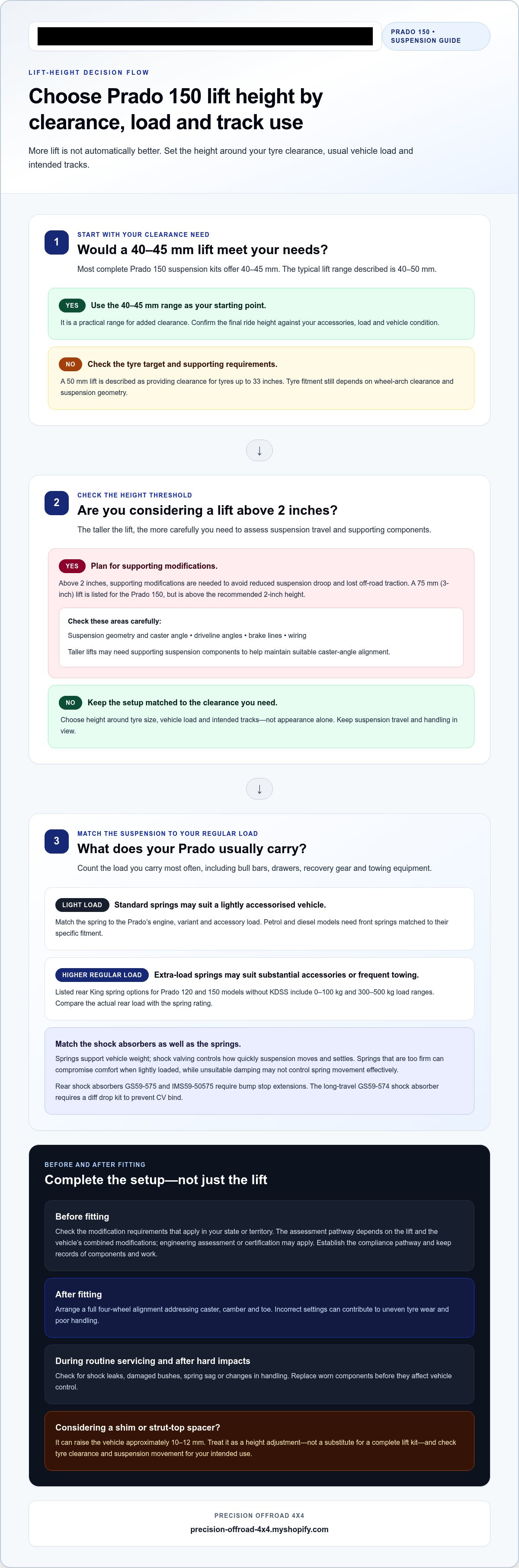
Prado 150 lift heights typically range from 40mm (2 inches) to 50mm. Most complete suspension kits offer 40-45mm, a practical range for added clearance without automatically requiring a taller setup. Choose height around your tyre size, vehicle load and intended tracks, not appearance alone.
A complete lift kit pairs springs with shock absorbers designed to control their movement. Raised-height measurements are guides only; accessories, load and vehicle condition affect the final ride height. A 50mm lift is described as providing clearance for tyres up to 33 inches, but tyre fitment also depends on wheel-arch clearance and suspension geometry.
Above 2 inches, supporting modifications are needed to avoid reduced suspension droop and lost off-road traction. Taller lifts may require supporting suspension components to help maintain suitable caster-angle alignment. A 75 mm (3-inch) lift is listed for the Prado 150, but it sits above the recommended 2-inch height and calls for careful attention to geometry, driveline angles, brake lines and wiring.
In Australia, vehicle modifications must meet the requirements that apply in your state or territory. The assessment pathway depends on the lift and the vehicle’s combined modifications; engineering assessment or certification may apply. Keep records of the components and work, and establish the compliance pathway before fitting.
After fitting a lift kit or suspension components, arrange a full four-wheel alignment. It should address caster, camber and toe, as incorrect settings can contribute to uneven tyre wear and poor handling.
A Prado 150 suspension upgrade can also include a shim or strut-top spacer, which raises the vehicle approximately 10-12 mm. Treat this as a height adjustment, not a substitute for a complete lift kit. Check the resulting tyre clearance and suspension movement against your intended use.
Inspect suspension during routine servicing and after hard off-road impacts. Check for shock leaks, damaged bushes, spring sag or changes in handling, and replace worn components before they affect vehicle control.
Professional installation and load-rated springs
Choose springs to suit your Prado’s engine, variant and regular load, then match the shock absorbers to the setup. Have a qualified professional install the lift kit to help avoid damage.
Front springs for petrol and diesel models
Petrol and diesel Prado 150 models need front springs matched to their specific vehicle fitment and accessory load. Record the engine, wheelbase and front-mounted equipment before choosing components. For example, a listed raised King front spring suits the long-wheelbase Prado 150 with a 0-50 kg load range. Matching the application helps the suspension support the vehicle without selecting a heavier spring rate than its usual load requires.
Rear springs and long-travel shocks
Rear spring choice should reflect carried accessories and towing use. Long-travel shocks also need the correct supporting components: rear shock absorbers GS59-575 and IMS59-50575 require bump stop extensions to prevent the shocks bottoming out. The long-travel GS59-574 shock absorber requires a diff drop kit to prevent CV bind. Treat these requirements as part of the component match, not optional additions after installation.
Selecting spring rates and shock valving
Spring rate supports the vehicle’s weight; shock valving controls how quickly the suspension moves and settles. Choose them as a matched setup for the Prado’s usual load and driving conditions. Springs that are too firm can compromise comfort when lightly loaded, while unsuitable shock damping may not control spring movement effectively. A qualified installer can assess fitment and component compatibility before assembly.
Matching spring rates to vehicle loads
Start with the load carried most often, including bull bars, drawers, recovery gear and towing equipment. Standard springs suit lightly accessorised vehicles; extra-load springs suit vehicles carrying substantial accessories or towing frequently. Listed rear King springs for Prado 120 and 150 models without KDSS include raised options for 0-100 kg and 300-500 kg load ranges. Compare your actual rear load with the spring rating, then review ride height once the vehicle is equipped.
Use the Prado 150 suspension components to compare fitment options against your vehicle and load setup.
Benefits of suspension upgrades for off-road driving
On corrugated tracks, matched springs and shock absorbers help control repeated suspension movement. Springs support the Prado’s weight, while shock absorbers manage compression and rebound. This helps keep the tyres tracking across uneven ground and limits excessive bouncing that can unsettle the vehicle. It also helps the driver maintain steering control over ruts and washouts.
Rocky climbs and cross-axle sections call for suitable suspension travel. As the wheels move independently over obstacles, appropriate damping helps limit sudden body movement and maintain tyre contact. A poorly matched setup can top or bottom out, reducing control and increasing impact stress on suspension components. After fitting, test the vehicle on familiar tracks and note harsh impacts, noises or unsettled movement.
Touring setups need to cope with long highway drives and changing track surfaces. Compare Dobinsons and Fulcrum options by intended use, spring behaviour and shock absorber design, rather than brand name alone. Account for the Prado’s accessories and usual load, then assess its response on sealed roads and corrugations. A touring setup should control body movement without feeling unnecessarily harsh between tracks.
Daily driving remains practical when spring rate and damping suit the vehicle’s regular use. A heavily rated spring on a lightly equipped Prado can feel firm over suburban road joints, while a soft spring may allow excess movement when carrying touring gear. Check ride comfort, steering response and braking stability on ordinary roads, then compare them with the vehicle’s off-road behaviour.
Tyres and wheels also affect suspension performance. Heavier wheel and tyre combinations add unsprung mass, making it harder for the suspension to control wheel movement. After fitting, assess the vehicle at its normal load and drive a consistent mix of sealed roads and tracks. Note repeated bouncing, poor tyre contact or shock fade, which occurs when an overheated shock absorber loses damping. These checks help show whether the setup suits your driving conditions.
Alternative suspension brands
Compare suspension brands by Prado fitment, spring load rating and the components included, rather than by badge alone. Dobinsons offers several Prado 150 suspension options, including Nitro Gas, MRA and IMS designs. Its listed MRA kit provides a 2-inch lift, while IMS options include monotube front and rear shock absorbers. These product names distinguish different designs, but your vehicle’s variant, load and driving conditions should guide the final choice.
Bilstein is another brand to consider, with a listed 2-inch front lift kit for the Toyota Prado 150. Compare its front-only scope with complete kits that include both axles. A front kit and a full suspension kit aren’t interchangeable choices: assess what your vehicle needs and whether the rear suspension must also support touring equipment or towing loads.
Compare options against your Prado’s exact variant, fitted accessories, towing pattern and intended ride height. Review each option’s spring ratings, shock absorber design, included hardware and required supporting components. Confirm that the stated fitment matches your model and suspension configuration. A kit with a suitable lift figure may still be a poor match if its load rating or component combination does not suit your use.
Dobinsons Suspension Kits and Fulcrum Suspension Kits are two options to compare for a Prado 150. Focus on spring rate for load support, shock design for damping and compatibility with any geometry correction. Touring setups also need to balance highway comfort with control on corrugations. For a regularly loaded vehicle, give the stated load range more weight than brand recognition alone.
Shortlist by fitment and load first, then compare the complete component package. Explore Prado 150 suspension options to compare configurations for your vehicle and touring setup.
Precision Offroad 4x4: Wheel Upgrades
Precision Offroad 4x4 is Perth-based and offers options to consider when your Prado’s suspension choice also affects wheel and tyre fitment. Compare Wheel Upgrades alongside Fulcrum Suspension Kits, Maxxis Tyres and Supreme Innovations Products as you plan a setup for touring or off-road use around Perth and WA.
Start with your Prado’s model and intended load. Then consider how the chosen suspension height, wheel fitment and tyre size work together, including wheel-arch clearance. This narrows the options to parts suited to the vehicle’s actual use, rather than selecting components in isolation.
If you’re comparing parts for your build, visit precision-offroad-4x4.myshopify.com.
Plan your Prado build around how you use it
The next step is to turn your driving needs into a clear parts brief. Note your usual passengers and cargo, fitted accessories, towing use and the tracks you travel. That gives you a practical basis for comparing a Prado 150 suspension upgrade with wheel and tyre choices, rather than treating each component as a separate decision.
Precision Offroad 4x4 offers Wheel Upgrades, Dobinsons Suspension Kits and Fulcrum Suspension Kits. These options let you consider suspension and wheel fitment together as you plan a setup for touring, daily driving or off-road use. Keep the vehicle’s intended load and handling priorities central to the choice.
For your next step, explore Prado 150 upgrade options and identify the components that suit your build. A considered setup gives you a stronger starting point for a capable, usable Prado.
Frequently Asked Questions
What are common problems with Prado 150 suspension?
Warning signs include sagging at one corner, oil around a shock absorber, clunks over bumps or changes in steering response. Uneven tyre wear can also indicate worn parts or alignment issues. Note when symptoms occur, such as with a loaded trailer or on corrugated roads. That context helps distinguish component wear from a setup that does not suit the vehicle’s load.
What are the factors to consider when choosing a suspension upgrade?
Start with your Prado’s exact variant and existing suspension configuration, then account for accessories, passengers, cargo and towing. Check that each spring and shock absorber suits that fitment. Consider tyre and wheel changes too, as added unsprung mass affects suspension response. For example, a touring vehicle carrying drawers needs a different load assessment from a lightly equipped Prado used mainly for commuting.
Why do I need a good suspension kit?
A matched suspension kit replaces components as a coordinated system: springs support the vehicle while shock absorbers control their movement. Mixing parts without considering compatibility can lead to uneven ride height or poor damping. If your Prado regularly carries recovery gear, a suitable kit can help it remain composed under that load. After rough track use, inspect for leaks, loose hardware and damaged bushes.
What suspension upgrade options are available for a Toyota Prado 150 in Australia?
Prado 150 options include complete lift kits, replacement springs, front struts, rear shock absorbers and supporting components. Dobinsons and Fulcrum offer suspension kit options to compare, alongside separate components for targeted replacements. A complete kit groups matched parts, while individual components can address specific wear or setup needs. Confirm the model variant and existing suspension type before selecting a configuration.
Which Prado 150 suspension kits are best for touring, towing, off-road use, and daily driving?
There is no single best kit for every Prado. For touring, prioritise the usual loaded condition and stable highway behaviour; for towing, account for the regular trailer load. Off-road use calls for suitable travel and damping, while daily driving favours a spring rate that does not feel unnecessarily firm when unladen. Compare Dobinsons and Fulcrum configurations against these priorities, then choose according to fitment and load rating.
What lift height is recommended for a Prado 150, and how does it affect handling?
A moderate lift is generally the practical starting point for a Prado 150, with the final height shaped by tyre clearance, load and intended use. Taller lifts can alter suspension geometry and steering feel, and may reduce droop if supporting components aren’t matched. Handling also depends on spring rate, shock damping and alignment. After any lift, assess steering stability and tyre wear as part of the finished setup.