

Your expensive set of Maxxis tyres is being eaten alive by the very vehicle they're supposed to carry. It’s a common sight on WA tracks: a heavy-duty rig nose-diving under braking or feeling dangerously unstable on high-speed corrugations. You’ve likely felt that unsettling sway during a highway overtake or noticed uneven scalloping on your tread and wondered if it's just a bad alignment. Often, the issue sits much deeper in your vehicle's geometry.
Knowing exactly when to replace 4x4 suspension is the difference between a controlled trek through the Kimberley and a costly mechanical failure in the middle of nowhere. This technical guide identifies the critical warning signs of shock and spring fatigue before you ruin another set of rubber or compromise your safety. We’ll break down how to assess component health, manage your GVM requirements, and determine the right moment to upgrade to a specialised Dobinsons or Fulcrum kit designed for rugged Australian conditions.
Key Takeaways
- Identify physical warning signs like oil misting on shock bodies or excessive nose-diving under heavy braking before they lead to total component failure.
- Learn exactly when to replace 4x4 suspension by moving beyond generic odometer rules and focusing on real-world performance degradation after major off-road treks.
- Recognise how steering feedback and uneven tread wear on your Maxxis tyres indicate geometry shifts that require more than just a basic wheel alignment.
- Understand the functional benefits of upgrading to a specialised Dobinsons or Fulcrum kit to improve GVM management and handling for heavy touring.
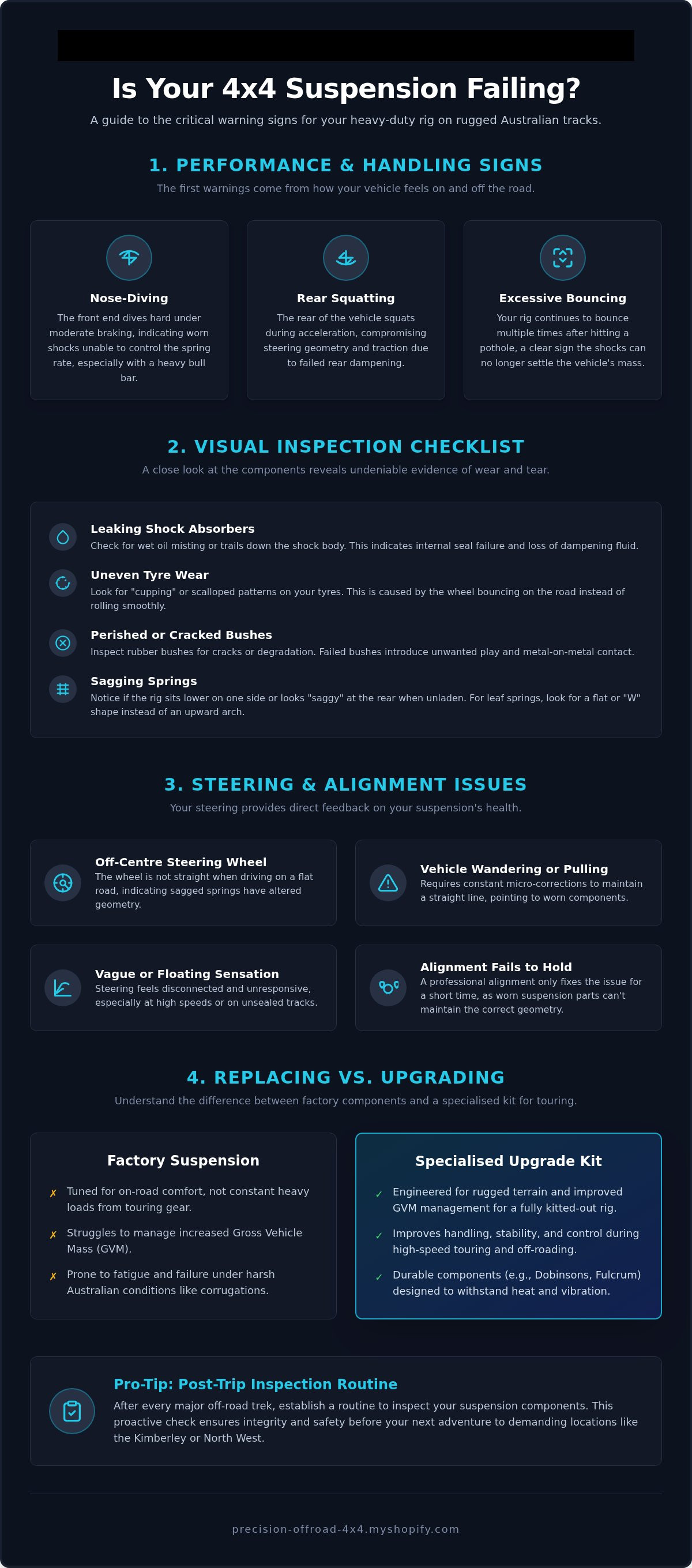
- Establish a post-trip inspection routine for your rig to ensure suspension integrity and safety before your next trip to the Kimberley or North West.
Common Signs Your 4x4 Suspension Needs Replacing
Identifying when to replace 4x4 suspension starts with observing how your vehicle manages weight during basic manoeuvres. Factory vehicle suspension systems are typically tuned for comfort rather than the constant loads of a kitted-out tourer. If your heavy bull bar causes the front end to dive hard under moderate braking, your shocks are no longer controlling the spring rate. Similarly, "squatting" during acceleration indicates the rear dampening is shot, which compromises your steering geometry and traction.
Physical inspections often reveal the most obvious failures. Check your shock absorber bodies for wet oil trailing down the tube, which signifies that the internal seals have failed. If your rig sits lower on the driver's side or looks "saggy" at the rear even when unladen, your springs have likely lost their tension. Uncontrolled bouncing after hitting a pothole or a dip in the road is a definitive sign that the dampening fluid can no longer settle the vehicle's mass.
Physical Handling Feedback
High-speed stability is the first casualty of worn components. You might notice a "floating" sensation while cruising the Kwinana Freeway, where the steering feels vague and disconnected. This instability worsens if you carry a rooftop tent, as degraded shocks allow for excessive body roll that makes cornering feel unpredictable. On unsealed tracks, worn components fail to keep the tyres in consistent contact with the ground. This lack of control significantly increases your braking distances and reduces your ability to steer safely through corrugations.
Visual Inspection of Components
Get under the vehicle with a torch to inspect the rubber bushes and ball joint boots. Perished, cracked, or missing rubber leads to metal-on-metal contact and introduces unwanted play into your steering. Look closely at your Maxxis tyres for "cupping" or scalloped wear patterns, which occur when the tyre bounces rather than rolls smoothly across the surface. To check your leaf springs, look for a "W" shape in the pack or leaves that have become completely flat instead of maintaining a healthy upward arch. These visual cues confirm your geometry has shifted and your components are ready for the scrap heap.
Technical Indicators: Alignment and Steering Feedback
Steering feedback provides a direct line of communication between your vehicle's geometry and your hands. When components begin to fail, this communication becomes erratic. A common indicator of when to replace 4x4 suspension is a steering wheel that sits off-centre while you are driving straight on a flat road. This usually indicates that your springs have sagged or your bushes have shifted, pulling the steering linkage out of its calibrated position. You might also experience the vehicle "wandering" or pulling to one side unexpectedly, requiring constant micro-corrections to maintain a straight line.
On high-speed tracks, a "loose" or unresponsive feeling in the steering wheel is a major safety concern. This vagueness often stems from worn ball joints or steering dampeners that can no longer mask the feedback from the terrain. If you feel persistent vibrations through the steering column that a standard wheel balance hasn't fixed, the issue is likely mechanical play within the suspension assembly. These symptoms shouldn't be ignored, as they often lead to rapid tyre degradation and reduced emergency handling capabilities.
The Suspension-Alignment Connection
Many drivers seek a professional wheel alignment to fix a pulling vehicle, only to find the problem returns within weeks. This happens because an alignment cannot hold if your control arm bushes are perished or your springs have lost their height. Sagging springs fundamentally alter your caster and camber geometry, making it impossible to stay within factory specifications. It is vital to distinguish between a failing steering rack and general suspension wear; if the "play" in your steering is accompanied by clunking sounds over bumps, the fault usually lies in the suspension arms or bushes rather than the rack itself.
The Impact of Corrugations and Off-Road Stress
Western Australian conditions are notoriously harsh on steering components. The Gibb River Road serves as the ultimate test for shock valving; the high-frequency vibrations from heavy corrugations generate immense heat, which can cause internal seals to fail and steering response to fade. High-speed sand driving also places cumulative stress on your alignment as the vehicle hunts for traction in soft tracks. If you've taken a heavy hit on a rock shelf, you may have physically bent a tie rod or drag link. Before your next big trek, you can browse our heavy-duty steering components to ensure your rig is up to the task of handling the North West's most demanding routes.
Replacing vs. Upgrading: Making the Right Choice
Deciding when to replace 4x4 suspension often leads to a choice between standard parts and performance upgrades. If your ute is strictly a city-based commuter that rarely carries more than a bag of groceries, a "like-for-like" replacement of factory components might be sufficient. This restores the original ride quality and safety without the added cost of specialised engineering. However, for vehicles frequently used for touring or work, standard components are often the weak link in the chain.
Upgrading to a Dobinsons suspension kit provides a significant advantage for vehicles carrying heavy bull bars, winches, or rear drawer systems. These accessories add constant weight that factory springs aren't designed to support, leading to premature sagging and poor handling. For those towing large caravans or heavy trailers, Fulcrum suspension kits offer enhanced stability and dampening. This prevents the "tail wagging the dog" effect on the highway and keeps your rig level under load.
Matching Suspension to Your Load
The most common mistake owners make is choosing the stiffest springs available without considering their actual vehicle weight. You must calculate your constant load, which includes everything permanently bolted to the chassis, versus your occasional weekend weight. Fitting heavy-duty springs to an empty tray results in a harsh, bouncy ride and reduced traction on corrugated tracks. The selection of 4x4 accessories like steel canopies or long-range tanks should directly dictate your spring rate. A matched system ensures the suspension works within its optimal stroke, protecting your GVM and your spine.
Performance Benefits of Aftermarket Kits
Aftermarket kits offer technical improvements that factory parts simply cannot match. Larger bore shock absorbers provide better heat dissipation, which is critical for preventing shock fade during long stints on outback roads. When you lift a vehicle, your wheel geometry changes; adjustable upper control arms (UCAs) are often required to correct caster and camber, ensuring your tyres wear evenly. You also have the choice between foam cell and monotube shocks. Foam cell shocks are generally preferred for heavy touring due to their durability and resistance to cavitation, while monotube shocks offer a more precise, responsive feel for high-speed dirt driving.
The Timing: When to Book Your Rig In
General automotive advice often suggests a "100,000km rule" for shock absorbers, but this metric rarely applies to a touring 4x4. Heavy-duty usage, such as constant towing or corrugated track driving, can degrade components in half that time. Determining when to replace 4x4 suspension depends more on your vehicle's environment than its odometer reading. A rig that spends its life on Perth bitumen will have a vastly different maintenance timeline than one regularly crossing the Simpson Desert or exploring the Kimberley.
Timing is also critical when you modify your vehicle's weight profile. You should assess your suspension immediately after installing significant weight, such as a steel bull bar, a winch, or a heavy canopy. Adding 150kg to 300kg of accessories without adjusting your spring rates causes immediate geometry shifts. Additionally, keep a close eye on your tyres. If your Maxxis tyres show signs of "feathering", where the tread blocks feel sharp in one direction and smooth in the other, your dampening is likely insufficient to keep the tyre stable.
The Pre-Trip and Post-Trip Health Check
A DIY driveway inspection is your first line of defence. Before any major North West trek, check for moisture around shock seals and ensure your bump stops aren't showing signs of frequent impact. After returning from long corrugated stretches, your shocks may feel "soft" or exhibit heat fade, where the vehicle takes longer to settle after a bump. Perth owners who frequent the dunes at Lancelin or Wilbinga should also check their alignment after heavy sand work. High-speed sand driving involves constant steering corrections and lateral stress that can knock your components out of spec faster than highway driving.
Integrating with Regular Maintenance
You should check your suspension components during every 10,000km tyre rotation. While many old-school mechanics suggest the "bounce test" (pushing down on a corner to see if it oscillates), this is often misleading for modern 4x4s with heavy-duty springs. A shock can be 50 percent degraded and still pass a bounce test because the high spring rate masks the lack of dampening. Instead, focus on checking the torque on your U-bolts and shackle pins, as these can vibrate loose on rough tracks. If you are unsure about the current state of your components, you can book a professional suspension assessment to ensure your rig is safe for the next trip.
The Precision Offroad 4x4 Specialist Advantage
Precision Offroad 4x4 operates with a clear focus on functional performance rather than aesthetic trends. We understand that a suspension system is a complex assembly of geometry, spring rates, and dampening curves. When deciding when to replace 4x4 suspension, the technical expertise of the specialist performing the work is as vital as the parts themselves. We specialise in tailoring Dobinsons and Fulcrum setups specifically for the demanding conditions found across Western Australia. Our workshop prioritises performance geometry over generic "lift and forget" kits that often compromise vehicle stability and safety.
We don't just install parts; we solve mechanical problems. Our team provides expert fitting and alignment services specifically for modified 4x4s. This ensures your vehicle remains stable at highway speeds while remaining highly capable on the tracks. By integrating premium Maxxis tyres and Supreme Innovations accessories into our builds, we create a cohesive system. This protection of your tyre investment is a core part of our service, as a correctly tuned suspension prevents the irregular wear that kills expensive rubber.
Tailored Solutions for Perth Off-Roaders
We begin every project by assessing your specific driving style and your vehicle's constant load requirements. A rig used for weekend beach runs near Lancelin requires a different setup than a heavy-duty tourer destined for a multi-week trip through the Kimberley. Our local knowledge of WA tracks allows us to tune your suspension for the specific frequency of local corrugations and the lateral stress of deep sand driving. We are committed to building durable, high-performance rigs that stand up to the most demanding environments in the country.
Get Your Rig Track-Ready
Booking a suspension health check is the most effective way to identify wear before it leads to a total component failure. Our technicians look beyond simple leaks, evaluating bush integrity and pivot point wear that often goes unnoticed during standard mechanical servicing. If you've noticed any of the handling changes or visual signs described in this guide, it's time for a professional assessment. Preparing your vehicle for an upgrade involves a clear understanding of your constant load and intended usage. Contact the team at Precision Offroad 4x4 for expert advice on your next suspension project.
Prepare Your Rig for the Next Adventure
Identifying when to replace 4x4 suspension is about maintaining vehicle control and protecting your mechanical investment. Whether you've noticed excessive body roll on the freeway or uneven wear on your Maxxis tyres, these symptoms indicate that your factory components are no longer fit for purpose. Moving beyond generic odometer readings and focusing on real-world performance ensures your rig remains safe for the demanding tracks of the North West. A proactive approach prevents costly trailside repairs and keeps your steering precise on the most corrugated surfaces.
As a Perth-owned and operated specialist in Dobinsons and Fulcrum performance kits, Precision Offroad 4x4 understands the specific geometry requirements of kitted-out tourers. We prioritise functional durability, ensuring your springs and shocks are matched perfectly to your GVM and driving style. Our local expertise ensures your vehicle is tuned for the unique demands of WA tracks. Upgrade your 4x4 suspension with Precision Offroad 4x4 to ensure your next trek is as safe as it is capable. We look forward to seeing your rig in the workshop soon.
Frequently Asked Questions
How many kilometres does 4x4 suspension usually last?
Determining when to replace 4x4 suspension is less about a fixed odometer reading and more about the environment where you drive. Standard factory shocks often degrade by 40,000 to 60,000 kilometres if used frequently off-road. A 4x4 carrying heavy accessories like steel bull bars and winches places significantly more stress on the components. You should assess your system based on handling performance. If the vehicle feels unstable on corrugations, it is time for an inspection.
Can I replace just the shocks or do I need new springs too?
You can replace shocks individually, but it is rarely the most effective solution for a touring rig. Springs are responsible for maintaining ride height and supporting the vehicle's mass, while shocks control the movement. If your springs have sagged due to age or heavy loads, new shocks will be forced to work outside their optimal stroke. This leads to premature failure and poor handling. We recommend replacing both as a matched set for better performance.
Will a suspension lift kit ruin my wheel alignment?
A suspension lift kit fundamentally alters your vehicle’s steering geometry, but it won't ruin your alignment if managed correctly. Lifting the chassis changes the caster, camber, and toe angles. Every professional installation must be followed by a comprehensive wheel alignment to bring these settings back to within safe specifications. In some cases, adjustable upper control arms are required to achieve the correct caster after a significant lift, ensuring your tyres wear evenly and the steering remains responsive.
What is the difference between sagging and a worn shock?
Knowing when to replace 4x4 suspension requires distinguishing between spring sagging and shock dampening failure. Sagging is a spring issue that you can identify by measuring the distance from the wheel centre to the guard. A worn shock typically manifests as oil leaks, perished bushes, or a vehicle that continues to bounce after hitting a bump. Both issues impact your safety, but they require different mechanical solutions to restore your vehicle's handling and stability.
How much does a 4x4 suspension replacement cost in Perth?
The total cost for a suspension replacement in Perth varies based on your vehicle's specific load requirements and the components selected. Factors such as whether you require a basic shock replacement or a full GVM-certified upgrade will influence the final price. A complete kit usually includes matched springs and shocks, plus the labour for professional fitting and a wheel alignment. Investing in premium kits often saves money long-term by preventing premature wear on other mechanical components.
Is it normal for a 4x4 to sit slightly lower on the driver’s side?
A slight "driver lean" is common in many 4x4 models because the fuel tank, battery, and driver are often located on the same side. This constant weight can cause the driver-side springs to fatigue faster than the passenger side. High-quality aftermarket kits often account for this by providing side-specific springs with slightly different rates or heights. If the lean is more than 10 millimetres, it usually indicates that the springs have sagged and require professional replacement.
Can worn suspension cause the "Death Wobble" in my 4WD?
Worn suspension components are a primary contributor to the "Death Wobble", particularly in vehicles with solid front axles. While the issue often starts with an unbalanced tyre, degraded steering dampeners and perished control arm bushes allow the vibration to oscillate uncontrollably. This creates a violent shaking in the steering wheel that can only be stopped by slowing down. Replacing worn bushes and upgrading to a heavy-duty steering dampener is essential for maintaining stability on rough WA tracks.
Does bad suspension affect my 4x4 fuel economy?
Degraded suspension can negatively impact your fuel economy by increasing rolling resistance and altering aerodynamics. When your alignment is out of spec due to sagging springs or worn bushes, your tyres don't roll straight, forcing the engine to work harder. Additionally, a vehicle that "drags" its rear or nose-dives creates more wind resistance. Maintaining healthy suspension ensures your tyres stay in optimal contact with the road, which helps protect your fuel range during long-distance outback touring.