

The toughest-looking wheel isn’t automatically the right choice for a long Australian tour. The best 4x4 wheels for touring need to suit your vehicle’s fitment, carry its real touring load and handle the mix of sealed roads, corrugations and tracks you plan to drive.
It’s easy to get caught between alloy and steel, or to focus on appearance while overlooking load rating and clearance. Those details matter when your 4x4 is packed with passengers, accessories and touring gear. A wheel change can also affect wheel track, handling and compliance, so the full setup needs to work together.
This guide explains how to compare wheel materials, check load capacity and assess fitment before you buy. You’ll also learn which clearance and compliance points to consider in Western Australia, including how wheel choice relates to your tyres and vehicle setup. Precision Offroad 4x4 is a Perth-based specialist retailer offering wheel upgrades, with practical guidance centred on how your 4x4 will be used, not just how it looks.
Key Takeaways
- The best 4x4 wheels for touring match your vehicle, typical trip load and mix of highways and tracks, not just your preferred look.
- Check wheel offset, wheel track and wheel-arch clearance together to understand how a wheel change may affect fitment.
- Compare alloy and steel wheel trade-offs separately from tyre construction and load rating; each affects a different part of your setup.
- Before buying, record your current fitment, check the wheel specifications, assess clearance and verify the requirements that apply to your vehicle and modifications.
- Use your touring plans, vehicle fitment, load and compliance needs to guide a practical wheel upgrade in Perth.
What makes the best 4x4 wheels for touring different from a show-focused setup?
Touring wheels suit your vehicle, its intended load and the roads and tracks you regularly drive. That sounds straightforward, but a touring 4x4 can spend long periods on sealed roads, cross gravel and corrugations, then carry passengers, water, recovery gear and camping equipment. Your wheel choice needs to work with the complete vehicle setup, not just look right while parked.
A show-focused build may place greater emphasis on stance, finish or a particular style. There’s nothing wrong with choosing a wheel you like. The practical check is whether its specifications also suit your vehicle and intended use. A change in wheel position or size can affect tyre fitment, clearance and compliance, so appearance should follow those checks, not replace them.
There’s no wheel material or design that is automatically best for every touring 4x4. The right choice depends on the vehicle, the wheel and tyre combination, the load you carry and the surfaces you plan to travel. Four-wheel drive (4x4) vehicles cover a broad range of designs, so start with your own vehicle’s requirements rather than assuming a setup that suits another model will suit yours.
How touring changes the wheel decision
A loaded vehicle makes wheel load rating and tyre compatibility central considerations. Think about the weight you carry on a typical trip, including passengers and equipment, and how that compares with regular everyday use. The wheel and tyre need to be suitable for the vehicle and its intended load; a suitable tyre does not make an incompatible wheel suitable, or vice versa.
Consider your route, too. Long highway sections mean sustained road use, while gravel, corrugations and other tracks present different surfaces. The best 4x4 wheels for touring are chosen for the combination you expect to drive, rather than a single dramatic off-road scenario. Match your decision to real trips and the vehicle as it will be loaded.
Start with the vehicle, not the wheel catalogue
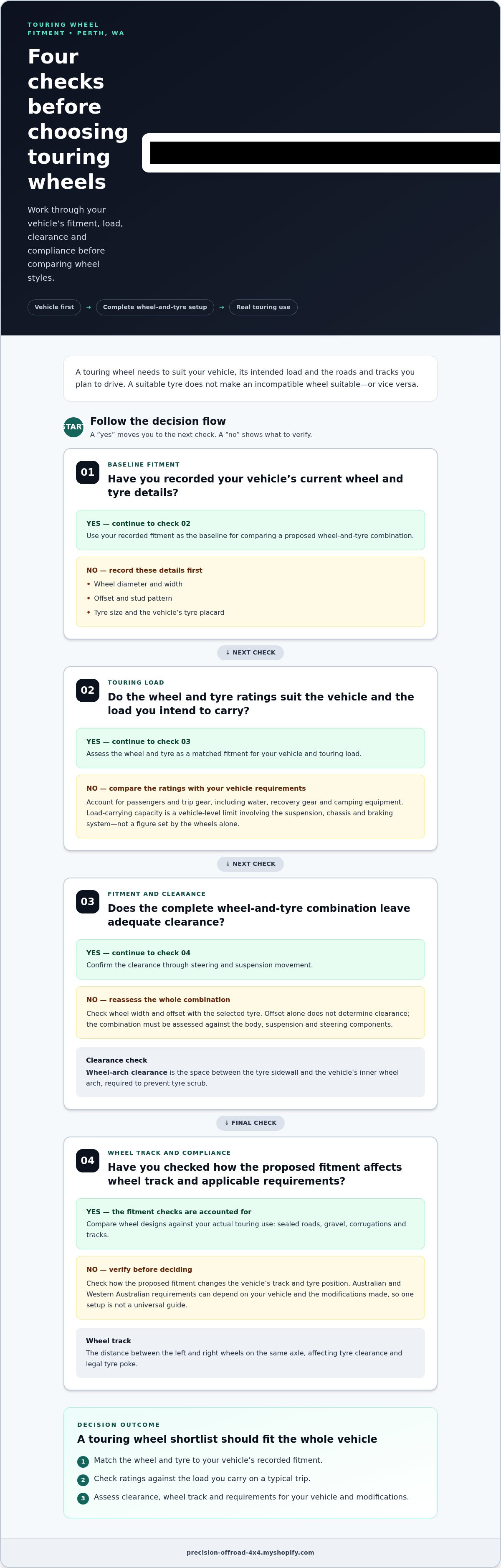
Before comparing designs, record your vehicle’s original fitment and the details of its current wheels and tyres. Note the wheel diameter, width, offset and stud pattern, then check the tyre size and the vehicle’s tyre placard. These details give you a baseline for assessing a proposed combination instead of relying on appearance or a general fitment recommendation.
Fitment, load and compliance are connected checks. A wheel must suit the vehicle’s mounting specifications, work with the selected tyre and leave adequate clearance through steering and suspension movement. The vehicle’s load and any existing modifications also affect which requirements apply. Australian and Western Australian rules can depend on your vehicle and the changes made, so avoid treating one setup as a universal guide.
Use the technical guide to 4x4 wheel upgrades in Perth alongside your recorded fitment details. That gives you a practical starting point for weighing style against the requirements of your vehicle and planned touring use.
Which 4x4 wheel specifications affect touring fitment and load?
Wheel specifications work as a system. A wheel can have a suitable load rating but still be the wrong width, offset or mounting fit for your vehicle. Check each detail against the vehicle’s original specifications, the tyre you intend to fit and the touring load you expect to carry. The best 4x4 wheels for touring aren’t selected by one number alone.
Offset is the distance between the wheel’s mounting face and its centreline. It affects how far the wheel sits in or out relative to the hub. The result also depends on wheel width, so offset alone doesn’t tell you whether the tyre will clear the body, suspension or steering components. Compare the complete wheel and tyre combination with your vehicle’s existing setup.
| Specification | What it describes | What to verify for your vehicle |
|---|---|---|
| Wheel load rating | The load the wheel is rated to support. | That it suits the vehicle and intended touring load. |
| Tyre load rating | The tyre’s rated load capacity. | That it meets the applicable vehicle requirements and suits the wheel. |
| Offset and width | How the wheel sits relative to its mounting face and centreline. | Position, mounting fit and clearance with the chosen tyre. |
| Wheel track | The distance between the left and right wheels on the same axle, affecting tyre clearance and legal tyre poke. | How the proposed fitment changes the vehicle’s track. |
| Wheel-arch clearance | The space between the tyre sidewall and the vehicle’s inner wheel arch, required to prevent tyre scrub. | Clearance through steering and suspension movement. |
Load rating and touring load
Load-carrying capacity is the amount of weight a vehicle can safely support, considering its suspension, chassis, and braking system. It’s a vehicle-level limit, not a figure set by the wheels alone. Compare the wheel and tyre ratings with the requirements that apply to your vehicle, including any relevant changes to its load configuration. Don’t assume a tyre’s rating can make up for a wheel that isn’t suited to the load.
Touring equipment changes the weight the vehicle carries. Account for passengers and trip gear, then assess the wheel and tyre ratings as a matched fitment. Research on tire design and load distribution research considers how tyre design and operating conditions relate to road-contact pressures, reinforcing why the complete setup matters.
Offset, wheel track and wheel-arch clearance
A wheel positioned further in or out can change its relationship to nearby components and the guard. A wider wheel can also alter the tyre’s position, even if its offset appears familiar. Check for rubbing risks against the body, suspension, steering and brake components through the vehicle’s operating movement. A clearance check while parked doesn’t establish that the tyre clears throughout steering and suspension travel.
Use your vehicle specifications and the proposed wheel and tyre details together. For a Perth-based option focused on wheel fitment, explore Precision Offroad 4x4 wheel upgrades as part of your comparison.
Alloy or steel 4x4 wheels: which suits touring conditions?
Alloy and steel describe wheel construction, not a guaranteed level of strength, durability or touring suitability. The right choice depends on the specific wheel’s documented specifications and how it fits your vehicle, tyres, load and planned route. Neither material is automatically the better option for every 4x4.
Keep three things separate: wheel material, tyre construction and load rating. A wheel’s material doesn’t tell you its rated load, and the tyre’s construction doesn’t establish whether the wheel suits your vehicle. Check each component on its own specifications, then assess the combination as a complete fitment. A light truck (LT) construction tyre, for example, is a tyre specification, not evidence of a particular wheel rating.
Alloy and steel: compare the trade-offs
Alloy wheels are made from an aluminium-based alloy, while steel wheels are made from steel. Those material descriptions alone don’t establish how a particular wheel will perform in touring conditions. Avoid choosing on assumptions about impact resistance, repairability or service life. Look for product-specific information that states the construction and relevant ratings.
Weight is also specific to the wheel, not something to assume from its material category. If wheel weight matters to your decision, compare the documented weight of the exact options you’re considering. Different sizes and designs may vary. Then check the wheel’s dimensions, mounting specifications and load rating against your vehicle and tyre requirements.
Appearance can still matter. Choose a finish and design you’re happy to live with, but don’t let them replace checks for fitment and load suitability. When browsing off-road wheel options through retailers such as STW Autosports, always verify how those designs align with your vehicle’s physical limits. The best 4x4 wheels for touring are the ones whose verified specifications match your vehicle and use, whether they’re alloy or steel.
Match the wheel choice to the route
Your regular route gives context to the decision. A tour made mostly of sealed roads differs from one that includes extended gravel sections, corrugations or rougher tracks. Don’t rank wheel materials by terrain alone. Consider the actual wheel specifications, the vehicle’s touring load and the fitment together. A choice suited to one vehicle and route isn’t automatically right for another.
Use this practical comparison before settling on a material:
- Route: Note the balance of sealed roads, gravel and rough tracks on your planned trips.
- Vehicle and load: Consider the vehicle as it will be packed, and compare the wheel and tyre ratings with applicable requirements.
- Documented specifications: Check the exact wheel’s construction, dimensions and load rating rather than relying on broad claims about alloy or steel.
- Wider setup: Consider how tyres and suspension work with the wheels. The 4x4 suspension performance and reliability guide can help you assess that broader vehicle context.
Keep the decision specific to your 4x4. If a product claim about construction, strength or suitability isn’t supported by reliable information for that wheel, don’t treat it as a verified feature. Compare stated specifications and choose the option that meets your vehicle’s requirements and planned touring use.
How to check 4x4 touring wheel fitment and compliance in Australia
Check fitment and compliance before committing to a changed wheel and tyre combination. The right sequence is practical: establish what’s fitted now, compare the proposed specifications, assess clearance, then verify which requirements apply to your vehicle and modification. Australian requirements can vary with vehicle details and the changes made, so don’t treat a measurement or fitment that suits one 4x4 as a universal approval.
A practical pre-purchase fitment check
Work through these checks in order. Keep the vehicle’s records and the proposed wheel and tyre specifications together so you can compare the complete setup, not isolated numbers.
- Record current fitment. Note the vehicle’s original wheel and tyre information from its documentation and tyre placard. Record the details of the wheels and tyres currently fitted, including dimensions, offset, mounting pattern and ratings where available.
- Compare specifications. Check the proposed wheel’s dimensions, offset, mounting details and load rating against your vehicle’s documented requirements. Check the tyre’s dimensions and rating as well. Don’t rely on a general size or load figure for another model.
- Confirm clearance. Assess wheel-arch clearance and the relationship between the tyre, body, suspension, steering and brake components. Consider the full range of steering and suspension movement, not only how the vehicle sits while stationary. A mismatch can create a rubbing risk even if the wheel mounts to the hub.
- Verify applicable requirements. Identify the vehicle and every relevant modification, then check current official guidance for that specific combination. Resolve any compliance questions before buying or fitting the changed setup.
Verify Australian and WA requirements
For a vehicle based in Perth, use current guidance from the WA Department of Transport and the relevant Australian vehicle standards sources for the proposed change. The requirements may depend on the vehicle, its existing modifications and the details of the wheel and tyre fitment. If a rule or approval pathway is unclear, don’t assume that a general online summary settles the question for your vehicle.
Keep product standards separate from legal requirements. A wheel or component meeting a stated product standard does not, by itself, establish that the complete vehicle modification complies with applicable rules. Equally, a fitment that physically clears the vehicle isn’t automatically compliant. Confirm both the component specifications and the requirements for the vehicle as modified.
Don’t use unverified wheel sizes, offsets or load figures to make a compliance decision. The best 4x4 wheels for touring need to suit the documented vehicle fitment, intended load and applicable requirements together. Precision Offroad 4x4 is a Perth-based specialist retailer offering wheel upgrades. Explore wheel upgrade options as you assess a fitment against your vehicle’s records and verified requirements.
Choosing touring wheels through Precision Offroad 4x4 in Perth
Your shortlist should reflect how the 4x4 is set up and used, not just the wheel’s appearance. Choose options that suit the vehicle’s documented fitment and intended touring load, then consider the roads and tracks you regularly travel. Treat these as connected checks: a wheel that looks right but doesn’t suit the vehicle’s specifications isn’t a practical choice.
Use your touring requirements to narrow the choice
Build a selection brief before comparing designs. Record your current wheel and tyre details, typical touring load, planned surfaces and any clearance considerations. Compare each option’s documented specifications with that brief. Style can remain part of the decision, but it should follow the fitment and use checks.
- Vehicle: Keep its original and current wheel and tyre details together.
- Load and route: Note the touring gear you carry and the surfaces you expect to drive.
- Fitment: Consider offset, wheel track and wheel-arch clearance as part of the complete wheel and tyre combination.
- Compliance: Verify requirements for your vehicle and proposed changes before committing.
For more detail on assessing an upgrade, use the 4x4 wheel-upgrade technical guide alongside your fitment notes.
Explore wheels with a local specialist
Precision Offroad 4x4 offers Wheels for 4x4 upgrades. Keep your vehicle information and intended use in view as you compare options, and resolve compliance questions before making a change. That gives you a clear basis for choosing a setup that works for your touring plans while leaving room for the style you prefer.
Explore Wheels at Precision Offroad 4x4 and use your fitment brief to guide your next step.
Set your touring fitment up for the next trip
A useful next step is to keep a record of the wheel and tyre specifications you choose, along with any documentation relevant to the modification. That gives you a clear reference when it’s time to replace a tyre or revisit your setup for a different type of trip. It also helps you avoid relying on memory when comparing options later.
The best 4x4 wheels for touring are a considered choice, not a last-minute styling decision. Give yourself time to compare the available options and make a decision you’re comfortable taking on the road.
Precision Offroad 4x4 offers Wheels for 4x4 owners. Explore Wheels at Precision Offroad 4x4 when you’re ready to take the next step. A clear record and a deliberate choice can help you feel prepared for the journeys ahead.
Frequently Asked Questions
Are bigger wheels better for 4x4 touring?
No. A larger wheel diameter doesn’t automatically improve a touring setup. The tyre’s overall diameter, sidewall, load rating and compatibility with your vehicle matter alongside the rim size. For example, changing to a larger rim while keeping a similar overall tyre diameter may alter the tyre’s sidewall profile without increasing ground clearance. The best 4x4 wheels for touring are chosen to suit the vehicle and intended use, not simply to maximise wheel size.
Can I use different wheel sizes on the front and rear of my 4x4?
Only if the vehicle manufacturer permits the combination and the complete fitment meets applicable requirements. Different wheel or tyre sizes can create different rolling circumferences between axles, which may be unsuitable for some four-wheel drive systems. Check the owner’s manual and vehicle specifications before mixing sizes. Also consider matching tyre type, condition and pressure across axles, as differences can affect how the vehicle behaves under braking and through corners.
Will changing wheels affect my vehicle’s speedometer?
Changing the wheel rim diameter alone may not affect the speedometer if the replacement tyre keeps the same overall rolling circumference. A different tyre size can alter that circumference, which may affect the relationship between wheel rotation and the vehicle’s indicated speed. Compare the proposed tyre’s overall diameter with the original fitment, and have speedometer accuracy assessed if the change could affect it. Don’t assume the rim size tells you the whole story.
Can I mix different wheel brands on the same vehicle?
Different wheel brands can be fitted only if each wheel suits the vehicle and the specifications are compatible across all positions. Check dimensions, offset, mounting details and load rating, rather than relying on brand names or appearance. Mixing wheel designs may also make it harder to identify whether every wheel meets the same requirements. For a touring vehicle, a consistent set makes it simpler to keep track of fitment details and inspect wheels for damage.
Should touring wheels be inspected during a long trip?
Yes. Include the wheels in regular vehicle checks, particularly after driving over rough surfaces or striking an obstacle. Look for visible cracks, bends, corrosion, missing fasteners and signs that a tyre has been losing pressure. Follow the vehicle manufacturer’s guidance for wheel-nut checks and tyre pressures; don’t guess torque settings. If you notice damage, vibration or a change in handling, stop somewhere safe and assess the vehicle before continuing.
Can damaged 4x4 wheels be repaired?
Sometimes, but repairability depends on the wheel construction, damage type and manufacturer guidance. A superficial mark is different from a crack, deformation or damage around the bead seat or mounting area. Don’t try to straighten or heat a wheel yourself, and don’t assume a repaired wheel is safe for touring without a proper assessment. If the damage affects structural areas or its condition can’t be verified, don’t continue using it until the issue is resolved.